

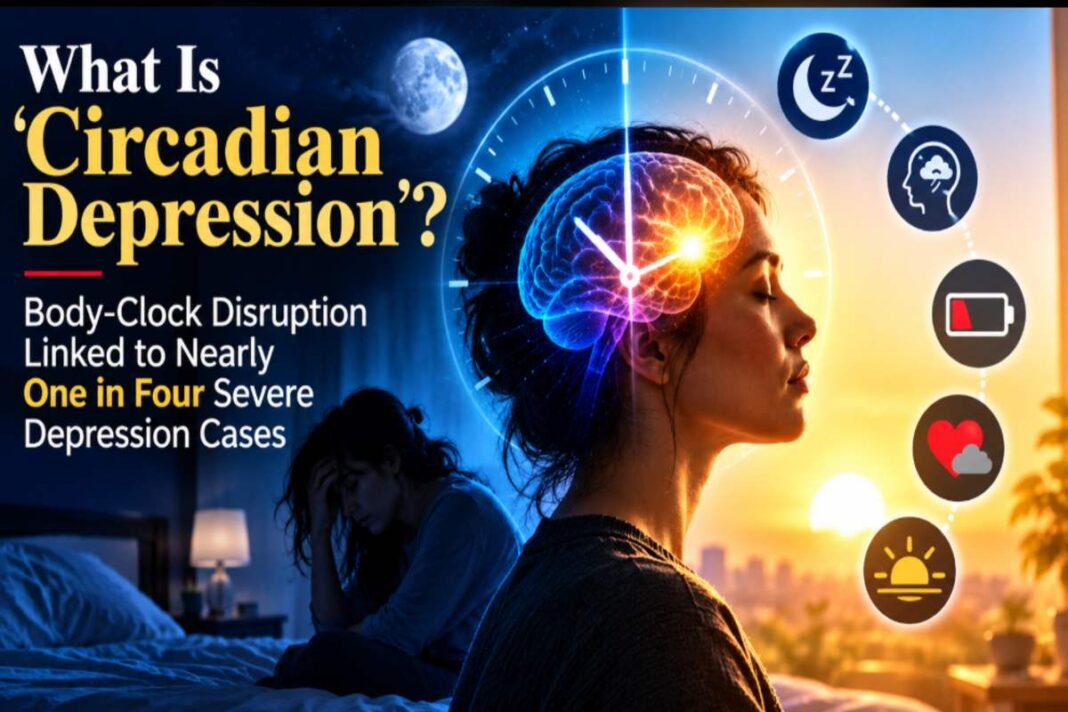

Your body is involved in much more than just determining when you feel drowsy; there is a built-in 24-hour clock which controls mood, hormones, metabolism, alertness and a number of other biological functions. A big study from Australia now indicates that disturbances to this system may account for a particular type of depression in about one in four of the people who were studied and who suffered from severe, recurrent or chronic depression, making it possible that therapies aimed at the body’s clock could be of help to some patients.
It’s easy for going to bed late, having difficulty wakening up in the morning, or feeling tired even after having slept the whole night to appear as if they were just issues of lifestyle.
Yet scientists are becoming more interested in the possibility that, in some cases with depression, these patterns might indicate something more fundamental, namely, a disruption of the body’s circadian rhythm.
In October 2026, scientists working at the University of Sydney suggested the use of the term “circadian depression” to describe a group of patients whose depression is accompanied by various signs indicating that their internal clock is out of sync. Their findings were published in The British Journal of Psychiatry at that time.
What Is the Body’s Circadian Rhythm?
The body’s internal timing system is the circadian rhythm.
It has a cycle that is about 24 hours long and is responsible for coordinating our sleeping, waking, feeling alert, releasing hormones, eating, and carrying out a number of other biological functions.
One of the most important signals it has is light.
The bright light of morning signals to the brain that it is time for the day to start, and darkness helps the body get ready for sleeping. Our eating habits, the amount of exercise we get and our daily routines all play a part in keeping our internal clocks in sync.
Circadian rhythms influence much more than just sleep; they are involved in regulating neurological, hormonal and metabolic processes which are related to both mental and physical health.
Trouble may occur when the workings of a person’s biological clock keep coming into conflict with their daily routine.
What Is Circadian Depression?
In this new study, the researchers looked at the clinical and genetic information from 11,380 Australians who suffered from severe, recurrent or persistent depression.
People were considered to have a circadian form of depression if they displayed at least three characteristics associated with disrupted biological timing.
This involved having a strong tendency to be a ‘night owl’, going to sleep later than normal, sleeping more during periods of depression, waking up feeling extremely tired, suffering from seasonal variations in their depression, and experiencing social jet lag, that is, a big difference between their sleep times on weekdays and on days off.
The researchers found 2,604 people, which is around 23 per cent, who matched this description.
The origin of the widely reported “one in four” figure is there.
It does not therefore mean that scientists have found that disrupted body clocks are the cause of one-quarter of all depression cases in the general population.
The study was carried out on a particular group of people who had mainly severe or recurrent depression.
Circadian Depression Appeared More Complex
It was found by the researchers that those participants who were classified as having circadian depression tended to report that their depression had started earlier and that their clinical symptoms were more severe.
They showed greater levels of psychological distress and were more likely to report having suicidal thoughts, experiencing weight gain during depressive episodes, and displaying certain manic-like symptoms.
The researchers also discovered variations in genetic risk.
The group studying the circadian rhythm showed that there were stronger genetic associations with a number of conditions and characteristics such as ADHD, bipolar disorder, major depression, insulin resistance, inflammation and later sleep timing.
It doesn’t mean that a person who stays up late will end up with these conditions.
In fact, the genetic results indicate that the proposed subtype might have biological features which are only slightly different from those of other types of depression.
Why Sleep and Depression Are So Closely Connected
The connection between sleep and depression has always been complicated since the two can influence each other.
Depression can disturb sleep.
Poor or irregular sleep can also have a negative effect on one’s mood, ability to concentrate and emotional regulation.
It is then hard to tell if circadian disruption is causing the depressive symptoms, or whether the symptoms are causing the circadian disruption, or whether it is part of a cycle that involves both.
They have therefore called for caution.
According to researchers who had no part in the study, ABC News learned that symptoms such as being a night owl, waking up tired or sleeping for longer periods can also be caused by normal sleep disturbance, and there is also overlap with a pattern recognised as atypical depression.
At this stage, circadian depression is considered to be a proposed subtype and not an independent diagnosis in the standard psychiatric diagnostic manuals.
Could This Explain Why Antidepressants Do Not Work for Everyone?
One of the most interesting findings of the study was concerned with treatment response.
People who matched the circadian profile had somewhat weaker responses to two commonly used categories of antidepressants: the SSRIs and the SNRIs, and they also experienced more side effects.
That result could be important since depression treatment is seldom equally effective for all people.
If scientists are able to identify the biological subtypes more accurately, patients could one day receive treatments that are a better match for how their disease functions.
The antidepressant effects were partly due to patients’ own reports of their treatment experiences, not because of a randomized clinical trial which had been set up to compare the different therapies.
Patients should not discontinue or alter the medication that has been prescribed as a result of the study.
Could Light Therapy or Melatonin Help?
It is thought that therapies intended to modify circadian timing should be subjected to further investigation.
This involves the use of bright-light therapy, taking melatonin or drugs that target melatonin at carefully chosen times, and behavioural methods which help to establish more regular sleep and wake times.
In some cases, being exposed to morning light can cause the biological clock to advance, and keeping regular times for sleeping, eating and exercising may reinforce the daily rhythms.
Yet the time at which something happens is important; the biological clock can be advanced or delayed depending on when melatonin is taken and light is exposed.
They should therefore not be regarded as simple do-it-yourself alternatives to professional depression treatment.
Is Circadian Depression a New Diagnosis?
Not yet.
The study has been described by Nature as providing further evidence for circadian depression, although it has also stressed that more research is required before any changes to diagnosis or treatment guidelines should be made.
The Australian results also need to be carried out in other countries, among different age groups and in other populations.
The study was cross-sectional, which meant that the researchers looked at the characteristics at a particular time rather than keeping track of people over time in order to show that circadian disruption caused their depression.
Still, the research points toward an increasingly important idea in psychiatry:
Depression might not be a single biological illness having one solution.
In some cases the serotonin-related pathways may be the main factor, while in other cases inflammation, stress, genetic factors or hormonal ones may be more important.
For a considerable subgroup, the body’s timing system, which determines when it should sleep, wake and carry out its functions, might be involved.
The most important question might therefore be merely how much sleep a person gets.
It could also be whether their body knows when it is supposed to be awake.