

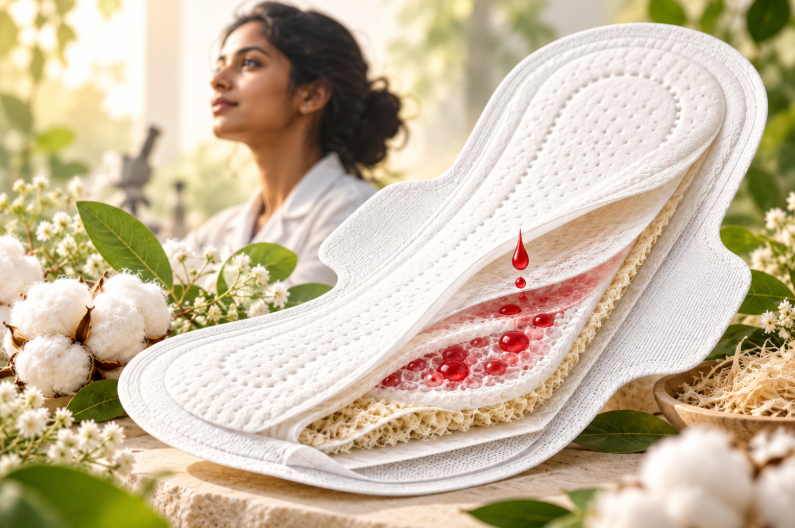

While most disposable sanitary pads are designed to deal with one main problem—absorbing menstrual fluid—the Indian company Papaya is dealing with it in a different manner. The company, established by mechanical engineer Shagun Maheshwari, has developed a plastic-free pad featuring a bio-coagulant layer meant to cause menstrual blood to solidify inside the product; this method is intended to keep the surface drier while at the same time tackling the huge amount of plastic waste resulting from conventional disposable pads.
A sanitary pad is just like any other ordinary item, but its environmental impact by no means is simple.
Traditional disposable sanitary napkins may contain as much as about 90% plastic, covering the backsheet, the adhesives, the packaging and the super-absorbent materials. Research mentioned by IIT Bombay and The BMJ suggests that one pad contains approximately the same amount of plastic as four shopping bags and could take between 500 and 800 years to decompose.
That problem led Maheshwari to ask a different engineering question: instead of simply trying to make a pad absorb more liquid, could it handle menstrual blood differently?
From Absorbing Blood to Solidifying It
The reason given for the papaya’s answer is its core, which has the ability to cause blood to coagulate.
Maheshwari, who is a mechanical engineer with experience in both product and process development, started working on the idea in about 2020. She has said that it took her approximately five years to develop the technology and to transform the laboratory prototypes into a product that can be manufactured on a commercial scale.
The simple nature of the insight behind Papaya is evident.
Menstrual blood is not water since it consists of cells, proteins, mucus and other biological substances, even though conventional pads are generally designed to absorb liquid.
The product features a bio-coagulant which is naturally derived and which the company states causes menstrual blood to clot within the pad rather than just spreading out through the absorbent core; it also combines cotton and cellulose with the coagulating layer and a biodegradable leak-resistant backsheet.
As Papaya states, keeping the locking fluid in the pad reduces the feeling of wetness and helps the surface to stay drier.
That distinction is central to the product’s positioning: control the blood rather than simply maximize absorbency.
Why Plastic in Sanitary Pads Is Getting More Attention
The environmental argument against conventional pads has been understood for years. But researchers are now also studying potential human exposure to plastics and chemicals from menstrual products.
A study carried out in 2025 and published in the Journal of Hazardous Materials looked at 29 commercial sanitary pads and found polypropylene microplastic particles in each of them, the number of particles per pad varying from six to 115. The study stated that the health effects need to be investigated further and added that it did not prove the detected particles cause illness in users.
In addition, a small study from 2025 found microplastics in human cervicovaginal lavage fluid, and research conducted in 2026 detected microplastics in menstrual blood. However, neither of these studies proved that sanitary pads was the source of those particles.
That distinction matters.
Increasing scientific evidence shows that people are exposed to microplastics and that menstrual products can contain or release them. However, the assertion that traditional pads have been proven to deposit microplastics directly into vaginal tissue or lead to particular reproductive diseases is now going beyond what the available evidence shows.
Papaya’s Answer: Remove the Plastic
Papaya takes a straightforward approach: design the pad without conventional plastic components.
The company refers to its products as 100% plastic-free and uses cotton, cellulose, a bio-coagulant derived from natural sources, and a biodegradable backsheet. The India Sanitation Coalition has cited Papaya as an example of material-led innovation in the area of menstrual-waste management.
The company has also provided testing which supports the environmental claim.
According to SITRA, independent tests showed that degradation occurred after 120 days as a result of soil-burial testing. Tests carried out by ERRL in accordance with an ISO standard for anaerobic degradation revealed that the product degraded within eight months under landfill conditions, and industrial-composting tests indicated that degradation took place within six months.
That landfill result is particularly relevant in India.
A product that is described as ‘compostable’ can only be of environmental use if it actually ends up in appropriate composting facilities; menstrual waste, on the other hand, usually enters the regular municipal waste streams.
Papaya’s design therefore considers not just theoretical compostability but also what happens when a used pad ends up in a landfill.
What About Skin and Safety?
Papaya also says its pads contain no added fragrance or chlorine bleach.
The company’s published testing information shows that the pads were found to be non-irritant based on BIS-related dermatological testing, and the SITRA testing stated that phthalates were not detected and also examined bacterial and fungal contamination in the unused product.
The results of those tests back the assertions regarding the product’s composition and its laboratory safety characteristics.
They should not, however, be interpreted as proof that Papaya pads prevent rashes, vaginal infections, or other medical conditions. Those outcomes would require specific clinical studies comparing users over time.
A Bigger Question About Menstrual Product Design
Papaya is interesting not only because it replaces plastic.
Its more unusual aspect is challenging a design principle the menstrual product industry has followed for decades.
Instead of asking:
How much liquid can a pad absorb?
Papaya asks:
How can menstrual blood be kept in place so the wearer feels dry?
The fact that this change has drawn attention outside the company itself is noteworthy, since Papaya was featured in the India Sanitation Coalition’s study of menstrual waste and there it described the company’s method as having designed sustainability into the product rather than asking consumers to make dramatic changes to their habits.
That seems to be the greater opportunity for Maheshwari.
Reusable menstrual cups and period underwear can greatly cut down on waste, but not everyone is interested in giving up disposable pads. Instead, Papaya aims to make the familiar disposable format work differently.
Whether blood-solidifying technology becomes a broader category in menstrual care will depend on consumer acceptance, manufacturing scale, pricing, and further independent evidence.
But the problem it aims to solve is hard to ignore.
Billions of disposable menstrual products are used worldwide, and products that contain a lot of plastic can stay in the environment for hundreds of years.
Papaya’s suggestion is therefore quite simple: if people are to continue using pads, the pads themselves should change.