

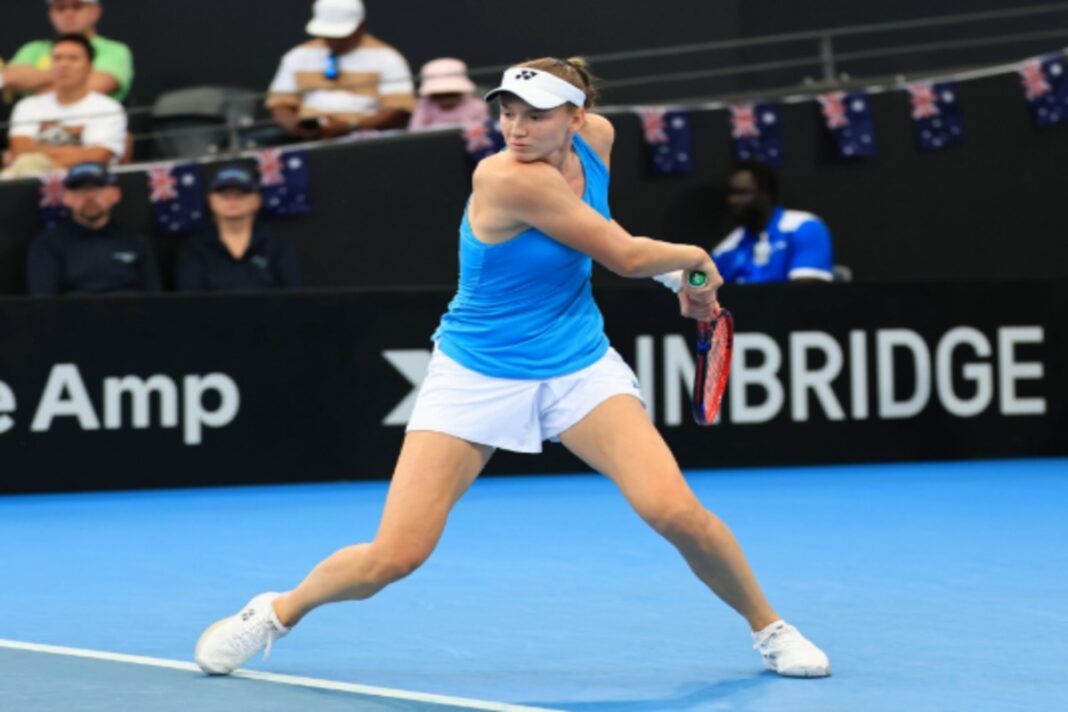

Elena Rybakina, who is world number one, has pulled out of Kazakhstan’s Billie Jean King Cup Finals tournament following a grueling period that concluded with her winning the 2026 US Open despite being injured. With Rybakina absent, Kazakhstan now has no singles player among its top-ranked players just a few days before its quarter-final match against Spain, and once again the increasing problem of player workload in professional tennis is coming under scrutiny.
Elena Rybakina was supposed to be the most prominent player on Kazakhstan’s Billie Jean King Cup team when she got to Shenzhen.
Rather, the newly crowned world number one will be in the process of recovering.
On September 18, Rybakina stated that she would be absent from the 2026 Billie Jean King Cup Finals, explaining that the previous month had been physically difficult and that she needed some time to recover before taking part again.
The decision was made less than a week after the 27-year-old won her first US Open title by beating Aryna Sabalenka 6–4, 5–7, 6–2 and rose to No. 1 in the WTA rankings.
For Kazakhstan, the timing is important. They will play against Spain in the quarter-finals in Shenzhen on September 23, with their qualification for the Billie Jean King Cup semi-finals being at stake.
Why Did Elena Rybakina Withdraw From the Billie Jean King Cup?
Rybakina gave a simple explanation: “The past month has been hard on my body.”
There is a series of tough tournaments, lengthy matches, and an injury that almost kept her out of the US Open altogether.
It was already obvious during the National Bank Open in Toronto in August how hard she was working physically.
To reach the final, Rybakina spent almost 11.5 hours on the court, comprising four matches that went to three sets, and her quarter-final, semi-final and final were all played on three successive days. Following her loss to Iga Swiatek in the final, Rybakina stated that she had very little energy left and that the effects of accumulated fatigue were felt by her.
There was hardly any chance of a long recovery.
After that, Rybakina went to Cincinnati, where she made it through to the quarter-finals before being compelled to retire against Swiatek on August 20 due to an injury to her left ankle. The severity of the injury raised questions about whether she could take part in the US Open.
The WTA stated that she had not played for a week and at one time experienced pain when walking.
Just 12 days after she retired in Cincinnati, Rybakina started her US Open run.
From Injury Concern to US Open Champion
What came next was one of the most remarkable periods in Rybakina’s career.
In New York, she won seven matches in a row and eventually beat Sabalenka in a three-set final to win her third Grand Slam singles title. This win also marked the first time that she had risen to world No. 1.
The last stages were especially demanding.
In her last three matches at the US Open, all ended after three sets; in the quarter-finals she came from behind against Zheng Qinwen and then against Coco Gauff in the semi-finals, before having a three-set match against Sabalenka in the final.
The Kazakhstan Tennis Federation afterward stated that the injury had still been causing her difficulties throughout the tournament and that she needed further medical examination as well as at least two weeks’ treatment and recovery.
The fact that there is such a context means that the withdrawal from the Billie Jean King Cup is less surprising.
After having completed a deep run in Toronto, Rybakina suffered an injury in Cincinnati and then immediately played seven Grand Slam matches, including three consecutive three-set matches to conclude the tournament.
Rybakina’s Withdrawal Highlights Tennis’ Workload Problem
Professional tennis presents a kind of challenge that is unlike that of many team sports.
For most of the year, players have to compete in different countries and continents, traveling from tournament to tournament with only a relatively short time for recovery; if they go deep in the competition, they may have to play every few days, whereas if they lose early, they will get considerably more rest.
Success will thus increase workload.
For Rybakina, reaching the final in Toronto and then going on to win the US Open meant spending much more time in competition than a player eliminated in the early rounds.
The Finals of the Billie Jean King Cup were scheduled just 10 days after the final of the women’s event at the US Open.
Certainly. Here is the rewritten text in English, adhering strictly to all the rules provided:
Her season is far from over.
The WTA has stated that Rybakina is expected to take part in the Asian swing, which will include the WTA 1000 tournaments in Beijing and Wuhan, and she has also secured a spot in the season-ending WTA Finals.
This decision highlights the broader difficulty top players face in balancing representing their country, protecting their ranking points, and playing in major tournaments while still leaving enough time for physical recovery.
What does Rybakina’s absence mean for Kazakhstan?
For Kazakhstan, the immediate effect is clear in that the team has lost its number one singles player before their knockout match.
Without Rybakina, Kazakhstan’s nominated squad includes Yulia Putintseva, Anna Danilina, Zhibek Kulambayeva, and Sonja Zhiyenbayeva.
That means Putintseva has greater responsibility.
She is now ranked 78th in singles and has a good deal of experience in the Billie Jean King Cup. Having taken part in over 30 ties for Kazakhstan, she is still the country’s most successful player in singles competitions.
Kazakhstan also has a valuable weapon when playing in doubles.
Anna Danilina is considered to be one of the top doubles players in the world, and she teamed up with Kulambayeva in the win that secured Kazakhstan’s qualification against Canada this year.
This would become especially important since each Finals tie includes two singles matches and then a doubles match, and the country that wins two of the matches advances.
Kazakhstan would therefore lose Rybakina, the player who would have provided the team with its greatest advantage in the singles event, and the rest of the squad will have to find another way through the tie.
Spain Now Faces a Different Kazakhstan Team
Kazakhstan will be playing against a Spain side that includes Cristina Bucsa, Jessica Bouzas Maneiro, Kaitlin Quevedo, Marina Bassols Ribera and Sara Sorribes Tormo.
There is also the question of history.
Kazakhstan has several times reached the Billie Jean King Cup Finals but has never progressed to the semi-finals; therefore, a win against Spain would take the country further in the competition than at any previous time.
Making the move without the player who has just become both the US Open champion and the world No. 1 means that the task is very different from what Kazakhstan first intended.
Recovery Now Comes First for Rybakina
Rybakina’s withdrawal is unusual, as she has seldom been in such a strong position professionally.
She is the current champion of the Australian Open and the US Open, has reached world No. 1 for the first time, and has become the first player from Kazakhstan to top the WTA singles rankings.
However, the same period that brought about those achievements seems to have had a physical effect as well.
Her not being in Shenzhen is therefore more than just a late change of player for Kazakhstan; it is yet another instance of the difficult dilemma that top tennis players have to face, namely that the better they perform, the more matches they play, and at times the most important decision is knowing when to avoid playing the next one