

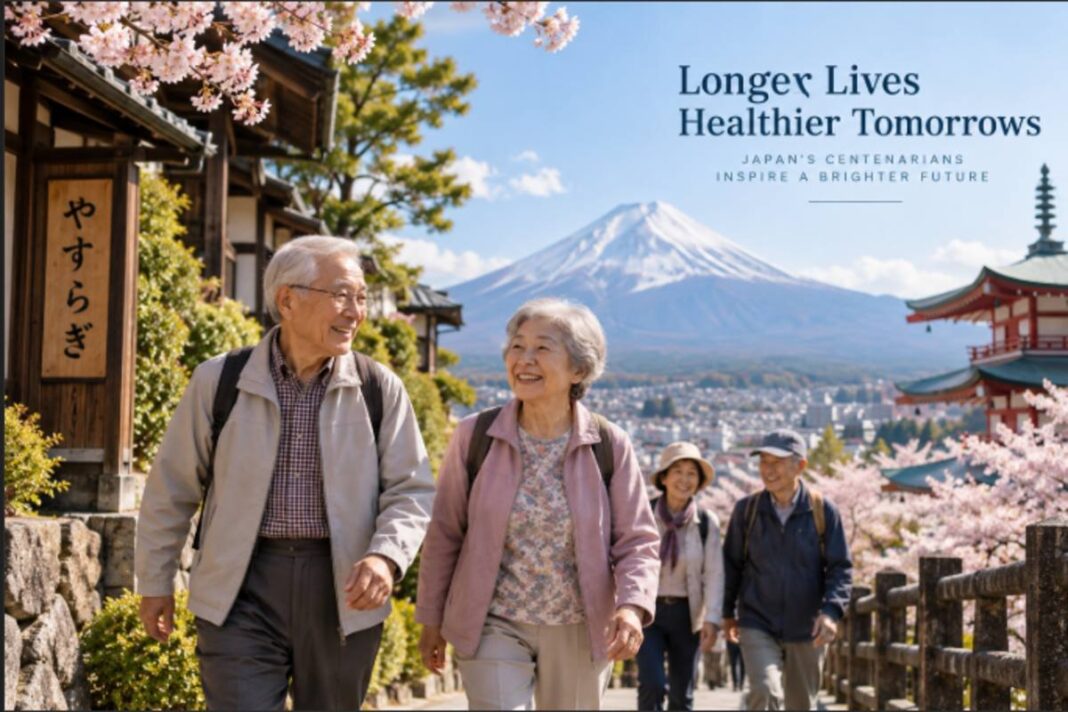

Japan has crossed a remarkable demographic milestone, with 107,677 people now aged 100 or older. The number has risen from just 153 when records began in 1963. There is no single Japanese secret to living to 100, but research points to a combination of nutrition, physical activity, social connection, healthcare, improved living conditions and genetics.
Reaching your 100th birthday remains exceptionally rare. In Japan, however, the number of people doing so has risen dramatically.
On September 15, 2026, Japan’s Ministry of Health, Labour and Welfare announced that the country had 107,677 centenarians, meaning people aged 100 or older.
It is the first time the official count has exceeded 100,000. The total increased by 7,914 from the previous year.
The long-term change is even more striking.
When Japan began recognizing and recording its centenarian population in 1963, there were only 153 people aged 100 or older. The figure passed 1,000 in 1981, reached 10,000 in 1998 and exceeded 50,000 in 2012.
Fourteen years later, it has more than doubled again.
Japan’s health ministry attributes the broader rise in longevity to factors including improvements in living conditions, diet and nutritional status, and advances in medical technology.
But those factors are only part of a much more complicated story.
Japan’s Centenarians: Key Facts
| People aged 100+ | 107,677 |
| Women | 94,298 |
| Men | 13,379 |
| Women as share of total | ~87.6% |
| Centenarians in 1963 | 153 |
| Passed 1,000 | 1981 |
| Reached 10,000 | 1998 |
| Passed 50,000 | 2012 |
| Passed 100,000 | 2026 |
Source: Japan’s Ministry of Health, Labour and Welfare.
Why Are So Many People in Japan Living to 100?
There is no scientifically established Japanese “secret” to reaching 100.
Exceptional longevity is influenced by a complicated interaction between genetics, nutrition, physical activity, healthcare, socioeconomic conditions, environment and social factors.
Japan’s experience is particularly interesting because the enormous growth in its centenarian population has occurred alongside major improvements in public health and living standards.
Japan’s health minister cited improvements in living conditions, nutrition and medical technology when discussing the country’s increasing elderly population.
Scientific research provides additional clues.
The Japanese Diet May Be Part of the Story
Food is one of the most frequently discussed explanations for Japanese longevity.
Traditional Japanese dietary patterns commonly include foods such as fish, vegetables, soy products, rice, seaweed and green tea, although diets naturally vary substantially across individuals and generations.
Researchers generally look at the overall dietary pattern rather than claiming that one particular Japanese food extends lifespan.
A review of evidence from the large Ohsaki Cohort Study, for example, found that greater adherence to a Japanese dietary pattern was associated with lower risks of all-cause mortality, functional disability and dementia.
Another analysis following nearly 15,000 Japanese adults over 20 years examined the relationship between adherence to a Japanese dietary pattern and survival.
These are observational findings, meaning they cannot establish that the diet itself caused people to live longer.
But they add to evidence that overall dietary quality may contribute to healthier aging.
Research among older Japanese adults also suggests that maintaining a balanced diet is associated with lower levels of frailty. A 2026 study of more than 15,000 community-dwelling adults aged 65 and older found an association between an unbalanced diet and frailty in both men and women.
The lesson is therefore more nuanced than simply “eat Japanese food.”
Dietary variety, adequate nutrition and maintaining healthy eating patterns over many years may matter more than any individual ingredient.
Staying Active Doesn’t Require a Gym
Physical activity is another recurring factor in healthy aging research.
That does not necessarily mean running marathons or performing strenuous workouts in old age.
Walking, gardening, cycling, household activities and other forms of regular movement can all contribute to maintaining mobility, cardiovascular fitness and independence.
Research specifically involving Japanese centenarians has also found an association between regular exercise and remaining independent at exceptionally old ages.
A nationwide study involving 1,907 Japanese centenarians found that those who remained autonomous were more likely to have characteristics including regular exercise, preserved chewing ability and more frequent protein intake.
The finding does not mean exercise guarantees that someone will reach 100.
Rather, it supports a broader principle: remaining physically active can help preserve function as people age.
And that distinction matters.
Living to 100 is one achievement. Reaching 100 while maintaining mobility and independence is another.
Social Connection May Matter Too
Longevity is not purely biological.
Social participation, relationships with family and friends, and involvement in community life can influence health in ways that are increasingly being studied.
Research involving older Japanese adults has found connections between social networks, social participation and healthier dietary behavior.
One longitudinal study using data from more than 25,000 older Japanese adults found that stronger community social networks were associated with greater social participation, which in turn was associated with healthier fruit and vegetable consumption.
A separate 2026 study found that social connections could also influence the relationship between diet and frailty, particularly among older men.
Again, these findings do not mean having more friends guarantees longevity.
But they reinforce the idea that healthy aging cannot be reduced to diet and exercise alone.
How people live socially may matter alongside how they eat and move.
Healthcare and Public Health Are Part of Japan’s Longevity Story
Focusing entirely on individual habits can overlook another major contributor to longevity: the environment in which people spend their lives.
Japan’s rise in life expectancy occurred alongside substantial improvements in living standards, nutrition, sanitation, disease prevention and medical care.
The Japanese government itself cites improved living environments, better diet and nutrition, and advances in medical technology as important contributors to the country’s growing elderly population.
Medical advances can prevent or better manage diseases that once caused earlier deaths.
Access to healthcare and preventive services can also help identify conditions before they become more serious.
This means Japan’s longevity cannot simply be attributed to individual discipline.
People age within healthcare, economic, environmental and social systems that can either support or undermine healthy aging.
Genetics MatterBut They Don’t Explain Everything
Genes also influence how people age.
Some people appear biologically more likely than others to survive to exceptionally old ages, and researchers continue to investigate genetic variants associated with longevity.
But genetics does not operate in isolation.
Diet, smoking, physical activity, disease exposure, socioeconomic circumstances, healthcare and other environmental factors interact with genetic predisposition throughout a person’s life.
That is one reason claims about a single “Japanese longevity secret” should be treated cautiously.
Japan’s centenarian population is not evidence that eating one particular food, drinking a particular tea or adopting one cultural practice will allow someone to live to 100.
The scientific picture is much more complicated and more interesting.
Why Are Most Japanese Centenarians Women?
One of the most striking features of Japan’s centenarian population is the enormous gender difference.
Of the country’s 107,677 centenarians, 94,298 are women and 13,379 are men.
That means women account for approximately 87.6% of the total.
This is not unique to Japan.
Women generally have higher life expectancy than men across many countries, although the size of the difference varies by population and period.
The reasons are likely to involve a combination of biological and behavioral factors rather than one simple explanation.
At the extreme end of longevity, however, the difference becomes particularly visible.
Japan’s oldest living person in the latest government-linked reporting is 114-year-old Fuyo Kishimoto of Kyoto, while the country’s oldest man is 112-year-old Hikaru Kato of Kumamoto.
Living Longer Creates Another Challenge
Japan’s centenarian milestone is a public-health achievement.
It is also part of a much larger demographic challenge.
As people live longer while birth rates remain low, Japan’s population structure is shifting toward older age groups.
That creates growing pressure on healthcare, pensions, long-term care services and the working-age population supporting those systems.
Japan’s health minister acknowledged this tension while announcing the latest centenarian figures, emphasizing the need to maintain a sustainable social-security system as the population continues to age.
So the significance of 100,000 centenarians goes beyond longevity itself.
A society that becomes exceptionally successful at helping people survive into old age also has to determine how to support those people throughout those additional years.
Healthspan May Matter More Than Simply Reaching 100
Japan’s longevity story ultimately points toward an increasingly important distinction in aging research:
lifespan versus healthspan.
Lifespan measures how long someone lives.
Healthspan describes how much of that life is spent in relatively good health and with the ability to function independently.
Research on Japanese centenarians illustrates why the distinction matters. In one large study, only a minority of centenarians met researchers’ criteria for preserved physical, cognitive and psychosocial autonomy.
That changes the question.
The goal of longevity research cannot simply be to increase the number printed on a birthday cake.
It is to understand how people can remain healthier, mobile, cognitively capable and socially connected for as much of their extended lives as possible.
So, What Is Helping People in Japan Live So Long?
There is no single answer.
Japan’s extraordinary rise from 153 centenarians in 1963 to 107,677 in 2026 reflects decades of change rather than one longevity hack.
The available evidence points toward a combination of better nutrition, regular physical activity, social engagement, healthcare, improved living conditions and individual biological differences.
Not every centenarian follows the same diet. Not every 100-year-old has followed the same exercise routine. And no scientifically validated formula can guarantee an exceptionally long life.
Japan’s milestone nevertheless demonstrates something important.
More people are surviving to ages that were once extraordinarily uncommon.
The challenge for Japan and increasingly for aging societies around the world is no longer simply figuring out how people can live longer.
It is figuring out how those additional years can also be healthier ones.