

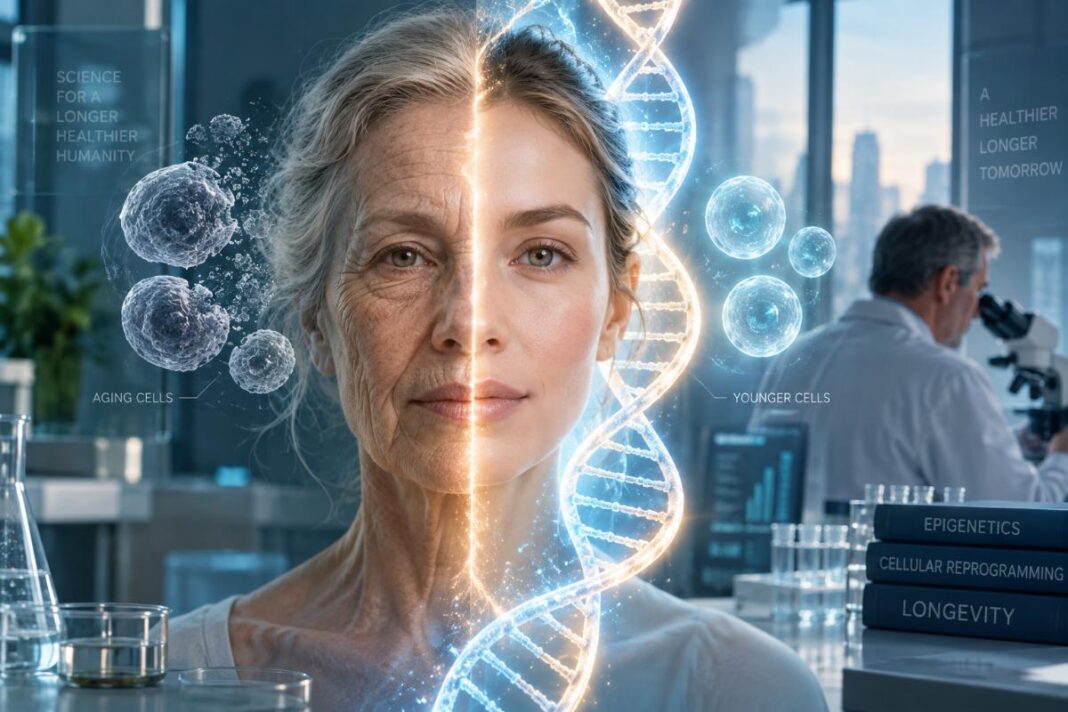

Can human aging actually be reversed? Harvard Medical School genetics professor David Sinclair argues that some aspects of biological aging may be reversible, while experiments in cellular reprogramming are beginning to show how older cells can recover younger characteristics. But the science remains experimental, and no proven treatment can currently make humans biologically young again.
For centuries, aging has been treated as a one-way biological process: cells accumulate damage, organs gradually lose function and the body becomes increasingly vulnerable to disease.
But a growing area of longevity research is challenging the idea that every aspect of aging is irreversible.
In a recent conversation with entrepreneur and podcaster Raj Shamani, longevity researcher David Sinclair discussed research suggesting that old cells may retain biological information that can potentially be used to restore some youthful functions.
The discussion, featured in an episode of Figuring Out, explored epigenetics, biological age and cellular reprogramming, an experimental approach that has already produced striking results in cells and animals.
The idea sounds futuristic.
The underlying biology, however, is the subject of serious scientific research.
Can Aging Really Be Reversed?
The short answer is:
Scientists have reversed some molecular and functional features associated with aging in cells and animals, but they have not demonstrated safe, reliable whole-body age reversal in humans.
Experiments involving partial cellular reprogramming have produced younger molecular signatures, improved tissue function and, in some animal studies, restored functions that deteriorated with age.
But translating those results into human treatments presents major challenges.
Researchers still need to determine how to rejuvenate cells safely, how long any benefits last, whether different organs respond differently and whether treatments increase risks such as abnormal cell growth or cancer.
So “reversing aging” currently describes an experimental scientific objective, not a treatment available to people today.
David Sinclair’s Information Theory of Aging
Sinclair’s view of aging goes beyond the traditional idea that the body simply wears out over time.
His research emphasizes the role of biological information.
Almost every cell in the human body contains essentially the same DNA, yet a brain cell behaves very differently from a liver or skin cell.
One reason is the epigenome.
The genome can be thought of as the underlying genetic instructions, while the epigenome helps determine which of those instructions a particular cell reads and when.
Chemical modifications to DNA and associated proteins influence whether genes are active or inactive, helping cells maintain their identities and functions.
Sinclair and colleagues have proposed the Information Theory of Aging, which argues that aging is driven in part by the progressive loss of youthful epigenetic information.
As that information becomes disrupted, cells may become less effective at maintaining their original patterns of gene activity and function.
This leads to an extraordinary question:
What if youthful biological information has not been completely destroyed, but can instead be recovered?
Scientists Can Reprogram Adult Cells
A major foundation for this research came from Japanese scientist Shinya Yamanaka.
Yamanaka’s work showed that mature cells could be reprogrammed into an embryonic-like state by activating four transcription factors:
OCT4, SOX2, KLF4 and c-MYC, collectively known as OSKM or the Yamanaka factors.
The discovery transformed stem-cell biology.
But completely resetting cells is not necessarily what scientists want when trying to treat aging.
A liver cell, for example, needs to remain a liver cell.
If reprogramming pushes a mature cell too far toward pluripotency, it can lose its established identity and create potentially serious safety problems.
That led researchers to investigate a more controlled approach known as partial cellular reprogramming.
What Is Partial Cellular Reprogramming?
Partial reprogramming attempts to expose cells to reprogramming signals sufficiently to restore younger biological characteristics without completely returning them to a stem-cell-like state.
Think of the distinction this way:
Full reprogramming:
Adult cell → pluripotent stem-cell-like state
Partial reprogramming:
Old adult cell → younger-functioning adult cell while attempting to preserve its identity
That second possibility has generated enormous interest in longevity research.
A 2024 review in Nature Communications found that partial reprogramming experiments have produced several signs of cellular rejuvenation.
Studies have reported effects involving mitochondrial function, inflammation, protein maintenance, stem-cell function and epigenetic-age measurements.
Researchers have also observed rejuvenation-related effects in human cells grown in laboratories and in multiple tissues in animal models.
But exactly why reprogramming produces these effects remains incompletely understood.
Sinclair’s Team Used Three Reprogramming Factors
Sinclair and his collaborators have investigated a modified approach using three factors:
OCT4 + SOX2 + KLF4 = OSK
The researchers omitted c-MYC, a proto-oncogene associated with cell proliferation and cancer risk.
One of the team’s best-known experiments involved retinal ganglion cells in mice.
In research published in Nature, scientists delivered OSK to mouse retinal cells and reported restoration of younger DNA methylation patterns and gene-expression profiles.
The treatment also promoted optic-nerve regeneration after injury and improved visual function in mouse models of glaucoma and in aged mice.
The researchers concluded that mammalian tissues appeared to retain information about a more youthful epigenetic state that could be accessed under experimental conditions.
That finding is one reason the idea of cells retaining a biological “backup” of youth has attracted so much attention.
Do Cells Have a ‘Backup Copy’ of Their Youth?
Not literally, at least not in the way a computer stores a backup file.
It is better understood as an analogy.
Sinclair’s team’s mouse experiments suggested that old mammalian cells retain enough epigenetic information to reconstruct at least some younger patterns of gene regulation.
Exactly where and how this information is maintained remains an active research question.
Sinclair and colleagues have argued that disruption of epigenetic information contributes causally to mammalian aging.
A 2023 study published in Cell experimentally induced changes to the epigenome in mice and reported accelerated signs of aging. The researchers also reported that OSK-mediated reprogramming could reverse several of those changes.
The findings support Sinclair’s theory.
They do not, however, establish that all aging is caused by epigenetic information loss or that every feature of aging can be reversed through reprogramming.
Biological Age Is Different From Your Actual Age
Understanding this research also requires distinguishing chronological age from biological age.
Chronological age is straightforward:
If you were born 50 years ago, you are 50 years old.
Biological age attempts to describe how aged your cells, tissues or physiological systems appear based on measurable biological characteristics.
Researchers examine indicators such as:
- DNA methylation patterns
- gene expression
- proteins and metabolites
- inflammation
- mitochondrial function
- physiological measurements
One increasingly studied approach involves epigenetic clocks, which use patterns of DNA methylation to estimate aspects of biological aging.
Partial reprogramming has reversed some epigenetic-clock measurements in laboratory experiments.
But that comes with an important caveat.
A younger epigenetic-clock reading does not automatically prove that a person, or even a cell, has been comprehensively rejuvenated.
Scientists are still investigating exactly what different biological-age clocks measure and how closely changes in those measurements correspond to longer life or better health.
Why Isn’t Age-Reversal Therapy Available Yet?
Because making cells appear younger is only part of the challenge.
The bigger challenge is doing it safely and predictably.
Reprogramming factors are extraordinarily powerful. They can alter gene regulation, cellular identity and proliferation.
Push reprogramming too far and cells can lose the characteristics that allow them to perform their normal jobs.
There are also concerns about tumor formation and cancer.
The 2024 Nature Communications review highlighted several unresolved issues, including preservation of cell identity, genomic stability, reliable measurement of rejuvenation and potential activation of cancer-related pathways.
Another challenge is that different tissues may respond differently.
A treatment appropriate for the eye may not necessarily work safely in the heart, brain, liver or other organs.
Researchers therefore need much greater control over where, when, how strongly and for how long reprogramming factors are activated.
Has Aging Been Reversed in Humans?
There is currently no approved medical therapy that has been proven to safely reverse whole-body human aging.
This distinction matters because headlines about age reversal can easily blur three very different achievements:
Making old cells display younger molecular characteristics
is not the same as:
Rejuvenating a particular tissue
which is still not the same as:
Making an entire human biologically younger and extending healthy lifespan.
Most of the strongest evidence for partial reprogramming currently comes from cultured cells and animal models.
Independent scientific reviews describe the field as promising but emphasize that substantial biological and safety questions remain before widespread clinical application becomes realistic.
Could Partial Reprogramming Treat Age-Related Diseases?
This may ultimately be a more realistic near-term goal than attempting to rejuvenate the entire human body.
If researchers learn to safely restore function within particular tissues, partial reprogramming could potentially be investigated for age-related diseases involving specific organs.
The eye is an obvious example because of the encouraging results seen in animal experiments.
Researchers are also studying rejuvenation in areas including muscle, skin, brain and other tissues. A 2024 Nature Aging report, for example, discussed partial reprogramming experiments that shifted aspects of an aged mouse brain’s neurogenic environment toward a more youthful state.
The eventual medical objective may therefore be less dramatic than “immortality” but far more useful:
keeping human tissues healthier for longer.
Healthspan May Matter More Than Lifespan
Longevity science often distinguishes between lifespan and health span.
Lifespan measures how long someone lives.
Healthspan measures how long someone remains relatively healthy and free from debilitating age-related disease.
Extending lifespan without extending healthspan could simply mean spending more years living with chronic disease.
The more meaningful objective would be to delay or reduce age-related decline so people remain physically and cognitively healthier for a larger proportion of their lives.
Cellular reprogramming is only one approach being investigated toward that goal.
So, Can We Really Reverse Aging?
The answer depends on what “reverse aging” means.
If it means making certain old cells exhibit younger molecular characteristics, scientists have already demonstrated aspects of that in laboratory and animal experiments.
If it means restoring particular functions lost with age, animal research, including Sinclair’s work on mouse vision, suggests that this may also be biologically possible in certain circumstances.
But if it means taking an older human and safely returning their entire body to a substantially younger biological state, science is not there yet.
That distinction should not diminish what researchers have discovered.
For decades, aging was largely viewed as an inevitable accumulation of damage moving in one direction.
Partial cellular reprogramming has introduced a more provocative possibility: some features of biological aging may be dynamic rather than permanently fixed.
Whether scientists can eventually turn that discovery into safe human medicine remains one of the biggest unanswered questions in longevity research.
Sources
This article was prepared using peer-reviewed scientific research, independent reviews and David Sinclair’s discussion of aging research with Raj Shamani.
– Nature: “Reprogramming to recover youthful epigenetic information and restore vision”: Sinclair and colleagues’ research showing that OSK expression restored youthful molecular patterns, promoted optic-nerve regeneration and improved visual function in mouse models.
– Cell – “Loss of epigenetic information as a cause of mammalian aging”: Research examining whether disruption of epigenetic information contributes to mammalian aging and whether aspects can be reversed through OSK-mediated reprogramming.
– Nature Aging – “The Information Theory of Aging”: Scientific perspective by Ryan Lu, Xiao Tian and David Sinclair outlining the hypothesis that loss of youthful epigenetic information contributes to aging.
– Nature Communications – “The long and winding road of reprogramming-induced rejuvenation”: Independent 2024 review examining the evidence, therapeutic potential and safety challenges surrounding partial cellular reprogramming.
– Nature Aging – “Mechanisms, pathways and strategies for rejuvenation through epigenetic reprogramming”: Review of partial-reprogramming research in mouse and human experimental models and the major challenges facing translation into therapies.
– Figuring Out with Raj Shamani: David Sinclair’s September 2026 discussion about aging, cellular biology and whether aspects of biological aging could potentially be reversed.