

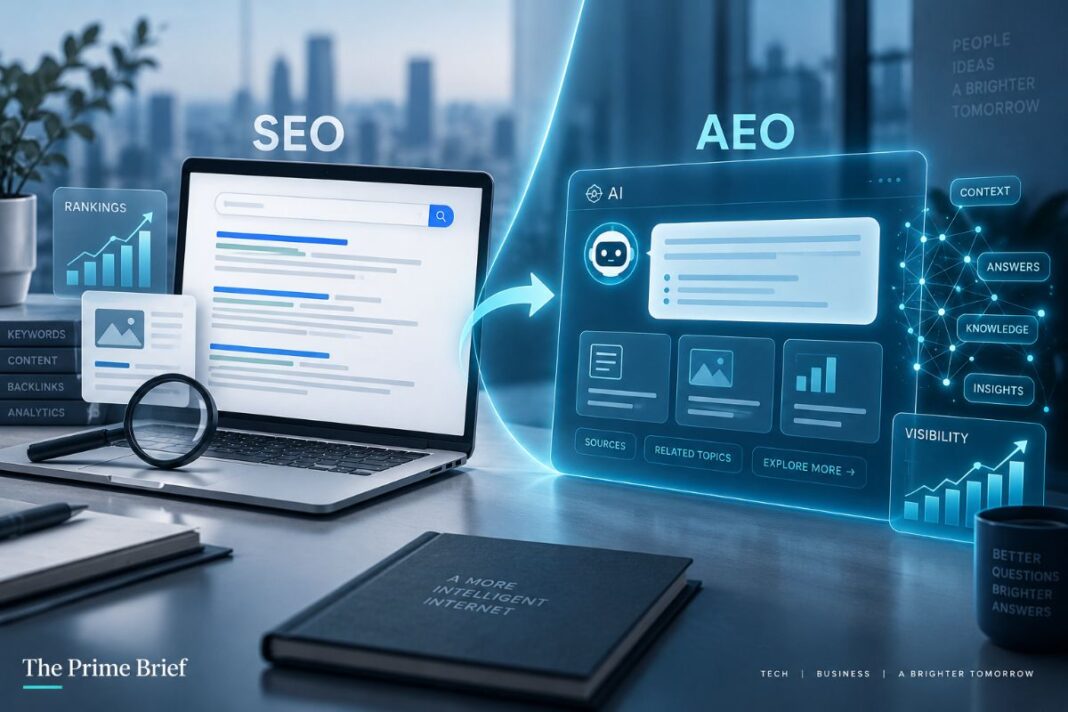

Is AEO replacing SEO? Not exactly. As Google AI Overviews, AI Mode and AI assistants change how people find information online, Answer Engine Optimization is becoming increasingly important. But Google’s own guidance suggests that AEO is better understood as an evolution of search optimization not a replacement for SEO.
For more than two decades, businesses and publishers have competed for one valuable piece of internet real estate: the first page of Google.
The formula was familiar. Someone entered a search query, Google displayed a list of websites, and the user clicked one or more links to find an answer.
Artificial intelligence is changing that experience.
Instead of searching for a few keywords and opening several websites, people can increasingly ask detailed questions and receive synthesized answers directly from AI-powered search tools.
Google now integrates AI Overviews and AI Mode into Search, while conversational AI tools have made question-and-answer discovery increasingly familiar.
That changes the question website owners need to ask.
It is no longer only:
“Can people find my website in search results?”
It is increasingly also:
“Can an AI-powered search system understand, trust and surface information from my website when answering a question?”
That shift has helped popularize a term that marketers will probably hear much more often: AEO, or Answer Engine Optimization.
AEO vs SEO: The Short Answer
SEO helps search engines discover, understand and rank web content. AEO focuses on making information clear and useful for systems that directly answer users’ questions. AEO is not replacing SEO because AI-powered search still depends heavily on many of the same foundations: crawlability, indexing, useful content, authority and relevance.
Google explicitly says that its established SEO best practices remain relevant to AI Overviews and AI Mode and that there are no additional technical requirements for appearing in those experiences.
The distinction is therefore less:
SEO versus AEO
and increasingly:
traditional search visibility + AI-answer visibility.
What Is SEO?
SEO stands for Search Engine Optimization.
In simple terms, SEO is the process of helping search engines discover, understand and appropriately surface content for relevant searches.
Imagine a company that installs solar panels.
Someone searches:
“best solar panels for homes”
A strong SEO strategy could help the company’s content appear prominently when Google determines that it is relevant and useful to the searcher.
SEO can involve:
- creating useful and original content
- understanding search intent
- using descriptive titles and headings
- internal linking
- earning relevant links and mentions
- maintaining fast, accessible pages
- ensuring search engines can crawl and index content
- using structured data appropriately
- demonstrating expertise and trustworthiness
The objective is not simply to repeat keywords.
It is to make useful information understandable and accessible to both people and search systems.
That objective remains relevant in the AI era.
What Is AEO?
AEO stands for Answer Engine Optimization.
The term generally describes efforts to make information easier for AI-powered search and answer systems to understand and potentially use when constructing direct responses.
Consider a person asking:
“How long does it take to charge an electric car?”
A traditional SEO article might rank for that question.
An answer-friendly article would also provide an immediate, contextual response for example, explaining that charging time depends on the vehicle’s battery, charging speed and charger type before breaking down the differences between home, fast and rapid charging.
That structure benefits the reader.
It may also make the information easier for search and AI systems to interpret.
A useful simplification is:
SEO helps make your content discoverable.
AEO helps make the answers within that content clear and usable.
The two increasingly overlap.
Why Has AEO Become So Important?
Because the interface through which people search is changing.
Google said in 2026 that AI Overviews had surpassed 2.5 billion monthly active users, while AI Mode had exceeded 1 billion monthly active users.
AI search also allows people to ask much more complicated questions.
Instead of:
“Japan trip”
a traveler might ask:
“Plan a seven-day Japan trip for two people in October on a moderate budget, including Tokyo and Kyoto.”
Google says AI Mode is designed for these more nuanced questions and may use a technique it calls query fan-out, where multiple related searches are performed across subtopics and data sources to help construct a response.
This creates a different discovery environment.
A webpage does not necessarily have to compete only for one exact keyword. Its information may potentially be relevant to one of several related questions an AI-powered search system explores.
Is AEO Replacing SEO?
No. Current evidence suggests AEO is expanding the scope of search optimization rather than replacing SEO.
Google’s guidance is particularly important here.
According to Google Search Central, the same foundational SEO practices used for conventional Google Search continue to apply to AI Overviews and AI Mode.
For a webpage to be eligible to appear as a supporting link in those experiences, Google says it must be indexed and eligible to appear in Search with a snippet.
There are no separate technical requirements for inclusion.
Google also says website owners do not need to create special machine-readable AI files or special Schema.org markup specifically for these features.
That makes an important point:
AEO without solid SEO foundations is unlikely to be an effective strategy for Google Search.
If Google cannot properly crawl or index a page, making its paragraphs more “AI-friendly” will not solve the underlying problem.
SEO vs AEO: What’s the Difference?
| SEO | AEO |
| Focuses on search visibility | Focuses on answer visibility |
| Targets searches and user intent | Often emphasizes questions and contextual intent |
| Helps pages become discoverable | Helps answers become understandable |
| Uses technical SEO, content and authority | Relies heavily on clear, trustworthy information |
| Often aims to earn search clicks | Can also aim for citation or inclusion within generated answers |
| Remains fundamental | Builds on many SEO fundamentals |
The important point is that these are not two completely independent systems.
At least within Google Search, they increasingly operate within the same search ecosystem.
What Does AEO-Friendly Content Look Like?
AEO-friendly content does not require writing for robots.
In fact, clear writing for humans is often exactly what makes information easier for machines to understand.
Suppose an article has this heading:
What Is Compound Interest?
Immediately underneath, it says:
Compound interest is interest calculated on both your original money and the interest that money has already earned.
The reader gets the answer immediately.
The article can then explain the concept in greater depth with examples, calculations and comparisons.
Compare that with an article that spends 400 words introducing financial markets before defining compound interest.
The first structure is more efficient for readers and gives search systems a clearer relationship between the question and its answer.
Useful AEO-oriented content therefore often includes:
Descriptive question-based headings → concise direct answers → deeper explanation → examples → supporting evidence.
But this should be done naturally rather than turning every article into dozens of artificial FAQs.
Google’s Advice Is Surprisingly Familiar
One of the most important developments in the AEO debate came from Google itself.
In 2026, Google published additional guidance specifically addressing optimization for generative AI features.
Its recommendations did not call for abandoning SEO.
Instead, Google emphasized valuable, unique and non-commodity content and reiterated that conventional SEO foundations remain important.
Google specifically recommends content that provides something beyond what can easily be found elsewhere, including first-hand experience, original perspectives and genuinely useful information.
It also recommends organizing content logically with clear sections and headings.
In other words, one of the most important strategies for AI search may also be one of the oldest principles of publishing:
Have something worth saying.
Keywords Aren’t Dead, But Context Matters More
The rise of conversational search does not mean keywords have stopped mattering.
People still search using short phrases such as:
“best running shoes 2026”
But AI interfaces make it easier to express much more detailed intent:
“What running shoes are suitable for someone with flat feet who runs five kilometers three times a week?”
The second question contains significantly more context.
A useful article therefore needs to do more than repeatedly mention “best running shoes.”
It might explain:
- different running surfaces
- cushioning
- stability
- foot shape
- weekly mileage
- shoe durability
- beginner versus experienced runners
- when professional assessment may be appropriate
This is where topical depth becomes particularly important.
Rather than creating ten thin articles targeting slightly different keyword variations, a publisher may be better served by creating authoritative content that thoroughly addresses the underlying topic and then connecting related articles through internal links.
Original Information Could Become More Valuable
AI systems can synthesize enormous amounts of existing information.
That creates an obvious problem for websites:
Why should a search engine surface another article that simply rewrites information already available on hundreds of pages?
Google’s 2026 guidance specifically encourages publishers to create unique, non-commodity content rather than simply reproducing information that already exists elsewhere.
For a news publisher, that could mean:
- original interviews
- exclusive reporting
- expert commentary
- original photographs or video
- data analysis
- primary-source research
- fact-checking
- first-hand reporting
- useful comparisons and explainers
For businesses, it could mean proprietary data, customer research, technical expertise, case studies, experiments or detailed first-hand product knowledge.
This is an important shift because AI can make generic information extremely cheap to produce.
Original information cannot be commoditized as easily.
The Business Around AEO Is Already Growing
The growing commercial interest in AI-search visibility is visible in the technology sector itself.
On September 15, 2026, Profound, a platform that helps brands understand and improve how they appear across AI-powered discovery systems, announced a $180 million Series D funding round at a $1.8 billion valuation.
The round was co-led by Sequoia Capital and Kleiner Perkins. Profound said it had surpassed 1,000 enterprise customers, including roughly one-third of the Fortune 100.
A single company’s valuation does not prove that AEO will replace SEO.
But it illustrates how quickly businesses are investing in tools designed to understand a new question:
How does my brand appear when AI answers the customer instead of simply giving them ten links?
Will AI Search Kill Website Traffic?
This remains one of the most contested questions.
Google says its Search products continue to send billions of clicks to the web each day and said in July 2026 that AI features within Search were sending billions of clicks to websites each week.
However, that figure should be presented carefully.
Google has not publicly provided the detailed methodology, baseline or site-level distribution behind the claim, and publishers continue to raise concerns about AI-generated answers reducing click-through traffic.
Both realities can coexist.
AI search can generate substantial aggregate web traffic while simultaneously changing which websites receive clicks and reducing clicks for certain types of informational queries.
For publishers, therefore, success should increasingly be measured beyond a single ranking position.
Relevant metrics may include search impressions, organic clicks, branded searches, engagement, conversions, citations, referral traffic and visibility across AI-powered discovery systems.
Do You Need Special Schema or an AI File for AEO?
For Google’s AI Overviews and AI Mode, no special AI-specific markup is required.
Google explicitly says website owners do not need new machine-readable files, AI text files or special Schema.org structured data to become eligible for these features.
That does not mean structured data is useless.
Appropriate structured data can still help Google understand page information and can make pages eligible for certain conventional search features.
For publishers, that means correctly implementing relevant markup such as NewsArticle, Article, Person, Organization and BreadcrumbList where appropriate, but not inventing special “AEO schema” because someone claims it guarantees AI citations.
There is currently no such guarantee.
What Should Websites Do for SEO and AEO?
The practical strategy is less revolutionary than the terminology suggests.
Make sure your website can be crawled and indexed. Publish genuinely useful information. Answer important questions clearly. Use descriptive headings. Demonstrate who wrote the content and why readers should trust it. Cite primary sources. Add original reporting or expertise whenever possible. Build meaningful internal links between related topics.
And above all, avoid producing hundreds of near-identical pages simply because an AI tool generated hundreds of keyword variations.
Google’s latest guidance emphasizes content that provides genuine additional value rather than material that can easily be reproduced from information already available elsewhere.
The Future Is SEO + AEO
The debate over whether AEO will replace SEO may ultimately frame the issue incorrectly.
Search engines themselves are evolving into answer engines.
Google Search increasingly combines conventional results with AI-generated summaries, conversational exploration and supporting links. Meanwhile, standalone AI assistants have introduced another route through which people discover information, brands and websites.
That means online visibility is expanding beyond achieving position one for a keyword.
The more durable strategy is:
Create information worth finding. Make the answer easy to understand. Demonstrate why the information can be trusted. Make the source technically accessible. Add something that cannot simply be copied from everyone else.
SEO helps make that information discoverable.
AEO helps make its answers understandable and usable in an AI-driven search environment.
For businesses and publishers, the future is therefore unlikely to be SEO or AEO.
It is increasingly SEO and AEO working together.
Sources
– Google Search Central – AI Features and Your Website: Google says existing SEO best practices remain applicable to AI Overviews and AI Mode and that no additional technical requirements or special AI markup are necessary.
– Google Search Central – Generative AI Optimization Guide: Google’s 2026 guidance emphasizes unique, useful and non-commodity content and warns against relying on supposed AI-search shortcuts.
– Google I/O / Google Marketing Live 2026: Google reported more than 2.5 billion monthly active users for AI Overviews and more than 1 billion for AI Mode.
– Alphabet Q2 2026: Google said AI-powered Search features were increasing Search usage and that AI Mode had surpassed one billion monthly active users.
– Profound: The company announced a $180 million Series D at a $1.8 billion valuation on September 15, 2026.