

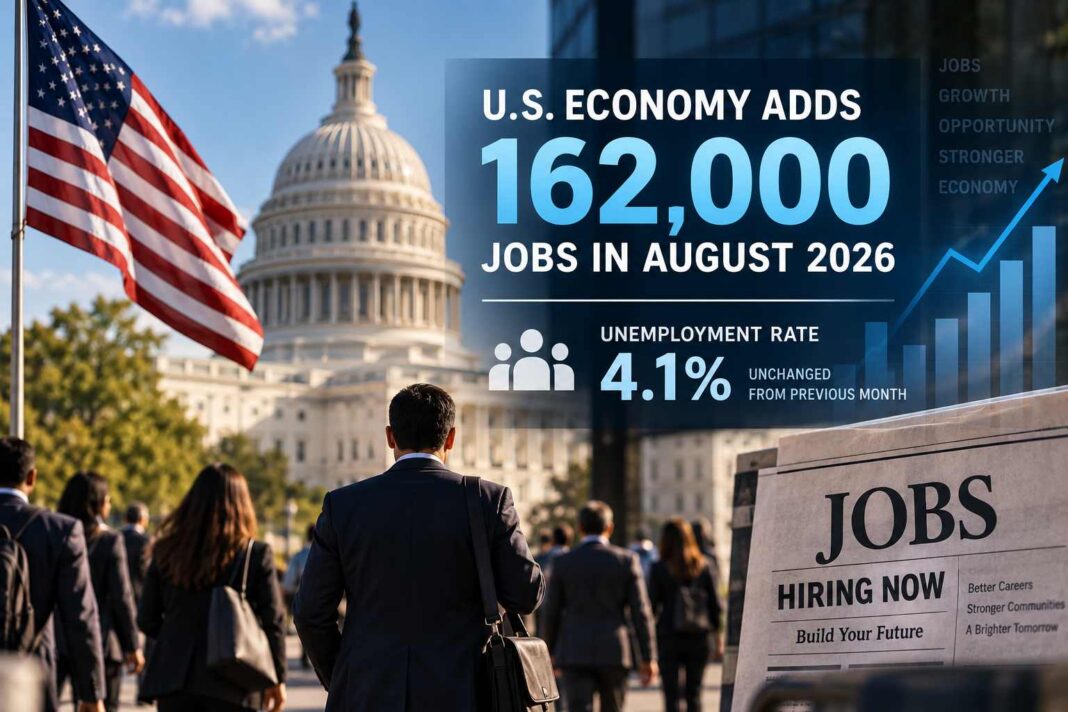

U.S. hiring accelerated sharply in August, with nonfarm payrolls rising by 162,000 and unemployment remaining at 4.1%, offering fresh evidence of labor-market resilience even as inflation and higher interest rates remain concerns.
The U.S. economy added 162,000 jobs in August 2026, significantly exceeding economists’ expectations and recording its strongest monthly employment gain in five months.
The unemployment rate remained unchanged at 4.1%, according to data released by the U.S. Bureau of Labor Statistics on September 4.
The report provided a stronger-than-expected signal from the American labor market after several months of relatively weak hiring.
Employment gains were particularly strong in food services and drinking places and local government education, while the information sector lost jobs.
Labor-force participation also increased, suggesting that more Americans entered or returned to the workforce during the month.
US Jobs Report August 2026: Key Numbers
The August employment report contained several important indicators:
| Indicator | Abugust 2026 |
|---|---|
| Jobs added | 162,000 |
| Unemployment rate | 4.1% |
| Labor-force participation rate | 61.6% |
| Number unemployed | 7.0 million |
| Year-over-year wage growth | 3.1% |
| Leisure & hospitality jobs | +62,000 |
| Local government education | +42,000 |
| Information jobs | -23,000 |
The payroll increase was substantially stronger than economists had anticipated. Reuters reported that economists had expected roughly 50,000 new jobs, making the 162,000 increase a significant upside surprise.
Unemployment Rate Holds at 4.1%
Despite the acceleration in hiring, the headline unemployment rate remained unchanged at 4.1%.
Approximately 7.0 million Americans were unemployed in August, little changed from the previous month, according to BLS.
The headline number nevertheless masks some movement underneath the surface.
The Federal Reserve Bank of St. Louis noted that the more precise, unrounded unemployment rate increased slightly from 4.090% in July to 4.141% in August.
Its analysis attributed much of the small increase to unemployed workers continuing to look for jobs rather than leaving the labor force.
Overall, the St. Louis Fed characterized August labor-market conditions as broadly similar to those of recent months.
More Americans Entered the Labor Force
One particularly important element of the August jobs report was an increase in labor-force participation.
The labor-force participation rate rose from 61.4% in July to 61.6% in August.
The civilian labor force expanded by approximately 683,000 people, while employment measured through the household survey increased by 569,000.
That matters because it provides additional context for the stable unemployment rate.
An economy can simultaneously create jobs and experience little movement in unemployment when more people enter the workforce and begin actively seeking employment.
Which Industries Added the Most Jobs?
August’s employment growth was not distributed evenly across the economy.
Leisure and hospitality was one of the strongest areas, adding approximately 62,000 jobs, according to Reuters.
Within that category, BLS specifically identified increased employment in food services and drinking places.
Local government education also recorded substantial employment growth, adding approximately 42,000 jobs.
There were gains in some other parts of the economy, including manufacturing, construction and healthcare, according to Reuters.
But not every sector expanded.
The information sector lost approximately 23,000 jobs, while financial activities also recorded declines.
That distinction is important because the employment report does not support the conclusion that technology was one of the principal drivers of August hiring.
Wage Growth Moderates to 3.1%
Wage growth remained positive but continued to moderate.
Average hourly earnings increased approximately 3.1% from a year earlier, compared with 3.2% in July, according to Reuters.
Slower wage growth can have mixed implications.
For workers, the relationship between wage growth and inflation determines whether purchasing power is improving. For the Federal Reserve, wage trends are one of several indicators used to assess inflationary pressure in the economy.
August consumer-price data subsequently showed that inflation remained a concern.
The Consumer Price Index increased 3.4% year over year in August, while prices rose 0.4% from July.
That combination—stronger hiring alongside persistent inflation—became particularly important for monetary policy.
What the Jobs Report Meant for the Federal Reserve
The stronger-than-expected employment report altered expectations surrounding Federal Reserve policy.
Immediately following the September 4 employment report, investors increased expectations that the Fed could raise interest rates at its September meeting. Reuters reported at the time that financial markets were assigning approximately a 62% probability to a rate increase.
Subsequent inflation data strengthened that case.
The Federal Reserve ultimately raised its benchmark interest rate by 25 basis points on September 16, taking the federal funds target range to 3.75%–4.00%.
The decision represented the Fed’s first rate increase in three years.
The central bank continues to face a balancing act between maintaining employment conditions and bringing inflation under control.
Is the US Labor Market Still Strong?
August’s 162,000 payroll increase was considerably stronger than recent monthly employment figures, but a single month’s data does not necessarily establish a new trend.
Hiring in 2026 has generally been slower than during the post-pandemic employment boom.
Recent data nevertheless indicate that layoffs remain relatively low.
Initial applications for unemployment benefits fell to 196,000 in the week ending September 12, the lowest level since mid-July, according to Labor Department data reported by Reuters.
The combination of relatively low unemployment, stronger August hiring and low layoffs suggests the labor market remains stable, although conditions vary considerably across industries.
Long-Term Unemployment Remains a Concern
The headline numbers also conceal areas of weakness.
BLS reported that approximately 1.9 million people had been unemployed for 27 weeks or longer in August.
Reuters also reported that the median duration of unemployment had increased to approximately 11.4 weeks, close to its highest level in four and a half years.
These indicators suggest that while layoffs remain relatively limited, some people who lose jobs may be finding it more difficult to return quickly to employment.
The unemployment rate also varied substantially among demographic groups.
BLS reported August unemployment rates of 4.0% for adult men, 3.5% for adult women, 3.7% for White workers, 6.0% for Black workers and 4.8% for Hispanic workers.
What the August Jobs Report Means for the US Economy
The August employment report delivered a stronger result than economists had expected.
The 162,000 increase in payroll employment, combined with unemployment holding at 4.1% and participation increasing to 61.6%, suggests the U.S. labor market retained momentum entering the final months of 2026.
But the broader economic picture is more complicated than the headline employment number alone suggests.
Inflation remains above the Federal Reserve’s target, wage growth has moderated, some industries continue to shed jobs and long-term unemployment remains elevated.
The Federal Reserve’s September rate increase further illustrates that policymakers are currently weighing a relatively stable labor market against renewed inflation pressure.
Future employment reports will show whether August’s strong hiring represents the beginning of a more sustained acceleration or simply an unusually strong month after a period of slower job creation.