

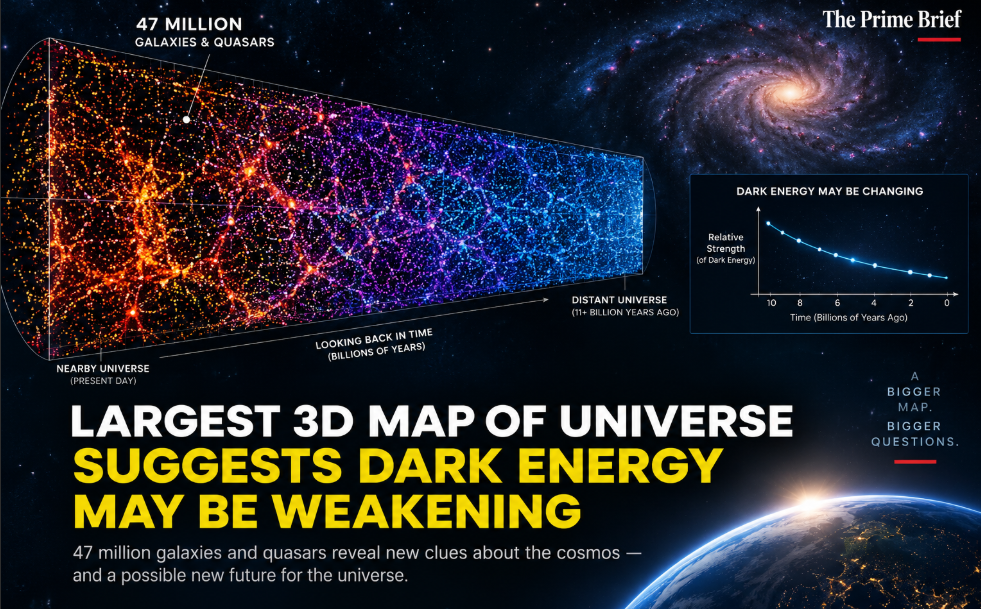

DESI has mapped more than 47 million galaxies and quasars, while earlier analysis offers growing evidence that dark energy may change over time, potentially challenging the standard model of cosmology.
The largest high-resolution 3D map of the universe ever created is giving scientists new clues about one of physics’ biggest mysteries: dark energy.
The Dark Energy Spectroscopic Instrument, or DESI, completed its originally planned five-year survey in April 2026 after observing more than 47 million galaxies and quasars, along with more than 20 million stars in the Milky Way.
The enormous cosmic map allows researchers to study how the universe has expanded over billions of years and test the long-standing assumption that dark energy, the mysterious component driving the universe’s accelerating expansion, remains constant.
Earlier analysis of DESI’s first three years of observations produced a surprising result. When DESI measurements were combined with other major cosmological datasets, scientists found growing evidence that dark energy may have changed over cosmic history.
If future observations confirm that result, it could force scientists to reconsider the standard model of cosmology and potentially change predictions about the ultimate fate of the universe.
What Is DESI’s 3D Map of the Universe?
DESI is installed on the Nicholas U. Mayall 4-meter Telescope at Kitt Peak National Observatory in Arizona.
At the heart of the instrument are 5,000 robotic fiber positioners. Each can precisely target a galaxy, quasar or other object in the sky and feed its light into spectrographs.
By analyzing that light, scientists can measure an object’s redshift and determine how quickly it is moving away from Earth. Combining millions of these measurements allows researchers to reconstruct the distribution of matter across enormous distances and different periods of cosmic history.
DESI was originally designed to measure about 34 million galaxies and quasars during its five-year survey. Instead, by April 2026, it had observed more than 47 million galaxies and quasars, substantially exceeding its original target.
The result is the largest high-resolution three-dimensional map of the universe produced to date.
DESI is not finished. Scientists are continuing observations and expanding the survey into additional areas of the sky.
Why Scientists Are Studying Dark Energy
Dark energy is the name scientists give to the still-unexplained phenomenon responsible for the accelerating expansion of the universe.
Observations in the late 1990s showed that cosmic expansion was not slowing under gravity as might have been expected. Instead, it was accelerating.
In the standard Lambda Cold Dark Matter, or Lambda-CDM, model of cosmology, dark energy is represented by the cosmological constant. Under this model, the density of dark energy remains constant even as the universe expands.
DESI provides scientists with a way to test that assumption.
Light from extremely distant galaxies has taken billions of years to reach Earth. Looking deeper into space therefore also means looking further into the universe’s past.
By comparing structures at different distances, astronomers can reconstruct how the universe expanded across roughly 11 billion years of cosmic history.
DESI Finds Hints That Dark Energy May Be Changing
This is where the results become particularly significant.
DESI’s first major results already produced hints that dark energy might not behave exactly like a cosmological constant. The evidence became stronger when researchers analyzed the first three years of observations.
That analysis used nearly 15 million well-measured galaxies and quasars.
DESI researchers studied a feature known as baryon acoustic oscillations, or BAO. These patterns in the distribution of galaxies act like a cosmic “standard ruler,” allowing scientists to measure how the scale of the universe has changed over time.
DESI data by themselves remain consistent with the standard Lambda-CDM model.
However, when scientists combine DESI measurements with observations of the cosmic microwave background, supernovae and gravitational lensing, the picture becomes more complicated.
Depending on which datasets are combined, the statistical preference for evolving dark energy ranges from approximately 2.8 to 4.2 sigma.
That is significant enough to attract serious scientific attention, but it remains below the 5-sigma threshold generally required in physics before researchers claim a discovery.
In other words, scientists have not discovered that dark energy is weakening. They have found increasingly interesting evidence that it might be evolving.
Why 47 Million Galaxies Do Not Yet Prove Dark Energy Is Weakening
There is an important distinction between DESI’s latest mapping milestone and its published dark energy results.
DESI has now observed more than 47 million galaxies and quasars, but the influential dark energy analysis published in 2025 was based on the first three years of survey observations and nearly 15 million carefully selected galaxies and quasars.
The complete five-year dataset should allow scientists to perform a much more precise test.
Researchers expect improved cosmological results based on the full five-year survey to be released in 2027.
That makes the next major DESI analysis especially important. If the evidence for evolving dark energy becomes stronger with substantially more data, the implications for modern cosmology could be profound.
If the signal weakens or disappears, the standard cosmological constant model may survive another major test.
Could This Change How the Universe Ends?
Potentially, but this is where interpretations need to be especially cautious.
Under the simplest cosmological-constant model, dark energy continues driving accelerated expansion indefinitely.
Over unimaginably long timescales, galaxies outside our gravitationally bound neighborhood would become increasingly distant and eventually disappear beyond the observable horizon. Stars would burn out and the universe would become progressively colder and darker, leading toward a scenario commonly described as the “Big Freeze” or “heat death.”
But if dark energy evolves, predictions of the distant future become much less certain.
If its influence continues weakening, accelerated expansion might eventually slow. Some theoretical models even allow the possibility that expansion could stop and ultimately reverse, resulting in a contracting universe and potentially a “Big Crunch.”
That is not, however, a prediction established by DESI.
DESI’s observations concern the past behavior of cosmic expansion. Extrapolating that behavior billions or trillions of years into the future requires theoretical assumptions that have not been confirmed.
So headlines claiming that DESI has proved the universe will end in a Big Crunch go considerably beyond what the observations currently demonstrate.
Why These Results Could Challenge the Standard Model of Cosmology
For decades, Lambda-CDM has been remarkably successful at explaining the large-scale evolution of the universe.
The model combines ordinary matter, cold dark matter and a cosmological constant representing dark energy. Despite its success, scientists still do not understand what dark matter or dark energy fundamentally are.
Evidence that dark energy evolves would create an even deeper problem.
It could mean that dark energy is not simply a fixed property of empty space. Scientists might instead need a dynamic field, modifications to gravity or another form of new physics to explain the observations.
Researchers have already begun investigating alternative models, but there is no consensus about which, if any, provides the correct explanation.
Other interpretations of the DESI results are also being explored, which is another reason scientists remain cautious about declaring that dark energy itself is changing.
What Happens Next?
DESI’s five-year milestone is not the end of the experiment.
The instrument continues to observe the sky, while its completed original survey gives researchers a much larger dataset with which to test the evolving-dark-energy signal.
Other major observatories will provide independent measurements. Data from the European Space Agency’s Euclid mission, the Vera C. Rubin Observatory and NASA’s upcoming Nancy Grace Roman Space Telescope could help scientists determine whether apparent cracks in the standard cosmological model are real.
For now, the most important conclusion is not that scientists have discovered the universe’s fate.
It is that one of cosmology’s most fundamental assumptions is facing an unusually powerful observational test.
If dark energy really does change over time, the discovery would transform our understanding of cosmic expansion and potentially rewrite predictions for the universe’s distant future.
But the next generation of data will determine whether DESI has uncovered new physics or simply another intriguing clue in the long search to understand the cosmos.