

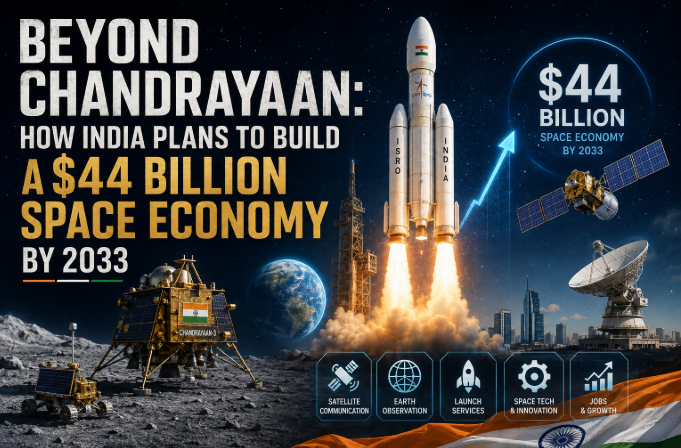

For decades, India’s space story was largely told through scientific milestones: Aryabhata, Chandrayaan, Mangalyaan and increasingly ambitious missions beyond Earth.
The next chapter, however, is about more than exploration. India wants space to become a major economic industry encompassing satellite manufacturing, commercial launches, communications, Earth-observation data, navigation services and exports. Under IN-SPACe’s long-term strategy, the country is targeting a space economy of approximately $44 billion by 2033, including about $11 billion in exports. The ambition represents a significant jump from India’s estimated $8.4 billion space economy in 2023, which accounted for roughly 2% of the global space economy.
If the target is achieved, the government expects India’s share to reach around 8% by 2033. But reaching that scale will require something fundamentally different from the model that built India’s earlier successes. It will require private industry.
From ISRO-Led Space Program to a Wider Space Industry
India’s space program has historically revolved around the Indian Space Research Organisation. ISRO developed launch vehicles, satellites and technologies while simultaneously pursuing scientific exploration and providing space-based services for communications, weather forecasting, navigation and Earth observation.
The government now wants private companies to play a much larger role across that ecosystem. The change formally accelerated in 2020, when India opened its space sector to greater private participation. The Indian Space Policy 2023 subsequently created a broader framework allowing non-government entities to participate across the space value chain.
Private businesses can now undertake activities including satellite development and operation, launches, data acquisition and dissemination, ground-station services and other space-based businesses. The objective is not simply to replace ISRO with private companies.
Instead, the emerging model separates and expands different roles: ISRO can increasingly concentrate on research, advanced technologies and major national missions, while industry scales commercial products and services. That distinction is important when discussing the so-called “privatisation of ISRO.” ISRO itself is not being privatised. India is liberalising the wider space sector and transferring or commercialising selected mature technologies so industry can build businesses around them.
Why Private Companies Matter to the $44 Billion Goal
There is a practical reason for this strategy: scale. A government research organisation cannot be expected to simultaneously push the scientific frontier and satisfy every potential commercial requirement of a rapidly growing global space market.
Commercial customers value frequency, price, production capacity, reliability and turnaround time. Private companies can build rockets and satellites, operate services, attract investment, pursue international customers and expand production in ways that complement ISRO’s research role.
India’s official 2033 roadmap consequently focuses on commercialising areas including launch services, satellite and ground operations, Earth observation, satellite communications, navigation and the emerging in-orbit economy. This is where India’s $44 billion ambition moves beyond simply launching more rockets. The real opportunity lies in creating an entire commercial ecosystem around space.
India’s Private Space Sector Is Already Expanding
The transition is no longer theoretical. By January 2026, around 1,050 private companies had listed their capabilities on IN-SPACe’s digital platform, according to information provided to Parliament. The government separately reported 399 active space startups at the beginning of 2026. Private investment is also increasing.
By March 31, 2026, cumulative private investment in India’s space sector had reached approximately $618.5 million, according to the Department of Space. Another $187 million in private investment had been reported during 2026 by the time the government updated Parliament in July. The figures suggest that India’s space reforms are beginning to produce an industry beyond the traditional network of government contractors.
Vikram-I Marks an Important Turning Point
One of the clearest demonstrations of that change came in July 2026. On July 18, Skyroot Aerospace’s Vikram-I lifted off from the Satish Dhawan Space Centre in Sriharikota, becoming the first orbital launch conducted by a private Indian company from Indian soil. ISRO said the rocket successfully injected two satellites, SCOPE and Grahaa, into low-Earth orbit. The achievement matters commercially as much as technologically.
A functioning private launch industry would give customers alternatives to relying exclusively on government-operated launch vehicles and could eventually allow India to increase launch frequency. India is also developing an SSLV launch complex at Kulasekarapattinam in Tamil Nadu that will accommodate launches by private startups and other non-government entities. In other words, the country is building not only rockets but the infrastructure required for a larger launch industry.
ISRO Technology Is Moving Into Industry
Another important part of India’s strategy involves taking technologies developed through the government space programand converting them into commercial industrial capabilities. NSIL (NewSpace India Limited) acts as ISRO’s commercial arm. Its responsibilities include enabling industry to manufacture launch vehicles, commercialising space-based services, building satellites for customers and facilitating the transfer of technologies developed within India’s space program.
One prominent example is the Small Satellite Launch Vehicle (SSLV). Hindustan Aeronautics Limited has signed an agreement for technology transfer relating to the SSLV, allowing mature government-developed technology to move toward industrial production. This model could become increasingly important. Instead of ISRO having to manufacture every mature system indefinitely, industry can scale production while government scientists devote more resources to next-generation capabilities.
Space Is Much Bigger Than Rockets
The most important misconception about the space economy may be that it is primarily a launch business. Rockets are only the beginning. Satellites generate enormous quantities of commercially and strategically valuable information. Earth-observation systems can monitor crops, infrastructure, coastlines, weather systems and natural disasters.
Satellite communications can connect remote regions where terrestrial infrastructure remains limited. Navigation satellites support transportation, logistics and smartphones. Space-derived information can also support agriculture, fisheries, urban development and national security.
India’s official policy explicitly identifies communications, remote sensing, data services and launch services as components of the commercial ecosystem it wants to develop. That helps explain why the $44 billion target cannot be understood simply as a plan to launch more satellites. India wants to capture more of the economic activity that happens before, during and after a satellite reaches orbit.
The Export Opportunity
There is also an international dimension. IN-SPACe’s 2033 roadmap envisages approximately $11 billion in space exports as part of the overall $44 billion economy. That could come from launch services, satellite components, complete spacecraft, Earth-observation products, communications services, software and other space technologies.
India already has experience launching satellites for foreign customers. The challenge now is converting that reputation into a much broader commercial industry capable of competing globally. This is also why private companies are important. A successful space economy cannot depend exclusively on government-to-government projects. Companies need to find customers, attract investment, develop intellectual property and compete internationally.
ISRO’s Role Could Become More Ambitious, Not Smaller
Greater commercial participation does not necessarily mean a reduced role for ISRO.
It could mean a more specialized one. India’s official policy calls for advanced research and development to sustain and expand the national space program while private companies participate across the commercial value chain. ISRO is already working on technologies that point toward that future.
These include a partially reusable Next Generation Launch Vehicle, semi-cryogenic propulsion, high-thrust LOX-methane engines, booster recovery and reusable orbital technologies. The logic resembles a model seen elsewhere: mature commercial services increasingly move toward industry while the national agency concentrates resources on technologies and missions that are harder, riskier and farther into the future.
Chandrayaan Was About Reaching the Moon. The Next Challenge Is Building an Industry.
India has already demonstrated that it can undertake sophisticated space missions at relatively modest cost. Commercialisation presents a different test. Success will depend on whether private companies can manufacture reliably at scale, attract sustained capital, win international customers and develop products that compete globally.
There are encouraging signs. Private investment has risen, hundreds of startups have entered the sector, commercial infrastructure is expanding and India’s first private orbital launch has now taken place.
But the distance between today’s approximately $8–9 billion industry and the $44 billion target remains substantial. That is precisely why India’s current space reforms matter. The country’s next space milestone may not be defined solely by where ISRO lands a spacecraft. It could also be measured by how many rockets Indian companies manufacture, how many foreign satellites they launch, how much satellite data they sell, how many high-technology jobs they create and how much revenue the industry generates.
Chandrayaan demonstrated what India’s scientific establishment could achieve. The race to $44 billion by 2033 will test whether India can turn that scientific capability into a globally competitive space industry.