

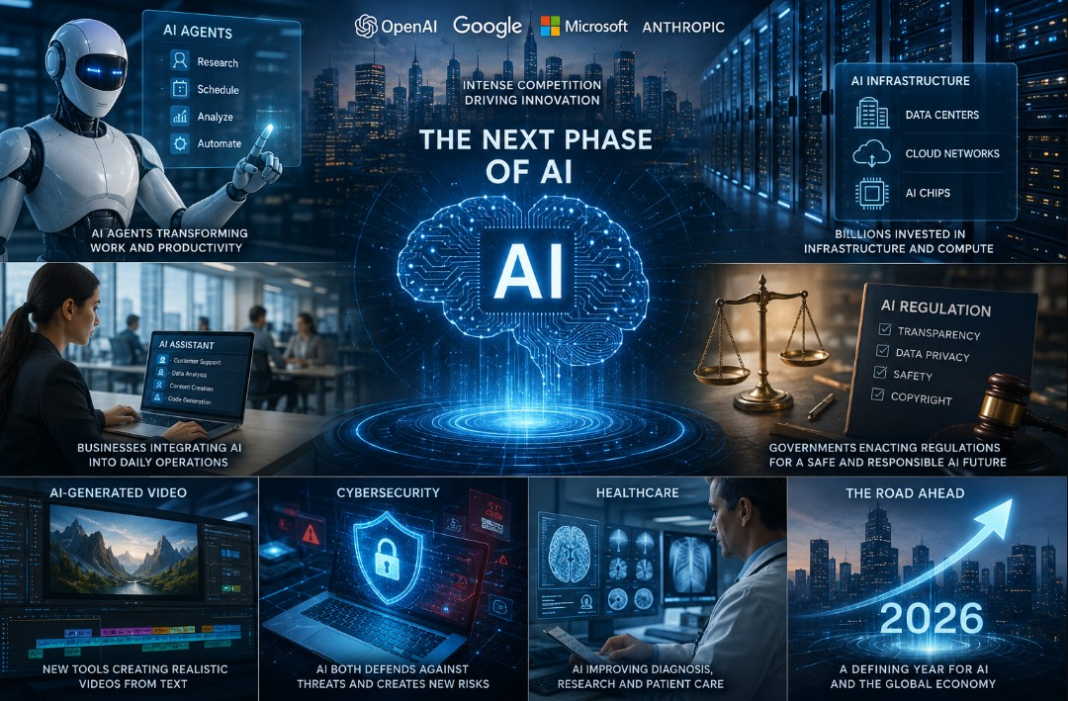

The global artificial intelligence industry is undergoing a major transformation as businesses, governments, and technology companies accelerate investments in advanced AI systems. While the early years of the AI boom focused largely on chatbots and content-generation tools, the market is now entering a new stage defined by autonomous agents, massive infrastructure spending, and growing government regulation.
One of the most significant developments is the rise of AI agents—systems capable of carrying out challenging tasks with limited human involvement. In contrast to traditional chatbots that primarily respond to questions, AI agents can perform multi-step activities such as conducting research, organizing schedules, analyzing data, and assisting with business operations. Industry experts believe these systems could become a central component of workplace productivity over the next few years.
Competition among leading AI companies is also intensifying. Technology giants and specialized AI firms are racing to develop more powerful and efficient models. The focus has shifted beyond simply generating text to improving reasoning abilities, reducing operating costs, and expanding real-life applications. As a result, innovation phases are becoming shorter, with new models and features being introduced at an increasingly rapid pace.
Businesses worldwide are moving beyond experimentation and integrating AI within daily operations. Organizations are deploying AI-powered tools for customer support, software development, data analysis, and content creation. Many companies that once viewed artificial intelligence as an emerging technology are now treating it as a core business resource capable of improving efficiency and decreasing operational costs.
This growing demand has fueled a spike in investment in AI infrastructure. Data centers, cloud computing networks, and specialized chips designed for AI workloads are receiving billions of dollars in funding. Industry specialists observe that the need for greater computing power is becoming one of the most important drivers of growth across the technology sector. As AI models grow larger and more sophisticated, companies are expanding their infrastructure to support the rising demand.
At the same time, governments around the world are paying closer attention to the technology’s impact. Policymakers are implementing new regulations focused on transparency, data privacy, copyright protection, and AI safety. Regulatory systems are evolving as authorities seek to align innovation with concerns about misinformation, security risks, and the responsible use of artificial intelligence.
Another area experiencing rapid advancement is AI-generated video technology. New tools are enabling the creation of realistic videos from simple text prompts, opening new opportunities in marketing, entertainment, and digital content production. Businesses are steadily exploring AI-generated advertising campaigns, virtual presenters, and automated video editing solutions to reduce production costs and speed up content creation.
Cybersecurity has also appeared as a key battleground in the AI era. Security firms are using artificial intelligence to detect threats, monitor networks, and respond to cyberattacks more efficiently. However, experts observe that malicious perpetrators are also using AI to develop more sophisticated phishing campaigns and deepfake content, creating new challenges for organizations and governments.
Healthcare remains one of the most promising sectors for AI adoption. Hospitals, research institutions, and healthcare providers are utilizing AI for medical imaging, patient documentation, and drug discovery. The technology is expected to play an increasingly important role in elevating healthcare efficiency and supporting medical professionals.
As artificial intelligence continues evolving, the industry is moving beyond hype and into large-scale implementation. With advances in autonomous systems, expanding infrastructure, and growing regulatory supervision, 2026 is shaping up to be a defining year for AI and its role in the global economy.