

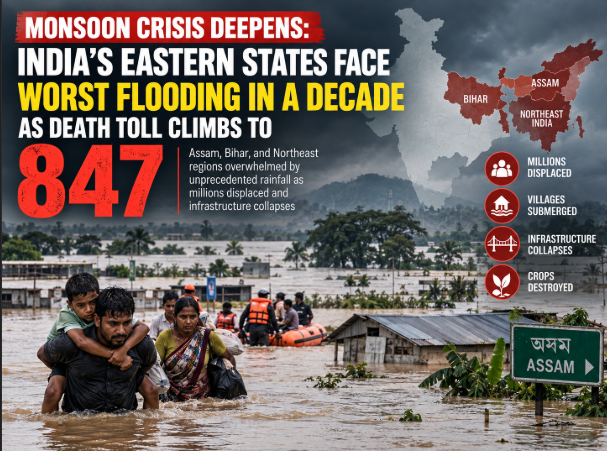

Assam, Bihar, and Northeast regions overwhelmed by unprecedented rainfall as millions displaced and infrastructure collapses
The eastern part of India is experiencing the most severe monsoon flooding in 10 years due to constant heavy rainfall. The number of deaths has now reached 847 in several states, Assam being the worst affected with 87 people killed and thousands forced from their homes. The situation has worsened over the past week, with no sign of relief, as meteorological departments have issued warnings of further heavy rain.
The extent of the destruction is astonishing; millions of people’s lives are still at stake since the floodwaters are still flooding villages, destroying crops, and carrying away infrastructure. This is not simply a weather phenomenon, it is a humanitarian crisis unfolding in real time in the fragile eastern region of India.
The situation regarding the floods in Assam, in India’s northeast, is still critical, with the death toll having reached 100 following the deaths of two more people during the night. The Assam State Disaster Management Authority said that several rivers are still above dangerous levels, raising the likelihood of further flooding in susceptible areas.
Assam at the Epicenter of Disaster
The effects of this disaster are most severely felt in Assam. The Sivasagar district alone has seen 47 deaths, with whole villages being entirely submerged under floodwater. The Brahmaputra River, the state’s key resource, has become a destructive force, overflowing its banks and flooding the communities that rely on it.
The situation worsened very quickly; what had at first been normal monsoon rains had become an extraordinary disaster within a few days. Nowadays, more than 10,000 people are housed in relief camps in Assam alone, with the figure increasing every day.
The flood crisis in Assam has displaced more than 500,000 people, caused many deaths, and caused considerable damage to transport infrastructure in northeast India. Almost 100 villages and more than 1,600 hectares of farmland have been flooded, together with a partial collapse of a railway bridge and the isolation of several villages.
Rivers Overflow at Danger Levels
Several tributaries of the Brahmaputra River have breached their banks, and at several places the rivers remain above dangerous levels, raising concerns that further waves of flooding could plunge areas already severely affected into an even deeper crisis.
The combination of heavy rain from multiple directions creates hazardous conditions. If the tributaries overflow simultaneously, the total volume of water exceeds the capacity of existing flood control systems, which were built to handle historical rainfall patterns rather than the extreme weather conditions now being experienced.
Widespread Devastation Across Multiple States
It is not just Assam that is suffering. In Kerala, at least 15 people have died, and seven are missing following several days of heavy rain, with more than 10,000 individuals taking shelter in over 300 relief camps. In Jammu and Kashmir, at least 31 people have been killed as a result of intense rainstorms.
The disaster affects all of India’s eastern and northeastern areas. Bihar, a region which has in the past been susceptible to flooding, is experiencing the same problems. All the states are handling their own disasters, while national resources are strained by the need to respond in so many places.
Agricultural Devastation and Livelihood Collapse
In addition to the number of people who die immediately, the flooding also destroys people’s means of earning a living. Crops that have been under water for several days are ruined. Animals, something which is important to rural communities, drown in the floodwater. Farming families lose the whole harvest that they have cultivated over the course of the year.
Before the floods, the village of Nepali Khuti had approximately 100 households, but now only a few houses remain since the rest were carried away by the floodwaters. The people who live there, most of whom were dairy farmers, now have to start their lives over after losing all their cattle.
The collapse of the agricultural sector affects regional economies. Food prices will rise. Rural areas will have to undergo years of recovery. Farmers who are unable to cover their losses on their own will end up in debt traps.
Infrastructure Collapse Complicates Response
Almost 481 villages have been entirely submerged, some roads and bridges have been damaged, and normal transportation has been disrupted. A railway bridge has partially collapsed, thereby isolating entire communities from any possibility of rescue or relief.
Because of the lack of functioning roads and bridges, it is difficult for relief supplies to reach the areas affected by the flooding. Communities that are cut off can remain inaccessible for several days. Medical emergencies can be fatal if people have no access to a hospital. The damage to the infrastructure increases the human cost of the flooding.
Climate Change and Human Factors Converge
Scientists are increasingly linking monsoon intensity to climate change, while environmental degradation worsens the effects of flooding. The severe stone and sand mining in the regional rivers, together with intensive deforestation and coal extraction in the Mon district of Nagaland, caused the disaster. Between 2002 and 2025,, Nagaland lost 14 percent of its tree cover, with the majority of this loss occurring in the Mon district, which lies next to Assam’s Sivasagar.
By cutting down trees, you eliminate the natural systems that absorb water, so rivers then overflow more suddenly since there are no forests to act as a barrier. Mining weakens riverbanks. Human activities increase the severity of disasters caused by climate change.
Government Response and Relief Efforts
The government of Assam, together with teams from the NDRF and SDRF, the Indian Army, local authorities, and various volunteer groups, is carrying out rescue operations, establishing relief camps, and distributing food and drinking water. Interim monetary compensation has already been provided to about 50,000 affected people.
The authorities have released their damage assessments and rehabilitation plans, but the extent of the need exceeds the available resources, causing the relief camps to overflow and straining food and water supplies.
Warning of Future Floods
The India Meteorological Department has cautioned that the southwest monsoon remains very active in eastern, northeastern, and northern India, with heavy or extremely heavy rain expected in the coming days.
The weather forecasts indicate that the disaster could get worse before it improves. Since the rivers have been at dangerous levels for long periods, further waves of flooding are possible. The horror might not end soon.
Looking Ahead
The 847 death toll represents tragedy beyond statistics, 847 families destroyed, 847 communities bereaved. Behind each number stands human suffering, loss, and distress.
As floodwaters recede, the true challenge emerges: rebuilding shattered lives and communities. Recovery from monsoon disasters spans years, not weeks.