

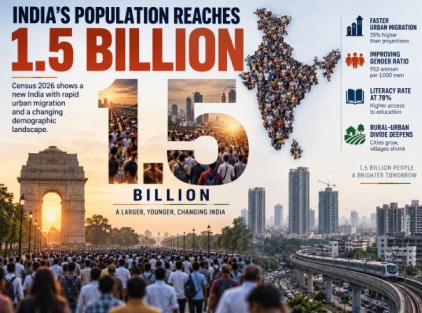

Census 2026 releases landmark data showing India exceeds previous projections while revealing massive urban-rural migration trends
The population of India has officially reached 1.5 billion, according to the 2026 Census, marking a significant milestone and establishing it as the world’s most populous country. The Census, released on Monday morning, shows remarkable demographic changes, including urban migration increasing at a rate 35 percent higher than the government’s projections.
It is hard to comprehend just how large the figure is: 1.5 billion people, about 19 percent of the world’s population, reside within India’s boundaries. The Census 2026 figures show how this population is distributed, where it moves, and how it is changing in real time.
Dr. Rajesh Sharma, who is the Census Commissioner, said: “It is not simply a figure; it stands for 1.5 billion individual lives, together with their dreams, aspirations, and difficulties. The 2026 Census shows India undergoing transformation, economic, social, and geographical.”
The launch of the data prompted immediate discussions about resource allocation, infrastructure requirements, and India’s standing in global population trends.
Urban Migration Accelerating Beyond Projections
The most notable finding is concerning movement patterns. Cities are expanding at a faster rate than had been previously expected.
Since 2021, urban areas have accounted for 42 percent of India’s population growth, exceeding the expected 31 percent. The metropolitan areas, including Delhi, Mumbai, Bangalore and Hyderabad, have together gained 8.7 million residents since the last Census.
The shortage of housing leads to a series of problems. The infrastructure is put under pressure. Traffic jams get worse. The water supply becomes a matter of great importance. At the same time, this kind of migration offers monetary advantages, as people move to access work, education, and improved living conditions.
The metropolitan area of Delhi now has a population of over 32 million, and, as a result,, it might be the largest city in the world in certain ways.
Male-to-Female Ratio Improvement Signals Progress
A highly encouraging demographic feature is that the sex ratio has improved significantly.
The number of women per 1,000 men rose from 943 in 2011 to 952 by 2026, indicating considerable improvement in correcting the gender inequalities that had affected earlier Census figures.
The progress made is the result of many years of campaigning against female infanticide and sex-selective practices. Although some gaps still exist, the trend shows real social advancement.
Some states have achieved remarkable progress. Kerala, which was already ahead of other places in gender indicators, now has 1,004 females per 1,000 males. States that have traditionally been problematic in this area, such as Punjab, also improved, rising from 895 to 917.
Literacy Rates Reach 78 Percent
Educational achievement has expanded significantly across India.
In 2026,, the general literacy rate had reached 78 percent, an increase from 74.4 percent in 2011; female literacy rose to 71 percent from 65.4 percent, indicating faster progress in access to education for girls and women.
The expansion of literacy has important implications, as educated people earn more, take a more active role in democracy, make better decisions about their health, and invest in their children’s education, producing positive effects that span many generations.
Urban literacy rates are over 88 percent, while in rural areas they are 72 percent, this shows a persistent gap between urban and rural areas that calls for policy intervention.
Rural-Urban Divide Deepens
Even though cities offer more opportunities, villages continue to lose people compared to cities.
The number of people in rural areas fell from 68.8 percent in 2011 to 64.2 percent in 2026. Although rural areas still contain 960 million people, the trend towards urbanization continues to accelerate, with a net outflow of younger people from rural India.
Young, educated people leave the villages, causing rural areas to age demographically. This phenomenon, known as ‘brain drain’, poses a threat to farming productivity and rural development.
The following questions now need to be addressed by those involved in policy-making: how can we make life in the countryside appealing, and how can we prevent villages from being abandoned without violating people’s rights to make their own decisions about moving?
State-Wise Distribution and Imbalances
The population is still unevenly distributed across India.
Uttar Pradesh is still the most populous state in India, having 235 million people; Maharashtra comes next with 128 million, and Bihar has 115 million. The three states taken together have a population of 478 million, just about one-third of India’s total population.
The fact that such a concentration gives rise to governance problems is that a small number of states have large populations,, increasing competition for resources, while states with smaller populations find it difficult to attract policy attention.
Although development programs have been implemented, the Himalayan and northeastern regions remain sparsely populated, and the coastal and industrial areas continue to attract migrants.
Impact for Resource Planning
Census data now shapes government policy in many areas.
Housing demand is expected to rise significantly as more people move to cities. The water infrastructure needs to be expanded to meet the needs of the growing city. There will need to be a huge increase in the size of the education and medical systems. Transportation networks need to be developed to accommodate high population density.
The Ministry of Housing and Urban Affairs believes that by 2030, India will need to build an additional 100 million housing units to address expected urban migration and population growth.
The amount of money needed for infrastructure investment is astonishing, it could exceed ₹20 trillion for housing, water, sanitation, and transportation.
Climate and Sustainability Concerns
1.5 billion people use resources. This puts more pressure on the environment.
Environmental scientists have warned that India’s population milestone coincides with the accelerating climate crisis; as the population grows, so do water scarcity, air pollution, and pressure on agriculture, making sustainable development pathways increasingly urgent.
India must grow its economy while managing environmental limits. This challenge is unique in its scale.
Looking Forward
The data from the 2026 Census indicate that India is undergoing major changes: cities are booming with opportunities whilst villages are becoming increasingly empty; education standards are rising, and the gender ratio is improving. At the same time, a number of problems are becoming more serious, namely housing shortages, infrastructure needs, ecological stresses, and questions about resource planning.
India’s 1.5 billion population isn’t a problem to solve, but a fact to manage thoughtfully. The next decade will determine whether the demographic transition becomes an opportunity or a crisis.