

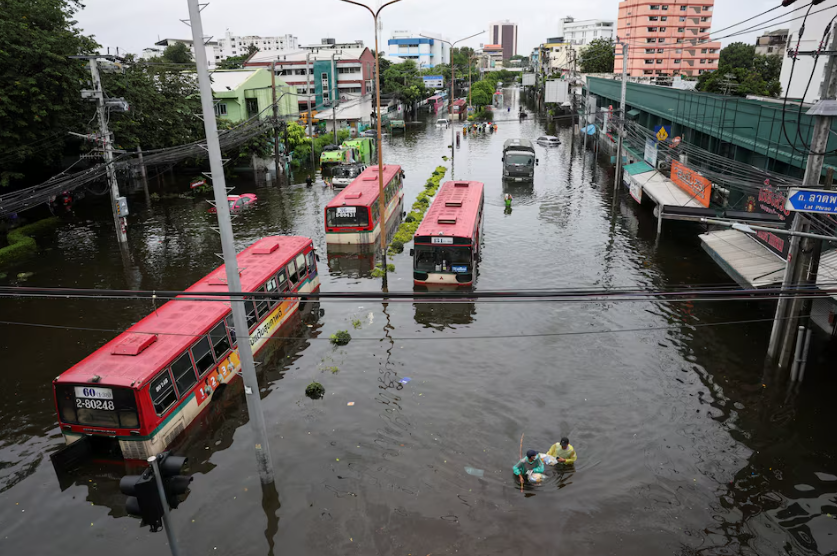

Thailand is now preparing for another period of intense rainfall since weeks of flooding have already resulted in at least 31 deaths and affected over 3.5 million people across the country. Bangkok, which has recently seen heavy rain submerging its roads, leaving vehicles stranded and forcing thousands to leave their homes, is especially at risk. Because of its position on a low-lying river delta, the ground sinking beneath it, the high density of development and its reliance on pumps and canals, the city – one of the largest in Asia – faces a difficult challenge: how can it keep water out when that water can come from the sky, the rivers and the sea at the same time?
On October 5, Thai authorities released new warnings after the official number of people dead from the floods since mid-September had reached 31 in eight provinces, including four deaths in Bangkok.
The Department of Disaster Prevention and Mitigation in Thailand stated that over 3.5 million people are still affected. The government has approved more than 4.1 billion baht, or approximately $122 million, in emergency funds for recovery purposes.
The danger is still there.
The Meteorological Department of Thailand has cautions regarding thunderstorms, strong winds and heavy rain in various parts of the country, with further heavy rainfall also expected in the central, eastern and southern areas, including Bangkok.
What Happened in Bangkok?
Bangkok suffered some of the most disruptive floods as a result of extraordinary rainfall which overwhelmed the city.
Almost 300 millimetres of rain occurred within a 48-hour period at the height of the emergency, which caused the governor of Bangkok to declare the capital a disaster-affected area on September 26. Many of the major roads were swept away by the floodwater, vehicles were partly submerged and people in certain neighbourhoods were forced to walk through water that reached their waists.
Reuters stated that the amount of rainfall had been about 320 millimetres over a period a bit longer than that, which is nearly the same as the amount of rain that Bangkok usually gets throughout the whole month of September.
At least 5,901 people were relocated to 234 evacuation centres during the most severe part of the flooding, and businesses, transport and airport operations were also affected.
Four Toyota factories were temporarily closed due to flooding causing problems with parts deliveries, and Thai Airways halted its cargo operations and encountered major difficulties at Suvarnabhumi Airport.
Why Does Bangkok Flood So Easily?
It is not true that heavy rain alone can account for Bangkok’s vulnerability.
The city is located on the delta of the Chao Phraya River upon naturally low and quite flat land, and according to Reuters it is situated on soft clay at about 1.5 metres above sea level.
It is difficult to get rid of the extra water because of the geography.
When a large quantity of rain falls rapidly, the water has to flow through canals and drains before being pumped into rivers and other nearby waterways. If the systems get water in faster than they can get rid of it, the streets are then in effect turned into temporary reservoirs.
The authorities in Bangkok are at present pumping out the city’s main canals in order to increase the storage capacity and placing in use more pumps in those areas which are regarded as being at high risk.
However, there is another serious issue taking place beneath the city.
Bangkok Is Also Gradually Sinking
Bangkok has had to deal with land subsidence for many years.
A major historical cause has been the drawing of groundwater. When large quantities of underground water are removed, the pressure in the aquifers decreases and this can lead to the soil layers above them being compressed.
This is especially problematic in Bangkok since a large part of the city is constructed on soft clay which is highly compressible.
A study published in Engineering Geology revealed that deep groundwater pumping in the past had intensified subsidence and that as a result some areas of Bangkok had eventually dropped below mean sea level, which in turn made drainage more difficult and costly.
The measures designed to control groundwater have contributed to a reduction in the extremely rapid sinking rates that were recorded decades ago, but the problem has not gone away.
A 2024 study based on satellite data showed that the average rate of subsidence in the area around Bangkok was about 7 millimetres per year, although in some of the adjacent areas the rate was much faster.
What this means is that Bangkok is undergoing two kinds of movement simultaneously, the ground is sinking while global sea levels are rising.
Rising Seas Make the Equation Harder
It’s not only a matter of rainfall when it comes to flood protection.
Bangkok is also near the Gulf of Thailand, with the Chao Phraya River running directly through the city.
High tides can cause it to be more difficult for the water to drain. Additionally, the flow of the river coming from northern Thailand can exert pressure from that side.
As sea level rises, the vulnerabilities that already exist become more serious over time.
The World Bank’s evaluation of Bangkok’s climate risks has cautions that when planning future flood protection and drainage infrastructure all of the following must be taken into account: increased rainfall, rising sea levels and land subsidence.
Which is why it is impossible to solve the whole problem simply by adding more pumps.
Has urban development caused flooding to become more severe?
The remarkable economic growth experienced by Bangkok has changed the landscape.
Roads, buildings, shopping centres and all other developments now cover the areas which formerly permitted more rainwater to soak naturally into the ground.
The historic canals, which are locally known as klongs, have likewise been reduced or modified as the city has expanded.
A previous analysis by the World Bank pointed out that the rapid development of areas susceptible to flooding and the filling in of drainage canals had increased the difficulties experienced by Bangkok when it came to flooding.
The city of modern Bangkok therefore has to pass on large quantities of water via a drainage system which serves a population of millions in the metropolitan area.
The system’s limits can be very clearly shown by extreme rainfall.
Is climate change causing the floods in Bangkok?
It would be too early to say that climate change had directly caused this particular flood without first carrying out a specific attribution study.
Thailand has a natural monsoon rainfall and is accustomed to having serious floods.
Yet climate change is raising the general risk encountered by coastal cities since a warmer atmosphere can hold more moisture and this results in heavier rainfall, and at the same time sea level rise increases exposure to coastal and tidal flooding.
The World Bank has always regarded the areas of Bangkok and Thailand that are heavily involved in exports as particularly susceptible to flooding and has warned that the economic damage caused by serious floods is likely to increase.
Can Bangkok Adapt?
Bangkok is by no means defenseless.
The city is provided with flood barriers, drainage canals, pumping stations and a comprehensive monitoring system. The authorities are at present boosting the pumping capacity and reducing the level of the canals in preparation for more rain.
The fact shown by the floods of 2026 proves that adaptation needs to extend beyond emergency pumping.
In order to deal with the problem, Bangkok must improve its drainage system, build more robust flood defences, manage its groundwater more effectively, enhance its urban planning, create larger water-storage areas and develop climate-resilient infrastructure.
The problem is not just about getting ready for the next storm.
It is adjusting a large and economically significant city for a future in which extreme rainfall, rising sea levels and sinking land can have a reinforcing effect on one another.
For Bangkok the issue is becoming more and more one of whether floods will return.
The question is whether the city can adapt at a faster rate than the growing water risk.