

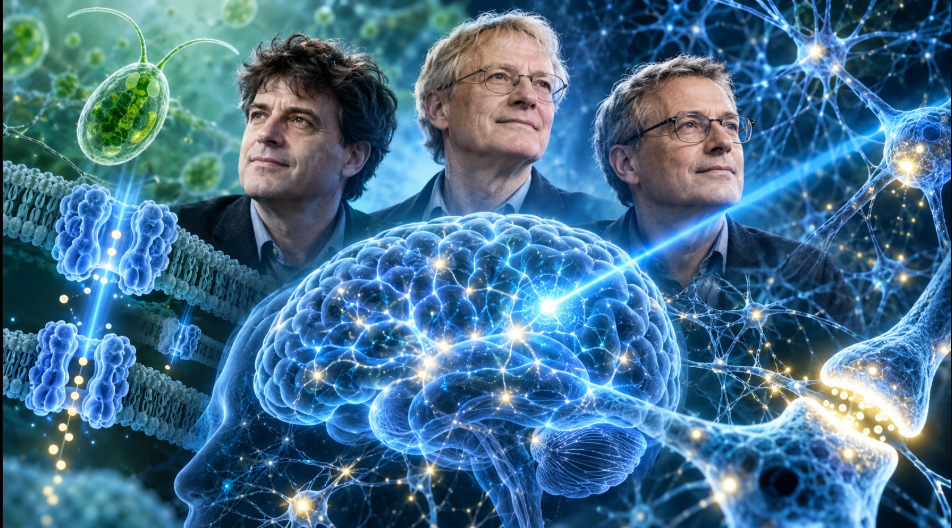

The Nobel Prize in Physiology or Medicine for 2026 has been awarded to three scientists whose research gave neuroscience one of its most transformative tools: the ability to turn individual nerve cells on and off with light alone.
The Nobel Assembly at the Karolinska Institute in Sweden awarded Karl Deisseroth of Stanford University, Peter Hegemann of Humboldt University in Berlin, and Georg Nagel of the University of Würzburg as joint winners on Monday, October 5. They received the award “for their discoveries concerning light-gated ion channels and optogenetics”.
What Optogenetics Actually Does
Optogenetics may seem complicated, but the basic principle is elegant: by inserting light-sensitive proteins into particular nerve cells, scientists can turn those neurons on or off simply by shining a light on them, with great precision, in a living brain.
Before optogenetics, neuroscientists lacked a reliable way to separate the function of one kind of brain cell from that of its neighboring cells. Optogenetics brought about this change and has since become one of the most commonly used techniques in neuroscience laboratories worldwide, helping researchers understand how particular cell types contribute to behaviors such as learning, fear, addiction, and movement.
The Nobel Assembly put it simply: optogenetics has fundamentally changed our understanding of the brain and continues to drive new discoveries about how it works.
A Six-Decade Journey, Starting With Pond Algae
The origin of this year’s prize goes back further than most people would imagine. As Abdel El Manira, a member of the Nobel Committee for Physiology or Medicine, pointed out, the basic concept can be traced to Francis Crick, the 1962 Nobel Prize winner, who at that time speculated that it might someday be possible to use light to control individual cells. El Manira, however, said the idea seemed completely far-fetched.
The real breakthrough started with something much simpler than brain science, a small aquatic algae known as Chlamydomonas. Research by Hegemann and Nagel at the Max Planck Institutes in Martinsried and Frankfurt discovered light-sensitive ion channels in this organism,, which later became the molecular toolkit for optogenetics.
Deisseroth then took that basic biology and applied it to neuroscience, creating techniques that let researchers use these light-gated channels in living brain tissue. As a striking early example, his team used optogenetics to wake sleeping mice in a carefully controlled way, providing visible evidence that specific neurons could be activated at will.
Why This Matters Beyond the Lab
Optogenetics is not simply a mere curiosity of the laboratory; it has changed the way scientists investigate a range of conditions, including depression, Parkinson’s disease, and addiction, since it allows them to identify precisely which neural circuits cause specific behaviours.
Clinical considerations influenced the course Deisseroth took to reach his field. Although he had originally intended to become a neurosurgeon, he changed his focus to psychiatry after coming across patients with depression and autism, and questions as to why these disorders occur then became part of the motivation for his research.
The translational link from fundamental biology in pond algae to the tools currently used in laboratories investigating human mental illness is one reason the Nobel committee found this year’s award so compelling.
The Moment of the Call
Deisseroth learned he had won in a late-night phone call, as he was about to go to sleep, according to an interview he gave to Scientific American right after the announcement. Hegemann and Nagel, who are now in their seventies, were said to have been just as surprised.
Describing decades of collaboration among the three scientists, Deisseroth said they had shared many discoveries, meetings, and informal moments over the years and considered it “absolutely perfect” to share the honor with two long-time collaborators.
A Milestone Prize
This year’s prize marks the 117th time the Nobel Prize in Physiology or Medicine has been awarded since it was established in 1901, bringing the total number of recipients in this field to 235.
The fact that optogenetics is such a young field, only just over two decades old in its current form, shows clearly how rapidly a technique that started out from simple curiosity regarding pond algae was able to transform an entire area of scientific research, and how much potential it still has for increasing our understanding of the human brain.