

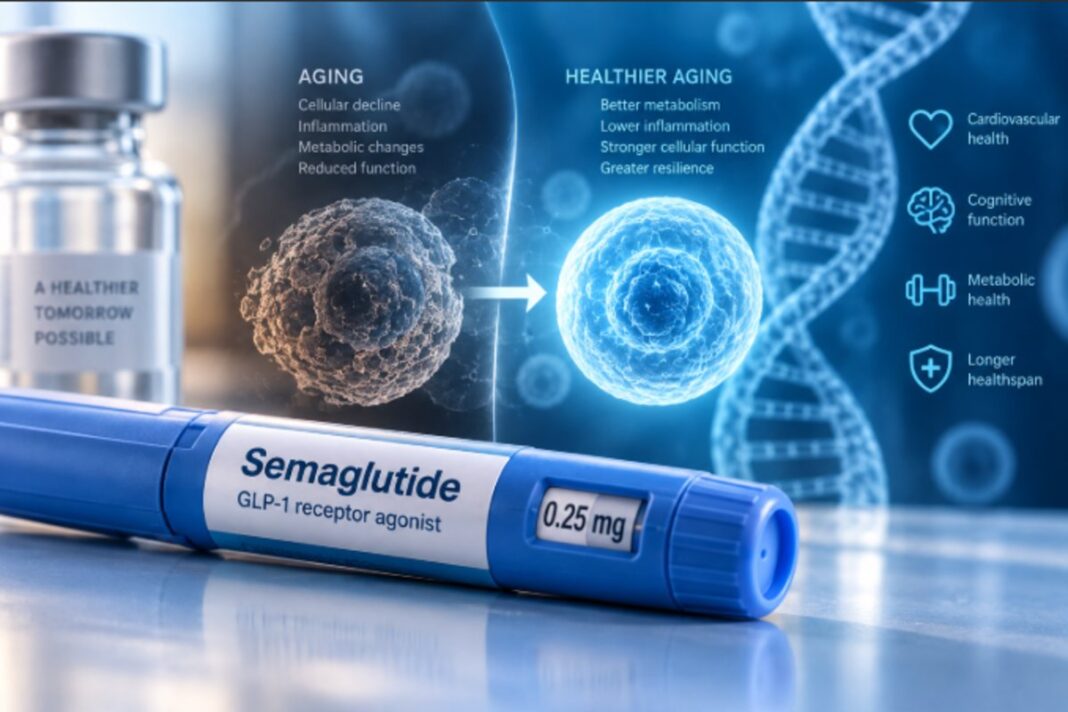

Could drugs such as Ozempic and Wegovy eventually play a role in longevity medicine? A new study found that semaglutide extended median lifespan by about 12% in older female mice while improving several measures of physical, metabolic and cognitive health. The findings are significant, but they do not show that semaglutide can make humans live longer.
Semaglutide is already widely used to treat type 2 diabetes and obesity. Now scientists are investigating whether the drug could influence something much more fundamental: the biological processes associated with aging.
In a study published in Nature on September 2, 2026, researchers led by scientists at the University of California, Berkeley gave semaglutide to older female mice and compared the effects with untreated animals and, in additional experiments, with calorie restriction.
The results were striking.
Mice receiving semaglutide late in life showed improvements in several functions that normally decline with age. More notably, in the lifespan experiment, their median lifespan increased from 742 days to 834 days, an increase of about 12%.
The drug also affected biological processes associated with aging in ways that could not be explained entirely by reduced food intake or weight loss.
That has raised an intriguing question:
Could GLP-1 drugs eventually do more than treat obesity and diabetes, and potentially influence how organisms age?
For now, the evidence is promising but preliminary.
What Did the Semaglutide Aging Study Find?
The researchers studied female mice that were 20 months old when treatment began, already late in a laboratory mouse’s lifespan.
For the lifespan experiment, mice received either semaglutide or a control treatment for the remainder of their lives.
The difference in survival was substantial.
| Group | Median lifespan |
| Control mice | 742 days |
| Semaglutide-treated mice | 834 days |
| Difference | ~12% longer median lifespan |
The experiment involved 40 semaglutide-treated mice and 39 controls.
But longevity was only part of the research.
In separate experiments examining physiological and molecular effects, older mice treated with semaglutide performed better across several functions that typically deteriorate with age.
According to the NIH’s summary of the research, these included muscular and cognitive function, coordination, balance and endurance. Researchers also observed changes in age-related gene activity.
That distinction is important.
Longevity researchers are increasingly interested not simply in extending lifespan, how long an organism survives, but also healthspan, the period during which it remains relatively healthy and functional.
Why Might Semaglutide Affect Aging?
Semaglutide belongs to a class of medications known as GLP-1 receptor agonists.
GLP-1, or glucagon-like peptide-1, is a naturally occurring hormone involved in regulating appetite and blood glucose.
Drugs that activate the GLP-1 receptor can reduce appetite, increase feelings of fullness and improve glucose regulation.
That connection led researchers to an interesting hypothesis.
Scientists have known for decades that calorie restriction without malnutrition can extend lifespan in several laboratory organisms.
Because GLP-1 drugs reduce food intake, researchers asked whether semaglutide might reproduce some of the biological effects of calorie restriction.
The Berkeley team therefore directly compared semaglutide treatment with dietary calorie restriction.
Both interventions reduced body weight and fat, but their biological effects were not identical.
The researchers concluded that activating the GLP-1 receptor may reproduce some features associated with calorie restriction, raising the possibility that GLP-1 drugs could act in part as calorie-restriction mimetics.
In simple terms, the drug may trigger some biological responses associated with consuming fewer calories.
But the study suggests the story could be more complicated than appetite suppression alone.
The Effects Went Beyond Weight Loss
One of the study’s most interesting findings was that semaglutide did not simply reproduce every effect of eating less.
Researchers found differences between mice receiving semaglutide and those undergoing calorie restriction.
Semaglutide-treated animals showed favorable outcomes across multiple measures of physical and cognitive function.
Nature reported that treated mice performed better on cognitive tests than calorie-restricted animals, suggesting that at least some of semaglutide’s effects could not be explained solely by reduced calorie intake.
Researchers also observed changes involving biological processes associated with aging, including inflammation and metabolic regulation.
A Nature commentary accompanying the study noted that semaglutide slowed the progression of several recognized hallmarks of aging in the female mice.
That raises a broader scientific possibility.
GLP-1 receptor activation might affect biological pathways connected with aging in addition to its established effects on appetite, body weight and glucose metabolism.
Exactly how much of the longevity effect comes from weight loss, reduced food intake or other biological mechanisms remains an important question for future research.
Does This Mean Ozempic Can Make People Live Longer?
No. There is currently no evidence that taking Ozempic or another semaglutide drug extends human lifespan.
That is the most important limitation to understand.
The lifespan experiment involved female mice from a single inbred laboratory strain.
The results therefore do not establish that the same effect occurs in male mice, other mouse strains or humans. Nature specifically highlighted the need for studies involving genetically diverse animals and both sexes.
Animal longevity studies are valuable because researchers can examine an organism throughout its entire lifespan and investigate biological mechanisms in controlled conditions.
But a drug that extends lifespan in mice does not automatically extend lifespan in humans.
Human aging takes place over decades and is influenced by genetics, lifestyle, environment, disease and many other factors.
Determining whether semaglutide affects human longevity would therefore require much longer and more specifically designed clinical research.
What About Biological Aging in Humans?
There is an intriguing piece of human evidence, but it needs to be interpreted carefully.
A study published in Nature Communications in May 2026 examined whether semaglutide affected molecular markers of aging in adults with HIV-associated lipohypertrophy, a condition involving abnormal fat accumulation.
Researchers analyzed stored blood samples from participants in a 32-week randomized, double-blind, placebo-controlled phase 2b trial.
The analysis included 45 participants who received semaglutide and 39 who received placebo.
Researchers examined DNA methylation patterns using several epigenetic clocks, which attempt to estimate aspects of biological aging from chemical modifications to DNA.
Across several second- and third-generation clocks, the semaglutide group showed slower epigenetic aging than the placebo group.
For example, the DunedinPACE measure indicated an approximately 9% slower pace of epigenetic aging during the study period. Other clocks, including PhenoAge, GrimAge V2 and PCGrimAge, also showed statistically significant differences.
That sounds dramatic, but there are important limitations.
An Epigenetic Clock Is Not the Same as Lifespan
The human study did not show that semaglutide makes people live longer.
The epigenetic analysis was conducted after the original clinical trial and was not its pre-specified primary outcome.
It was also performed in a specific population, people with HIV-associated lipohypertrophy, rather than the general population.
And not every aging measure changed significantly.
For example, an epigenetic measure designed to reflect intrinsic capacity did not show a statistically significant difference between semaglutide and placebo.
Epigenetic clocks are useful research tools, but changing a clock score is not equivalent to demonstrating that someone’s entire body has become younger or that they will live longer.
The human findings therefore provide a reason for further investigation, not proof that semaglutide is an anti-aging treatment.
Why Are GLP-1 Drugs Being Studied Beyond Weight Loss?
GLP-1 drugs are increasingly being investigated beyond their original use in diabetes.
Research has linked members of the drug class with benefits involving cardiovascular, kidney and metabolic health, among other areas.
The NIH notes that researchers have observed benefits associated with GLP-1 drugs that cannot always be fully explained by weight loss or improved blood-sugar control alone.
That has led scientists to investigate whether GLP-1 signaling influences more fundamental biological pathways.
Aging is especially interesting because many age-related diseases share underlying processes involving metabolism, inflammation, cellular stress and declining physiological resilience.
If a treatment could influence some of those processes simultaneously, researchers could potentially investigate it as a gerotherapeutic, an intervention intended to target biological mechanisms associated with aging.
Semaglutide has not been established as such a treatment.
But the new mouse study makes the hypothesis considerably more interesting.
Lifespan vs Healthspan: Why the Difference Matters
One of the biggest goals in longevity medicine is not necessarily helping people live dramatically longer.
It is helping them remain healthier for more of the years they already live.
That is the distinction between lifespan and healthspan.
Lifespan refers to the total length of life.
Healthspan refers to the years spent in relatively good health without substantial age-related disability or disease.
An intervention that simply extended lifespan while leaving people frail or chronically ill for longer would have limited value.
What makes the mouse findings interesting is that semaglutide was associated not only with longer median survival but also with improvements in several measures of physiological function.
Whether anything similar occurs over the long term in healthy humans remains unknown.
Should People Take Semaglutide to Slow Aging?
No evidence currently supports taking semaglutide solely as an anti-aging or life-extension treatment.
Semaglutide is a prescription medication with established medical indications, and like other drugs, it can cause side effects and is not appropriate for everyone.
The new research should therefore not be interpreted as a reason for healthy people to begin using Ozempic or Wegovy in an attempt to live longer.
The scientifically appropriate question is not whether people should start using semaglutide for longevity today.
It is whether the findings justify larger and longer studies specifically designed to investigate aging and healthspan in humans.
The answer from the emerging research is that the question is increasingly worth studying.
Could GLP-1 Drugs Become Longevity Medicines?
It is too early to know.
But scientists now have two intriguing lines of evidence.
In older female mice, late-life semaglutide treatment improved several measures of health and increased median lifespan by approximately 12%.
In humans with HIV-associated lipohypertrophy, an exploratory analysis found favorable changes across several molecular measures of biological aging during 32 weeks of semaglutide treatment.
Neither proves that semaglutide extends human lifespan.
Together, however, they provide researchers with a stronger reason to investigate whether GLP-1 signaling influences some of the underlying biology of aging.
Semaglutide has already transformed the treatment of diabetes and obesity.
Whether drugs in the same class will eventually have a place in longevity medicine is now a serious scientific question, but one that will require much more human evidence to answer.