

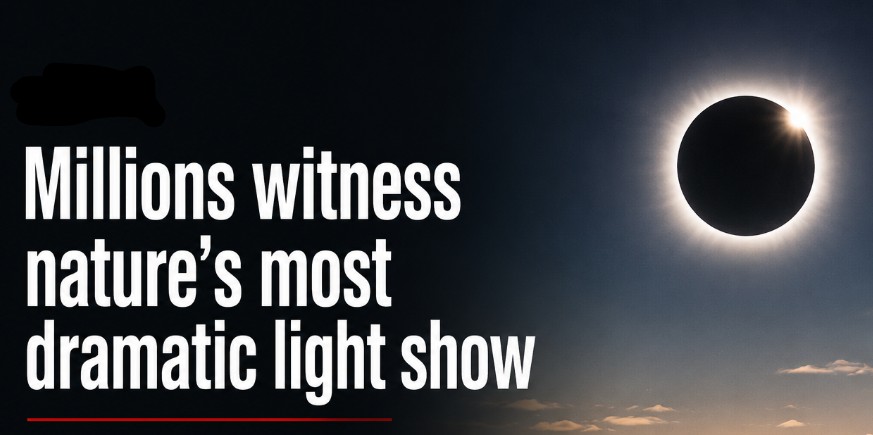

Millions witness nature’s most dramatic light show as the Moon perfectly blocks the Sun across Greenland, Iceland, and Spain
On Wednesday, the sky in the Northern Hemisphere took on a condition that most people encounter only in their dreams or in documentaries: total daytime darkness. The total solar eclipse of 2026, the only eclipse that year, was an astronomical masterpiece that left observers awestruck, humbled, and permanently changed.
The path of totality stretched from Greenland through Iceland and into northern Spain, creating a corridor of total shadow during which day changed into night for a few valuable minutes. For those who were fortunate enough to be in that small region of the Earth’s surface, the experience went beyond simple astronomy; it served as a deep reminder of our universal insignificance and the subtle ways our planet interacts with the heavens.
When the Moon Perfectly Steals the Sun
A total solar eclipse is undoubtedly nature’s most amazing optical illusion because although the Moon is some 400 times smaller than the Sun, it is also about 400 times closer to Earth and, as a result, moves in front of our star with such exact precise accuracy that it completely covers the solar disk and thereby reveals the secrets which are normally hidden by daylight.
What makes the eclipse on Wednesday so special is that it is a rare occurrence. During one year,, there can be several partial or annular eclipses visible somewhere on Earth. Total solar eclipses are uncommon, and it is even rarer to find one that moves over inhabited areas. However, it is like winning the lottery in the astronomical world to find one that goes through several countries.
The eclipse passed through three countries, each offering different viewing conditions and experiences.
Greenland: The Arctic Preview
The eclipse path first made contact with the Earth’s surface in Greenland, where thousands of eclipse observers had gathered to see the event. Against the Arctic landscape, there was a striking setting, ice sheets and glaciers shining beneath the coming darkness, before suddenly falling towards dusk as totality set in.
During the eclipse, the temperature fell, some places registering a drop of 10 to 15 degrees Fahrenheit within a minute. Animals showed strange behavior, the birds went back to their roosting places, as if it had now become night. The corona, the Sun’s outer atmosphere, which is invisible in normal daylight, shone with magical beauty, and the stars appeared in the middle of the day.
People observed intense emotional feelings; those who had witnessed a number of solar eclipses said that this particular one was especially impressive because of the outstanding visibility of the corona and the clear weather, which enabled unprecedented detail to be seen.
Iceland: Where Daylight Dares Not Tread
The most spectacular passage of the eclipse took place over Iceland. Known for its unspoiled natural beauty, including volcanoes, glaciers and geysers, the island country turned into a natural amphitheater for universal theatre.
Icelanders and eclipse chasers from all over the world went to the sites where they had planned to view the event, with a number of them through specialized telescopes and cameras to record the phenomenon. The path of the eclipse passed through some of the most isolated areas of Iceland, which meant that people had to go on expeditions into the wilderness since few people go there.
The period of totality lasted about 3 to 4 minutes, depending on the precise location, seeming as if forever to the people observing the eclipse, yet only a flash in astronomical terms. For that time the daytime sky changed to look rather like twilight, with the stars appearing above. At the same time, Jupiter and Venus became visible even though the corona was blazing around the eclipsed Sun.
Scientists at different locations carried out experiments to measure temperature changes, investigate atmospheric effects, and gather data that will help strengthen our understanding of solar dynamics throughout the years ahead.
Spain: Where Europe Witnessed the Wonder
The eclipse reached northern Spain towards the end of the afternoon, which gave European eclipse enthusiasts the best possible conditions for viewing. Viewings were arranged in Spanish cities, and thousands gathered in public areas, parks, and at the designated observation sites.
The eclipse experience in Spain was especially moving since it passed through inhabited areas, enabling millions to see at least part of the event. People who were within the path of totality saw the complete phenomenon, while those a little outside the path of totality still enjoyed eclipse coverage of 95 percent or more, enough to observe dramatic effects such as shadow bands rippling over the landscape.
Spanish scientists and various international research groups observed the eclipse from several locations, examining how the corona’s structure varies throughout the solar cycle. The data gathered will help in studying solar physics and the Sun’s effect on Earth’s space weather.
What Made This Eclipse Extraordinary
A number of factors made Wednesday’s eclipse exceptional:
The weather was clear over most of the route. Although eclipse weather is notoriously difficult to predict, a number of places had remarkably clear conditions, which was a great advantage for photographers and observers.
The eclipse lasted several minutes within the totality zone, which meant the opportunity to observe it was much greater than during shorter eclipses, and each extra minute of totality brought additional phenomena.
There was a research opportunity because the event occurred when research into the Sun was underway. Various satellites and ground-based observatories kept simultaneous watch of the eclipse, yielding a large amount of information on solar dynamics.
Regarding accessibility, although the path was far away,, it did pass through international territory accessible to determined eclipse chasers, because Iceland’s popularity with tourists had led to existing infrastructure to handle the number of observers.
The natural environment, comprising Arctic ice, volcanic landforms, and striking lighting, made the experience of the eclipse go beyond the astronomical event itself.
The Physics Behind the Poetry
What the observers saw was a demonstration of solar physics. The corona, which is the Sun’s outer atmosphere, stretches millions of miles into space. It becomes visible as a fine, glowing crown around the Sun when a total eclipse occurs, and the Moon blocks the Sun’s bright disk.
The structure of the corona shows the solar electromagnetic fields. In order to understand the solar processes that affect our planet, scientists examine the corona’s brightness, temperature, and structure. Solar flares, coronal mass ejections, and other solar activities all start in the corona. By studying the corona,, we can predict the space weather that affects satellites, energy networks, and communications.
The temperature inversion occurs during totality because the corona is, in fact, hotter than the Sun’s visible surface, a fact that is still not entirely understood. It is possible to acquire insights into this mystery by studying the corona at eclipses.
The visible surface of the Sun, known as the photosphere, shows granulation patterns and sunspots which are usually hidden by the glare. It is only during totality that the fine details can be seen, allowing the study of the Sun’s structure at scales which would otherwise be impossible.
The Human Experience
Apart from the scientific aspect, those who observe eclipses speak of deep psychological and emotional experiences; standing under the darkened Sun, seeing day turn into night within minutes, and witnessing the radiant beauty of the corona have a primal effect on human consciousness.
People say that they have spiritual experiences during a total eclipse. When the Sun, the Moon, and the observer are aligned, a rare occasion occurs wherein the cosmic geometry becomes visibly apparent, serving to remind the spectators of their place in the universe, aware at the same time of their small importance and of the blessing that they have in being able to witness the grandeur of nature.
People who are seeing the eclipse for the first time often say that it has a life-changing effect; the experience of totality, such as the sudden darkening, the fall in temperature, the stars coming out at noon, and the beauty of the corona, leaves them with memories which endure for many decades.
The Photography Challenge
It is notoriously difficult to photograph a solar eclipse. There is a strong contrast between the brightness of the Sun’s outer regions as well as the faint corona. To take the photograph, photographers have to adjust the exposure so as not to overexpose the bright inner layers of the corona or the partial phases as they approach or leave it.
Professional eclipse photographers set up their equipment at strategic locations along the path of totality. Using high-speed cameras, they took detailed pictures of solar features. Time-lapse sequences were used to record the progression of the eclipse, and composite images were produced by combining multiple exposures to show details not visible to the human eye.
The most memorable photographs of eclipses show both technical skill and artistic perception, since they record not only the scientific phenomenon but also the wonder it evokes.
When’s the Next One?
For those who want to see an eclipse, the natural question is: when will the next total solar eclipse occur?
The following total solar eclipse will pass across Australia and New Zealand in July 2028; afterward, an eclipse path will go across Antarctica and part of Australia in 2030. Those who are unable to get to these remote areas will not see a total eclipse in North America until 2044.
It therefore means that Wednesday’s eclipse is likely to be the principal solar event for people in the Northern Hemisphere for many years to come, and those who had traveled there to see it have invested in a memory which won’t soon recur at their latitude.
The Bigger Picture
Since ancient times, eclipses have caused human wonder and have led to scientific discoveries, for example, Einstein’s observation during the 1919 eclipse confirmed the theory of general relativity. They have also encouraged international cooperation, as scientists from dozens of countries have worked together on observations and data analysis.
On Wednesday, the eclipse continued this practice. Even though there were diplomatic strains elsewhere, scientists worked together across national boundaries to study the cosmic event. Peacefully, international eclipse enthusiasts came together to witness something that rose above nationality, politics, or ideology, the wonder of the universe itself.
For millions who saw it, the total solar eclipse of 2026 will stay firmly imprinted in memory; the day on which the Moon took the Sun prisoner, the instant when daylight faded, and the heavens revealed itself in all its splendor, an indication that we inhabit a universe of utterly astonishing beauty, one which anyone who is lucky enough to look up can currently experience.