

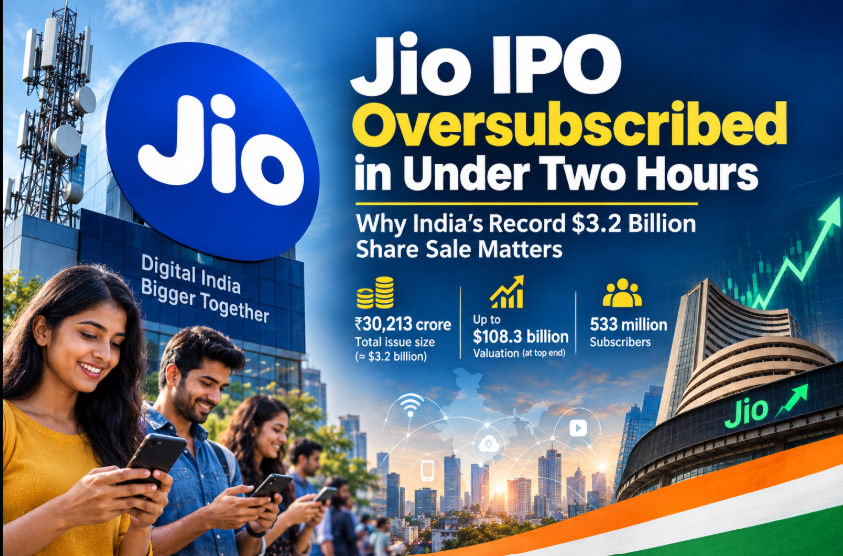

Jio Platforms’ $3.2 billion IPO was fully subscribed within the first two hours, showing the immense demand for India’s largest-ever share offering. This Reliance Industries subsidiary, with more than 500 million telecom subscribers, is aiming for a valuation of up to $108.3 billion. Beyond its record size, the IPO matters because it gives stock market investors direct access to one of the companies that transformed India’s digital economy.
In recent years, India has had a number of blockbuster IPOs, but none has generated such high expectations as J Platforms’ IPO.
The public bidding began on October 21, and the offering was fully subscribed in less than two hours; by early afternoon, investors had placed orders for more than twice the available shares.
The fact that demand is so rapid makes the listing important even in a country which has recently seen a remarkable boom in IPOs.
How Big Is the Jio Platforms IPO?
The Jio Platforms IPO aims to raise approximately ₹30,213 crore, or $3.2 billion, by offering up to 270 million new shares.
The shares will be offered within a price range of ₹1,065 to ₹1,119 per share. If the top end of the range is taken, the IPO gives a value of about $108.3 billion to Jio Platforms.
It makes this India’s biggest ever IPO.
It is also noteworthy that this is Reliance Industries’ first public share offering, controlled by Mukesh Ambani, in about two decades.
Reliance will still hold a majority share in Jio after the listing.
Investors Were Interested Even Before the IPO Opened
Indications of extremely high demand were visible before the normal public bidding started.
As reported by Reuters based on sources familiar with the situation, the anchor book issued by Jio attracted bids amounting to more than $25 billion, with the investors comprising major global institutions such as BlackRock, Fidelity and the Abu Dhabi Investment Authority.
As Business Standard stated, the portion allocated to the anchor investors attracted demand amounting to more than ₹2.5 trillion, which is roughly thirty times the number of shares available to those investors. Finally, Jio allocated a stock value of about ₹8,110 crore to 212 anchor investors.
Strong institutional demand stayed when the public bidding began.
Reuters stated that within the first 10 minutes, institutional investors had offered bids for about 4.9 times the number of shares that had been allocated to them. Retail investor participation developed more slowly at first.
It is worth pointing out that an IPO can as a whole be heavily oversubscribed even if various categories of investors show very different levels of demand.
Why Is Jio So Important to India’s Digital Economy?
Jio didn’t merely become another Indian telecom operator.
The fact that it arrived had a fundamental effect on the way in which Indians use mobile data.
At the time of its commercial launch in 2016, Reliance Jio provided very cheap data and free voice calls, which caused its competitors to lower their prices and thus sped up the adoption of smartphone internet throughout the country.
According to figures cited in its IPO documentation, Jio currently has about 533 million subscribers and handles nearly 60% of India’s mobile data traffic.
It thus makes the company India’s biggest telecom operator and one of the world’s largest mobile networks.
However, Jio Platforms extends beyond telecommunications.
The company has expanded into broadband, digital entertainment, cloud services, enterprise technology, and artificial intelligence, making it a key part of Reliance’s broader digital strategy.
Among its existing strategic investors have been some of the global technology companies such as Meta and Google.
What Will Jio Do With the IPO Money?
The majority of the money raised will not just remain on Jio’s balance sheet.
As Reuters reports, around $2.89 billion of the funds from the IPO will be put towards paying off the debt of Jio’s telecom subsidiary, while the rest of the money will be used for capital expenditure and general corporate purposes.
Since the company is still making heavy investments in telecom networks, broadband, digital infrastructure and AI-related services, reducing its debt can improve its financial position.
Such businesses need huge amounts of capital.
Setting up mobile networks involves buying spectrum, installing towers, laying down fiber lines and then constantly upgrading the technology; additional costs for expanding into cloud computing and AI mean another level of infrastructure spending.
How Profitable Is Jio Platforms?
Jio is not entering the market as a technology company in its early stages who might achieve profits at some point.
Reuters states that the company achieved a revenue of about $15.5 billion and a profit of $3.2 billion for the financial year ending March 2026.
Its profitability has drawn significant interest from large institutional investors.
What investors are in effect being asked to decide is whether or not Jio’s future growth warrants a valuation exceeding $100 billion.
To some extent, the calculation will depend on whether Jio can earn more revenue from each customer rather than simply relying on more subscribers.
Why Does the IPO Matter for Reliance Industries?
Up to now, investors who wished to have a position in Jio had to buy shares in the company’s parent, Reliance Industries.
The IPO changes that.
When Jio Platforms becomes a separately listed company, investors will be able to value and trade the digital business directly.
This could also make it easier for the market to evaluate the various businesses that Reliance has, such as its energy, retail, and digital services.
The listing thus marks a significant stage in the development of the wider Reliance empire.
The IPO Is Also Testing India’s Capital Markets
The market for equity fundraising in India has already shown unusually strong performance in 2026.
A record amount of $25.27 billion was raised by companies in the first half of the current financial year, despite the wider stock market providing only relatively weak returns.
Jio is now checking whether domestic and foreign investors will be able to take in an offering that is much larger than an average Indian IPO.
The early evidence indicates that they can.
The IPO has also affected India’s currency market; the foreign investment associated with it sent the rupee to a six-week high against the US dollar.
Not necessarily.
Oversubscription is the number of shares investors request relative to the number available.
It doesn’t guarantee that the stock will rise following its listing.
People will still have to assess Jio’s valuation, its future growth, the competitive situation, its capital requirements and the regulatory risks; furthermore, the company’s IPO documents point out possible difficulties arising from changing Indian telecom and data-protection regulations.
The IPO will stay open until October 23, and Jio shares are expected to start trading on October 28.
No matter what takes place on listing day, the extraordinary demand has already shown something important.
A company which has been responsible for making mobile internet affordable for hundreds of millions of Indians is currently investigating whether its digital aspirations can be the basis of one of the largest corporate valuations in the country.
Jio transformed the way India connected to the internet, and now its IPO will serve as a test of how highly investors will value future developments.