

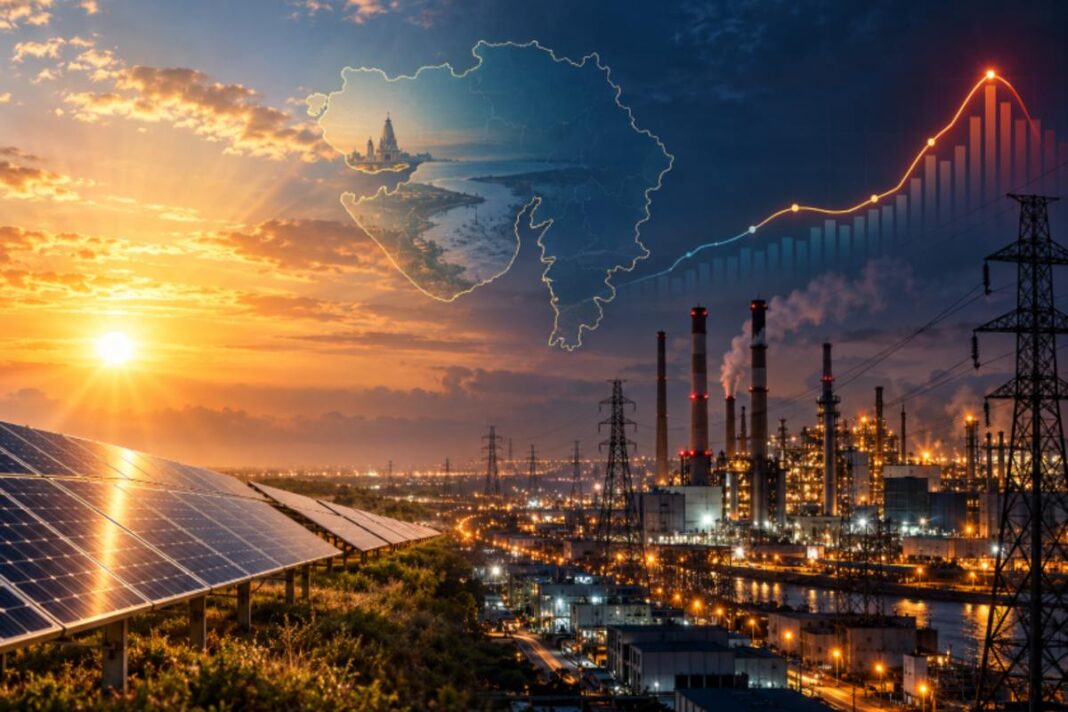

Gujarat is urging factories to voluntarily cut back on their electricity usage during the evening peak times since India is facing a rising demand for power, decreasing coal stocks, and a lack of battery storage. It is being recommended that industries move their production away from 5 p.m. to 11 p.m., when solar power generation drops, though homes, businesses and factories still use large quantities of electricity. This appeal underlines an increasing difficulty for India: although the country is quickly expanding its renewable energy capacity, it remains difficult to store enough of that electricity to use after sunset.
India’s most industrialized states are used to using huge quantities of electricity.
Now Gujarat is asking some of its largest power users to reduce their electricity consumption.
The Uttar Gujarat Vij Company Ltd has urged industries and consumers to conserve electricity from 5 p.m. to 11 p.m., while the state government has encouraged factories to voluntarily shift energy-intensive production outside those hours. Gujarat has also requested the central government for further supplies of both electricity and coal.
The fact is that factories in all of Gujarat are not being told to close down.
Instead, the objective is to lessen pressure on the grid during periods when it is hardest to supply electricity.
Why Is Electricity Demand Rising So Quickly?
Several problems have occurred at the same time.
India has seen hotter-than-normal conditions because of El Niño, which has increased demand for cooling. Demand for electricity for agricultural purposes has risen as farmers use more power for irrigation, and at the same time strong industrial activity is adding another layer of demand.
The increase is considerable.
Government data quoted by Reuters shows that daily peak electricity demand has recently been 45 to 50 gigawatts higher than the previous year’s figure. To put this in perspective, 50 GW equals the combined output of many major power stations.
The Central Electricity Authority of India has already forecast a substantial long-term increase in electricity consumption; its planning figures show national peak demand will be about 345 GW by 2029–30, up from the record peak of 250 GW in FY2024–25.
India therefore has no need merely for more electricity.
Electricity must be available at the right time.
Why Are Evenings the Biggest Problem?
It is here that India’s success in the field of renewable energy presents a new engineering challenge.
Solar farms are able to produce large amounts of electricity at a relatively low cost during the day. However, output drops quickly as the sun sets, exactly when millions of people are coming home, turning on their air conditioners, lights and appliances, while factories and commercial buildings are still operating.
The best approach would be to store the excess solar electricity generated in the afternoon in large batteries and then use it in the evening.
India still lacks sufficient battery storage capacity to do this at the required scale.
According to Reuters, the lack of storage is forcing the grid to rely more on coal-powered generation when demand is high in the evenings and at night.
It is sometimes called the “evening ramp” problem because solar power production drops rapidly while demand remains high, requiring conventional power stations or stored electricity to cover the gap.
Coal Supplies Are Also Under Pressure
Coal is still important to India’s electricity system, especially after sunset.
The amount of coal at the power stations has decreased.
On October 19th, the number of India’s 191 coal-fired power stations running on critically low stocks rose to 96, up from 60 in mid-September. The total coal reserves at the power stations had dropped by about 5 per cent since the beginning of October.
It is exactly when demand is rising that the grid has less flexibility.
Coal-fired power generation increased by 13.3% compared to the previous year, which indicates that the thermal power stations had already had to work harder to meet demand. However, the extra output was still not sufficient to put an end to the shortages.
In September, the shortfall in India’s electricity supply reached 560 million kilowatt-hours, the largest gap between demand and supply since August 2023.
Weak Hydropower Has Made the Situation Harder
Hydropower usually provides an additional flexible source of electricity which can quickly respond when demand increases.
The hydroelectric production has been reduced because of weaker rainfall linked with El Niño.
The government’s data shows that hydropower generation decreased by about 20% compared to the previous year in September.
That is important since hydropower can usually be increased faster than coal power during times of peak demand.
In October earlier on, about 41 GW of generating capacity was also out of action due to maintenance and other reasons, which in turn made the supply during the night even more limited.
A number of states, such as Gujarat, Rajasthan, Maharashtra, Tamil Nadu, Andhra Pradesh, West Bengal, Uttar Pradesh and so on, have already asked for extra electricity allocations in order to prevent outages.
The fact that Gujarat is asking the factories about it is part of a more general national problem.
Why Gujarat Matters So Much
Gujarat is one of India’s most important centres for manufacturing, covering a wide range of industries such as chemicals and pharmaceuticals, engineering, textiles, automobiles and refining.
The result of electricity shortages is that they can have repercussions which go beyond mere inconvenience to households.
If it is necessary for factories to cut back on production or alter their working hours, then the supply chains, the production schedules and the industrial costs can all be impacted.
The government is therefore attempting to control demand until such time as more disruptive measures are needed.
The state of Gujarat also intends to add capacity for coal, nuclear power and battery storage in order to meet future requirements.
Is Renewable Energy the Problem?
No.
The problem isn’t that India has an excessive amount of solar power; it is that the electricity system still requires additional infrastructure if the renewable energy is to be transmitted both over time and across different geographical areas.
A solar panel which is generating electricity at 2 p.m. will not be able to assist in meeting the demand at 9 p.m. unless the energy it produces can be stored.
All large battery systems, pumped-storage hydropower, stronger transmission networks and flexible generation can contribute to filling that gap.
The Indian Ministry of Power has already been encouraging developers in the renewable energy sector to speed up the integration of battery storage so that the excess solar electricity generated during the day can be used after sunset.
India’s Power Challenge Is Changing
For many years the problem concerning India’s electricity has been one of generating sufficient power.
The problem is growing more complicated.
The country now possesses a great deal of solar and wind power potential, but electricity consumption is rising quickly because of industrialisation, the use of air-conditioning, irrigation, the development of digital infrastructure and the fact that household incomes are increasing.
The following stage in India’s energy transition will therefore be determined not merely by the number of solar panels, wind turbines or power plants that it constructs.
It will come down to whether the country is able to store the electricity and transmit and deliver it exactly when consumers need it most.
The idea of Gujarat requesting factories to move their production away from the evening hours is merely a simple short-term measure.
But it also exposes the much larger question India’s power system must solve:
How do you keep the lights on after the sun goes down?