

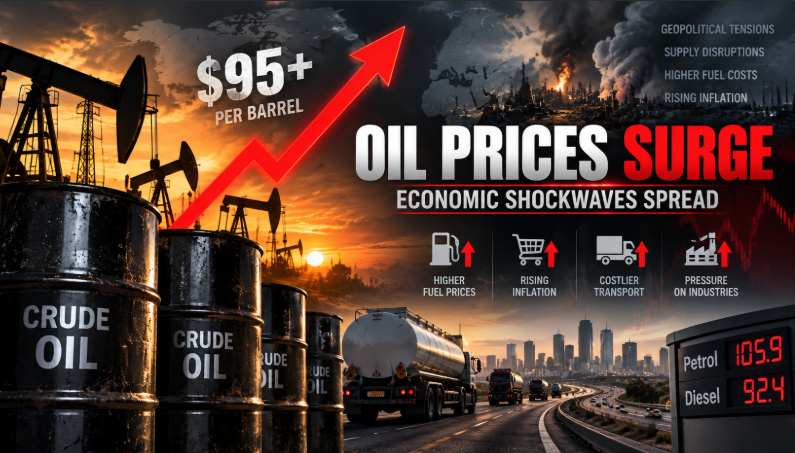

Crude exceeds $95 per barrel amid geostrategic tensions, inflation pressure mounts as transport and energy costs spike across sectors
The global oil market is facing serious disruption, with crude oil prices rising above $95 a barrel this week for the first time in 18 months, driven by geopolitical tensions, supply disruptions, and the growing conflicts in the Middle East, which threaten the world’s energy infrastructure.
The rise in prices has a series of economic effects. Increases in crude oil prices lead directly to higher consumer costs through more expensive fuel, higher electricity generation costs, and elevated transportation costs across supply chains, ultimately resulting in inflationary impacts on both household budgets and corporate profits.
India’s Energy Cost Vulnerability
India is under severe pressure from high energy costs. Since 84% of its petroleum needs are met through imports, the country is highly susceptible to changes in global oil prices, when the price of oil rises to $95 per barrel from the baseline of $70 per barrel, the annual import bill increases by about ₹15,000 crore.
The course of inflation is under threat, as rising oil prices contribute to inflation through higher petrol and diesel costs, elevated transportation costs that reduce supply chain efficiency, and higher energy-intensive industrial production costs, possibly causing inflation to exceed the RBI’s 4 percent medium-term target.
Financial analysts have warned that if the price of oil reaches $95 or more, headline inflation could rise by 0.5 to 0.8 percentage points, thus making it more difficult for the RBI to decide on its monetary policy since inflation would be rising even though growth rates were slowing down, this scenario amounting to one similar to stagflation.
Inflation Pressures Across Economy
Consumer prices are rising quickly. Within 48 hours of crude oil prices rising, petrol prices went up by ₹4 per liter and diesel prices by ₹3.50 per liter, with further increases expected should the price trend continue, this will impact the transportation costs of commuters, commercial logistics, and agricultural operations.
The airline sector is especially susceptible. Since aviation fuel accounts for 30 to 35 percent of airlines’ operating costs, rises in oil prices have a direct effect on ticket prices, with airlines already announcing wholesale price increases of 5 to 8 percent for both domestic and international routes.
The tourism and hospitality industries are experiencing revenue difficulties as rising ticket prices have lowered demand for leisure travel, while higher operating costs from rising energy and fuel prices are squeezing profit margins across accommodation and dining services.
Manufacturing Sector Challenges
There has been an increase in production costs. Industries based on energy-intensive processes are now under immediate cost pressure, sectors that produce petrochemicals, fertilizers, cement, and steel are seeing their margins squeezed as energy prices rise, and they have little ability to pass these increases on. on
Manufacturers in India who are already competing on an international scale now face further challenges to their competitiveness, as the depreciation of the rupee, together with rising energy costs, is reducing their operating margins, this, in turn, threatens the profitability of the export sector.
Transportation and Logistics Impacts
The cost of moving goods rises. Road transport operators are facing rising fuel costs, leading to an 8 to 12 percent increase in logistics expenses, and the industry warns that supply chain delays will result as high fuel costs cause unprofitable routes to cut back on capacity.
The margins of e-commerce companies and those involved in last-mile delivery are being squeezed as rising transport costs cannot be passed on to price-sensitive consumers, this could, in turn, affect service expansion and profitability.
Agricultural Sector Vulnerability
Farm activities are affected. Rising costs for agricultural machinery operations, pesticide production, and fertilizer manufacturing put farm profitability at risk, especially for small farmers with limited ability to absorb costs, thus possibly leading to greater monetary strain in rural areas.
Fears of rising food prices are growing, as higher costs for agricultural inputs, together with disruptions to supply chains, could reduce food production and lead to higher prices, thus adding to the pressure on household budgets from overall inflation.
Currency Depreciation Connection
The rupee is under pressure. Rising oil prices are causing capital to leave emerging markets such as India, leading to depreciation of the rupee and worsening inflation concerns, as import costs rise due to both higher commodity prices and currency depreciation.
The depreciation of the rupee raises the cost of imports for all kinds of goods, not just oil, thereby causing inflation in import costs across the economy and influencing the prices of items such as consumer electronics and industrial equipment.
Government Fiscal Impact
Pressure on the budget appears. As the price of crude oil rises, government fuel subsidies increase sharply, putting pressure on fiscal deficit targets and possibly requiring budget reallocation, including cuts to social spending or infrastructure investment.
An increase in the amount paid for oil imports directly affects the current account deficit and could necessitate external financing if oil prices remain high, making it more difficult to manage the balance of payments.
Stock Market Feedback
The equity markets were volatile, with the Indian stock indices showing daily volatility of 2 to 3 percent as changes in crude oil prices shifted investment focus between companies that guard against inflation and those vulnerable to margin compression, which in turn led to uncertainty among investors about the direction of valuations.
Because of rising prices, oil and energy stocks gained, while consumer discretionary and technology stocks came under selling pressure, reflecting market worries about inflation and reduced consumer spending.
Monetary Policy Implications
The RBI is facing a policy dilemma since inflation caused by oil makes it difficult to carry out its strategy of raising interest rates, raising rates too sharply could risk bringing growth to a standstill, while not tightening rates enough will fail to tackle inflation, meaning that a carefully calibrated response is needed in order to equalize these opposing aims.
As the outlook for oil prices remains uncertain, forward guidance becomes more uncertain as well, prompting market participants to be cautious about their long-term investment decisions until there is greater clarity on the resolution of the geopolitical situation and the stability of oil supply.
Global Supply Chain Disruption
International trade is affected by rising oil prices, which increase shipping costs and have consequences for the economics of global supply chains and trade patterns, especially for countries such as India, which relies on maritime trade to move goods.
Consumer Impact and Purchasing Power
Household budgets are under pressure. On average, households face monthly budgetary difficulties of ₹500 to ₹1,500 due to rising fuel costs, and as a result, spending on entertainment, dining, and other non-essential items is likely to fall, thereby affecting consumption-driven economic growth.
Households with lower incomes suffer a greater impact because energy costs make up a larger share of their budgets, potentially threatening the livelihood security of daily-wage workers who rely on personal transportation.
Duration and Resolution Uncertainty
It is not clear what the price will be. Different analysts have very wide-ranging forecasts about whether oil prices can be sustained, with scenarios ranging from short-term spikes to $95-$100 to sustained levels of $90 or above, the outcome depending on how the geopolitical situation resolves and the timing of supply normalization.
If oil prices remain high, economic policymakers expect to face inflation and growth problems over two to four quarters and will therefore need to adopt counter-cyclical policy measures, such as providing consumption stimulus or managing supply-side inflation.
Oil price escalation amounts to a significant economic headwind. Without geopolitical de-escalation or OPEC production increases, elevated oil prices will persist, creating sustained inflationary strains, growth dampening, and policy complications that will affect India’s economic path through the remainder of 2026.