

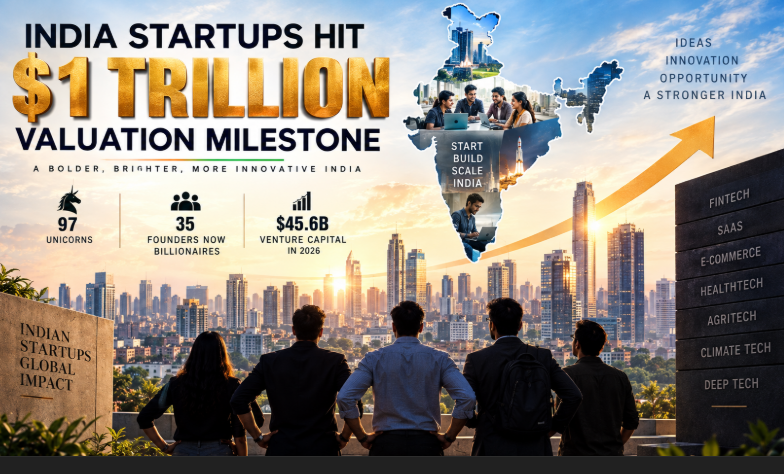

Collective unicorn ecosystem surpasses historic benchmark, 35 founders join billionaire ranks as innovation economy matures
The Indian startup ecosystem has achieved a historic milestone since, for the first time, its total value has gone beyond $1 trillion, owing to the existence of 97 unicorn companies (companies valued at one billion dollars), and the total wealth of entrepreneurs in the private sector is now more than ₹50 lakh crore, which means that India has become the third biggest startup ecosystem in the world, after the United States and China.
This achievement is the outcome of ten years of evolution; the startup ecosystem in India was once struggling but has since grown into a dynamic innovation economy and in 2026 attracted $45.6 billion in venture capital investment, which indicates that institutions have confidence in both the entrepreneurial capabilities and the market potential of India.
Unicorn Concentration and Distribution
Bangalore is at the forefront in the production of unicorns, having 32, followed by Mumbai with 24, then Delhi with 18 and Gurugram with 12; fintech, software-as-a-service (SaaS) and e-commerce make up 65% of the total unicorn valuations, indicating that the market is concentrated among technology-oriented sectors.
The ecosystem becomes vulnerable as a result of sectoral concentration, since a setback in the fintech sector or a correction in the SaaS market could have a significant effect on the overall valuation, this demonstrates the need to diversify into the healthcare, agritech, and climate tech sectors.
Founder Wealth and Billionaire Emergence
As a result of entrepreneurship, a huge amount of wealth has been created, because the valuations of unicorn companies have caused 35 Indian founders to reach billionaire status, their total founder wealth amounting to more than ₹10 lakh crore and thus enabling individual entrepreneurs to become wealth creators on a national scale comparable to traditional industrialists.
The wealth held by technology entrepreneurs is shifting the landscape of business leadership in India, with companies run by their founders now competing with well-established family business conglomerates for economic power and access to policy.
Venture Capital Maturation
The process of professionalization in the investment sector: there were over 250 venture capital funds active in India, with assets under management totaling $80 billion, thereby establishing institutional sources of capital that enable continuous funding of innovation without depending on foreign investors.
The venture capital arms of well-established companies are nowadays giving funding to startups, which in turn sets up channels for the transfer of knowledge through which the startups’ innovations are adopted into the companies’ operations and as a result leads to synergies between traditional and technology-based business models.
Exit and Liquidity Events
The number of public market debuts rose. In 2026, Indian startups raised $12.3 billion via IPOs, with 18 unicorn companies listing on domestic stock exchanges, which in turn gave earlier investors the opportunity to realize liquidity and enabled founders and employees to realize their wealth.
Interest in acquisitions rose, with established companies carrying out mergers and acquisitions worth $18.7 billion of startups, mostly to acquire their technology, talent, or access to new markets, thus creating other ways of exiting the business than an IPO.
Employment Generation and Talent Creation
Job creation is increasing at a faster rate. Unicorn companies have hired more than 450,000 professionals, and the startup ecosystem is believed to offer 1.5 million jobs through direct employment, via its supplier networks and related service industries, bringing the total to 2% of the Indian workforce engaged in the startup environment.
Since high-paying jobs in the technology industry attract capable professionals, there is a competitive bidding for engineering talent, which causes traditional employers to raise their compensation offers, leading to an increase in wages across the entire technology sector.
Geographic Expansion Beyond Metros
Startups are currently being established in second-tier cities such as Pune, Hyderabad, and Kolkata, with some achieving valuations exceeding $100 million, this indicates that the necessary ecosystem has matured and can now enable entrepreneurship to extend beyond the usual metropolitan areas.
The measures taken by the government to support startup hubs in smaller cities accelerated geographic diversification, reduced the risk of concentration, and enabled entrepreneurship to emerge in regions that had previously been dependent on traditional industries.
Sectoral Diversification Momentum
Innovation in areas other than fintech is increasing, as evidenced by rising activity among startups in the healthcare, agriculture-tech, and climate-tech sectors. Healthcare-tech raised $4.2 billion in 2026, and agri-tech secured $1.8 billion, showing that the focus is now extending beyond fintech.
Venture capital showed interest in deep-tech startups in semiconductors, space technology, and autonomous cars, but because these companies required longer development cycles and more capital, the risk-reward profiles differed from those of software-oriented startups.
International Market Growth
The ambitions on a global scale have now been achieved; an increasing number of Indian SaaS companies are targeting international markets and have earned $3.2 billion in foreign revenue, thus establishing India as a major exporter of technology services and allowing it to compete with firms from the United States and Europe on a global level.
Now multinational venture capital firms are investing increasing amounts in Indian startups, as they see high-quality talent, cost advantages, and market opportunities that enable these companies to grow on an international scale while still keeping their head offices in India.
Government Policy Support
Improving the regulatory framework: the government has introduced start-up-friendly policies such as tax incentives for start-up investments, simplified regulatory compliance requirements, and a preference in government procurement, all aimed at supporting the development of the ecosystem.
There are still regulatory shortcomings in areas such as data privacy, cryptocurrency regulation, and restrictions on foreign investment, leading to ongoing policy problems that must be addressed if the ecosystem is to achieve growth.
Investor Confidence and Market Attitude
The amount of capital available is great. Investments from venture capital have reached record levels, with seed-stage financing readily available and later-stage funding competitive, this shows investors’ confidence in the Indian startup market, even though there are sometimes concerns about a correction.
Institutional investors, including sovereign wealth funds, insurance companies, and pension funds, increased startup allocations, establishing patient capital sources enabling long-term innovation investment.
Challenges and Market Corrections
Concerns regarding profitability remain. Since many of the unicorns are currently operating at a loss, with a focus on advancement rather than profitability, questions have been raised about whether their business models can be sustained and whether their long-term valuations will remain viable if the schedule for profitability is extended indefinitely.
Market corrections took place in certain sectors, such as ed-tech and food delivery, with valuations dropping by 40 to 60 per cent since the growth stories had not been proven, this serving as a warning that not all unicorns end up achieving ultimate value creation.
Ecosystem Support Infrastructure
Supporting services develop and become more sophisticated; specialist law firms, accounting firms, recruitment agencies, and operational consulting firms are established to provide start-up support by creating the necessary infrastructure, allowing founders to focus on innovation and outsource operational complexities.
There were a great many business incubators and accelerators, more than 450 of them actively operating and providing guidance to entrepreneurs and helping them make contact with investors, thus establishing institutional mechanisms for the transfer of knowledge that aid entrepreneurial success.
Global Recognition and Soft Power
The international reputation has been improved. The start-up ecosystem in India has gained global recognition, drawing attention from international media and establishing India as a center of innovation, thus boosting its soft power and increasing the international credibility of its technology sector.
Female Entrepreneurship Rising
The number of different genders is on the rise. The proportion of women who start companies has risen from 8% to 18% over the past five years, although a large gap still exists relative to international standards, this does represent progress in the democratization of entrepreneurship.
Looking Forward: Trillion-Dollar Implications
The fact that India has reached a startup valuation of one trillion dollars is a sign of economic transformation. If the ecosystem is to continue to mature, it will need to deal with a number of challenges, such as pressure relating to profitability, market saturation in certain sectors, changes in regulation, and competition for talent, all of these factors will decide whether or not India is able to keep its position as a global leader in start-ups as the ecosystem develops