

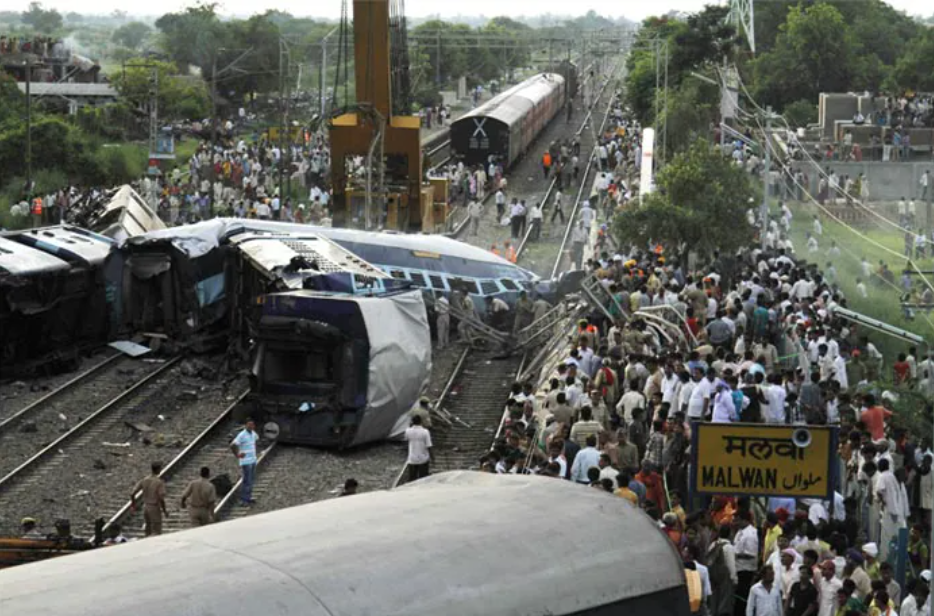

Derailed passenger train near Fatehpur sparks urgent inquiry into signaling and maintenance failures
Railway workers started to clear up the wreckage of a passenger train that had derailed in northern India following the conclusion of a rescue mission which resulted in 68 bodies being found. The Kalka Mail derailed near Fatehpur, about 50 miles southwest of Kanpur in the state of Uttar Pradesh, and officials are describing it as one of the most severe railway accidents in recent years.
The tragedy developed with terrible speed. On Sunday evening the passenger train derailed suddenly, causing the carriages to go off the tracks and leading to a state of confusion and destruction. By Monday 68 bodies had been recovered by the rescue teams from the bent wreckage, the total number making this one of India’s most deadly rail accidents in the last twenty years.
At least 239 passengers were injured as the Kalka Mail jumped the tracks, a large number of them suffering serious trauma due to the violent derailment. Relatives who were grieved overwhelmed the main hospital run by the government in Fatehpur, looking for their family members among the injured and the dead.
Rescue Operations Complete
The rescue workers searched all night long for any victims or survivors in the badly bent coaches, and on Monday many worried relatives, coming to look for their missing family members, gathered at the spot where the crash took place, there being rows of bodies covered with white shrouds on the ground beside the train.
The emotional suffering experienced by the survivors and their families was just as severe as the physical damage. Passengers gave accounts of the frightening moments of the derailment.
The 20-year-old passenger Subajit Ghosh described the moment when the collision occurred: “I was listening to music from my upper berth when there was a loud bang and then a thud; I was thrown from my seat and struck my head against the side of the coach.”
Primary reports show how suddenly the disaster occurred. There had been no warning and no opportunity to prepare for the impact, only a sudden catastrophe.
Railway Board Investigation Launched
The Railway Board has at once started a thorough inquiry into what caused the derailment; initial reports point to possible signaling failures or problems with track maintenance.
Before now, railway accidents have been attributed to human error or the use of obsolete signalling equipment. This inquiry will look into whether the same factors played a role in this tragedy.
The investigators will look into a number of possible causes, such as failures of the signalling system, insufficient track maintenance, speeding, adverse weather conditions, or mechanical defects. It will be the results of the investigation that decide who is to be held accountable and will also help in the establishment of future safety measures.
Safety Concerns Escalate
The accident is once again bringing up significant questions regarding the safety of India’s railways. Since the system has to serve over one billion people, many of whom have no other way of travelling long distances, this is a major consideration. Certain of the lines are old and originated during the British Empire era, and the passenger trains are often severely overcrowded.
As reported by Indian Railways, the amount of money allocated for track renewal projects fell from 9607.65 crore in 2018-2019 to 7417 crore in 2019-2020, and the funds allocated were not fully used. Of the 1127 derailments that took place between 2017 and 2021, 289 (26 per cent) were connected to track renewals.
The fact that this budget limitation reveals a fundamental weakness is that aging infrastructure, along with inadequate maintenance funding and postponed upgrades, results in hazardous conditions.
Government Response and Compensation
The Prime Minister, Narendra Modi, stated that severe penalties would be imposed on those who were responsible; the families of the deceased will be given one million rupees (£12,000), those who have suffered serious injuries will receive 200,000 rupees (£2,400), and people with minor injuries will get 50,000 rupees (£607).
Looking Ahead
When the rescue work had ended and the recovery operations started, the Railway Board was under increasing pressure to introduce thorough safety improvements before such tragedies happened again. The 68 deaths do not simply constitute statistics; they signify a great loss that calls for systemic change.