

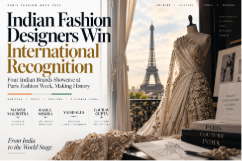

Manish Malhotra, Rahul Mishra, Vaishali S, and Gaurav Gupta redefine global luxury as Indian craftsmanship claims its place on the world’s most prestigious fashion stage
The Paris Haute Couture Week, held from July 6 to 9, 2026, was a major achievement for the Indian fashion industry; for the first time in history four Indian designers appeared together on the official calendar, not as visitors or as collaborators, but as couture houses presenting their collections on the most exclusive stage of fashion in their own right.
India is no longer just producing high-end fashion in the background; it is now displaying its fashion on the runway, occupying the highly desirable front row, and exerting an influence on global luxury debates like never before.
This achievement goes well beyond simply appearing in fashion magazines; it represents international recognition of traditional Indian crafts, such as zardozi, dabka, chikankari, and hand embroidery, practices that Indian artisans have perfected over many centuries, yet have rarely received international recognition.
Breaking the Ceiling: Four Indian Designers
In July, four Indian designers, including Manish Malhotra, who was referred to on July 8, together with Vaishali S, Rahul Mishra and Gaurav Gupta, showed their designs at one of the most important stages in the fashion world, moving from a position of having been on the periphery of the conversation to one of becoming an integral part of its institutional structure.
Each designer brought distinct vision and heritage to Paris’s most prestigious fashion calendar.
Manish Malhotra’s Couture Debut
Manish Malhotra made his historic debut in Paris for High Couture with the ‘Maa’ collection, which was dedicated to his mother, whom he had tragically lost earlier in 2026.
On July 8th Manish Malhotra made his debut on the runway at Couture Week with his Maa collection, which was dedicated to his mother, someone to whom he sadly lost this year.
The collection, alongside its outstanding craftsmanship, had deep emotional value, since it was already well known for having dressed Kim Kardashian and Ivanka Trump at the Anant Ambani-Radhika Merchant wedding; Malhotra’s appearance in Paris established him as a global luxury designer.
Manish Malhotra, who is a well-known fashion and costume designer in India, made his first appearance on the couture schedule this season and his designs have attracted international attention, especially following his work on outfits for Kim Kardashian and Ivanka Trump at the wedding of Anant Ambani and Radhika Merchant in 2026.
Rahul Mishra’s Temple Inspiration
Rahul Mishra, who made himself the first Indian designer to present a collection on the Paris Haute Couture runway in 2020, is back with “Devi: The Eternal Muse”, the collection being inspired by 2,000-year-old temple sculptures.
The fashion designer and couturier Rahul Mishra, who is based in New Delhi, brought back to Paris his collection called Devi: The Eternal Muse, the design having been inspired by temple sculpture from 2,000 years ago. The models were airbrushed to resemble sculptures and decorated with beads and crystals, thus bringing out the intricate craftsmanship that has always been a characteristic of Indian design.
Mishra is well known outside the world of fashion. The fact that he was included in the official Haute Couture Week lineup has led to him attracting considerable attention, especially since Zendaya wore one of his designs at the launch of the Nita Mukesh Ambani Cultural Center in 2026. His work has also drawn the attention of prominent celebrities, with Cardi B being one of his most enthusiastic supporters.
Vaishali S’s Revolutionary Cording Technique
Vaishali S, who made herself the first Indian woman designer to debut at Paris Haute Couture in 2021, is back with “Swayam”, a collection of 30 pieces made using handloom techniques and featuring her own cording method.
The Indian designer Vashali Shadangule, who went by Vaishali S, made her debut at Paris Haute Couture Week in 2021 as the first Indian woman to do so and has since returned to the event. Her most recent 2026 collection, named Swayam, consisted of thirty pieces made on handlooms; the title means “of one’s own accord” and the collection was created for a woman who dresses entirely for herself, giving up heavy use of crystals in favour of smooth, self-forming shapes that appeared to grow organically from the body.
What makes Shadangule so brilliant is her special method of cording, which involves shaping thousands of thin textile cords into three-dimensional, woven relief sculptures. Instead of serving as a decorative element, these cords form the garment’s structure and gradually reveal the collection’s main concept, blooming. By working with weavers in seven states, the collection has turned traditional Indian textile techniques into modern haute couture.
From Behind-the-Scenes to Center Stage
The Indian fashion success in Paris was not achieved overnight. Designers from India had not suddenly arrived at Paris Couture Week; instead, the way was laid decades earlier when Indian embroidery was used in European luxury fashion lines, artisanal methods were incorporated by the major international fashion houses, and native design elements, from the Kolhapuri chappal to refined hand embroidery, drew worldwide attention.
Indian ateliers had, previously to the appearance of Indian designers on the Paris couture calendar, been producing elaborate embroidery and handwoven patterns for leading European luxury brands like Chanel and Dior; the change at present is that Indian designers are now being acknowledged not only as artisans but also as creative authors.
The Economics of Handcraft
The way people around the world now see artisanal production has changed. Since more consumers of high-end couture have begun to prefer handmade, limited-production items over mass-produced fashion, India’s artisanal system has become a competitive advantage.
As sustainability and genuineness become markers of luxury, Indian craft traditions fit perfectly with global luxury values.
Cultural Validation
The fact that Indian designers are taking part in Paris Haute Couture goes beyond fashion metrics and signifies cultural validation.
To be included in the official couture calendar is regarded as one of the top honours in the fashion industry; for this, the Fédération de la Haute Couture and the French Ministry of Industry establish strict criteria, and only those designers who satisfy the rigorous standards in the fields of handcraft, atelier size, and technical skill are eligible.
Isha Ambani pointed out the importance of these designers presenting their work in Paris, saying that “Indian craftsmanship has been working to the couture standard for centuries, long before the modern European concept of couture came into being.”
Looking Forward
The fact that Indian fashion has achieved success in Paris denotes a turning point. India is no longer merely a follower of fashion trends but has become a creative force that is transforming global luxury standards through its heritage, authenticity, and outstanding craftsmanship.
The 1990s were European couture. The 2020s belong to Indian artisans, who are winning back their rightful place as the world’s greatest luxury craftspeople.