

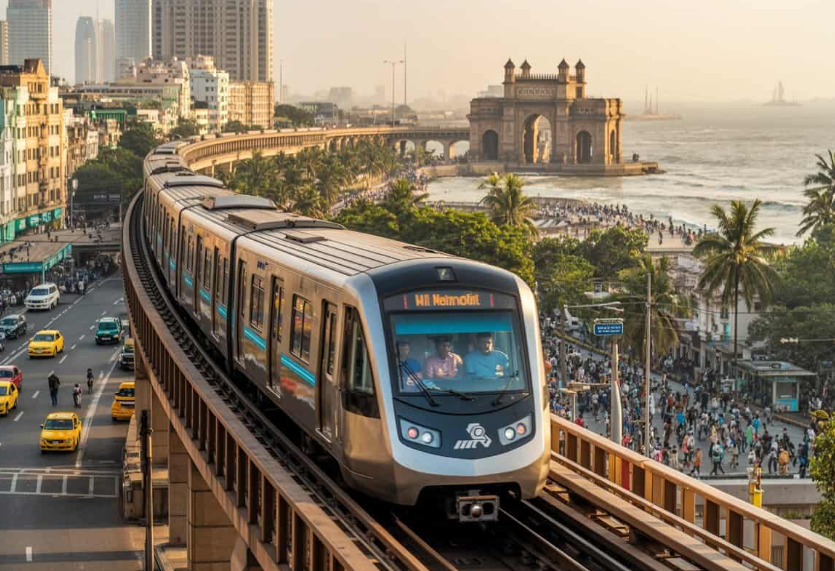

Mumbai’s Metro Line 7A, designed to provide a crucial Metro connection to Chhatrapati Shivaji Maharaj International Airport, has run into a major technical hurdle after aviation height restrictions raised concerns over nearly one kilometre of elevated infrastructure. If authorities cannot find a technical solution, completed work worth around ₹250 crore could potentially have to be modified or reconstructed.
Mumbai’s ambitious Metro expansion has encountered an expensive complication, with a section of the upcoming Metro Line 7A facing possible reconstruction because of height restrictions around Chhatrapati Shivaji Maharaj International Airport (CSMIA). The issue involves the elevated section of the corridor in Vile Parle East, including infrastructure near Airport Colony. The additional height needed for the Metro’s overhead electrification equipment, or OHE, conflicts with aviation height clearances applicable around the airport.
The Mumbai Metropolitan Region Development Authority (MMRDA) is currently pursuing the matter with the Airports Authority of India (AAI), and no final decision to demolish the infrastructure has been taken. AAI’s final technical assessment will therefore be critical in determining whether the existing structures can remain or require modifications.
What Is the Problem With Metro Line 7A?
Metro Line 7A is an extension of Mumbai Metro Line 7 towards the international airport. It will include an elevated Airport Colony station and an underground station at the airport, according to MMRDA’s official project information.
The problem has emerged in the elevated portion of the corridor that passes through an airport-controlled height-restriction zone. Infrastructure around airports is subject to strict height regulations because structures can potentially interfere with aircraft approach and departure paths.
According to The Indian Express, the Metro’s overhead electrical equipment requires additional height beyond the clearance permitted by AAI, creating a mismatch of roughly 2.5 metres in the affected section. The issue is particularly significant because much of the physical infrastructure has already been built.
Nearly 1 Km of Metro Infrastructure Could Be Affected
The affected elevated stretch is approximately one kilometre long and is located in Vile Parle East. By February 2026, MMRDA’s own project updates showed that major elements of the elevated viaduct, including piles, piers, pier caps, U-girders and deck slabs, had been completed.
The Indian Express reported that the entire elevated viaduct was complete by February, while approximately 95% of the elevated ramp had also been constructed. Work on Airport Colony station was substantially complete. That means the clearance problem is not simply a design issue on paper. It affects infrastructure where substantial public money and construction work have already been invested.
Is ₹250 Crore Already Lost?
No. This is an important distinction in reports surrounding the controversy. The widely reported ₹250 crore figure represents a potential financial impact if the existing infrastructure has to be demolished, modified or reconstructed. It is not a confirmed ₹250 crore loss that has already occurred.
Hindustan Times reported that MMRDA could face an additional cost of approximately ₹250 crore if AAI rejects the requested height relaxation and parts of the Airport Colony infrastructure and installed systems have to be reconstructed.
Other reports put the value of civil works potentially at risk at more than ₹260 crore. Therefore, describing the development as a potential ₹250 crore setback is more accurate than saying ₹250 crore has already been lost.
Overhead Electrical Equipment at Centre of Dispute
The controversy largely revolves around the Metro’s overhead electrification system. OHE infrastructure supplies electricity to Metro trains and requires poles and electrical equipment above the track. MMRDA Director, Metro Project, Basavaraj M B said the project’s general consultant was responsible for coordinating design and statutory requirements, including aviation-related height restrictions. According to MMRDA, the additional height required for OHE was not adequately highlighted and incorporated at the appropriate stage of planning.
The situation is also somewhat more nuanced than suggestions that the entire Airport Colony station itself violates the permissible height. According to a more recent account of MMRDA’s position, Airport Colony station is within the approved height limit, while the ramp needs approximately 2.4 metres of additional height for OHE poles. Other points along the elevated alignment reportedly require additional clearance ranging from 0.025 metres to 2.244 metres.
How Did the Problem Emerge?
The clearance issue appears to have developed over several stages. Hindustan Times reported that MMRDA sought AAI clearance for Airport Colony station and the ramp in November 2023. AAI granted clearance on January 2, 2024, but the permitted height was reportedly 2.9 metres below the project’s design requirement.
MMRDA subsequently sought another clearance for the viaduct between Airport Colony station and the ramp. AAI issued another No Objection Certificate in March 2024 containing height restrictions that were again below what was required for Metro operations, according to Hindustan Times.
MMRDA has since been pursuing additional clearance with AAI and other aviation authorities. The authority says it is awaiting AAI’s final technical report before determining what modifications, if any, will be required.
Who Is Responsible?
MMRDA has publicly pointed towards the project’s external general consultant. The consultant consortium comprises SYSTRA, CEG and SMCIPL. MMRDA says the consultant was responsible for coordinating design requirements with statutory restrictions and did not adequately account for the additional height required by the OHE system.
However, responsibility remains disputed. The Indian Express reported that SYSTRA maintains that it was not responsible for the error. It would therefore be premature to describe responsibility for the problem as conclusively established until the technical and contractual questions are resolved.
Why Can’t the Metro Simply Be Lowered?
Changing the height of an almost-completed Metro viaduct is considerably more complicated than lowering an ordinary structure. Metro systems have strict engineering requirements governing track gradients. This becomes particularly important on Line 7A because trains transition between elevated and underground sections.
Hindustan Times reported that MMRDA has argued that changing the Metro’s height creates engineering difficulties in maintaining the required ramp gradient. If AAI does not approve the additional clearance, engineers may consequently have to identify another design solution or reconstruct parts of the affected alignment.
Demolition Is Possible, But Not Yet Decided
Some reports have generated attention by suggesting that nearly one kilometre of the Metro viaduct could be demolished. That is a possibility, but demolition has not been confirmed. An MMRDA official told The Indian Express that the viaduct may have to be reconstructed if authorities fail to find a technical solution.
MMRDA has also said that after receiving AAI’s final report, it will conduct a comprehensive technical assessment before deciding its next course of action. The outcome could therefore range from additional clearance or engineering modifications to partial reconstruction.
Why Metro Line 7A Matters
Despite its relatively short length, Metro Line 7A is an important part of Mumbai’s expanding transport network. The corridor is intended to connect Andheri East with the airport and provide Metro access to CSMIA. MMRDA’s official project information lists Airport Colony as an elevated station and CSIA as an underground station.
The airport connection is also expected to integrate with the underground Metro Line 3, or Aqua Line, improving connectivity between the airport, Mumbai’s northern suburbs and areas towards South Mumbai. This makes delays to Line 7A more significant than its relatively short distance might suggest.
Another Delay Could Be on the Horizon
Metro Line 7A has already faced delays, and the latest problem could push its opening further back. The Indian Express reported that the line was originally scheduled to open in 2021 and has missed several deadlines. The latest complication could make commissioning during the 2026-27 financial year difficult.
The final impact will depend heavily on what AAI decides. If the required additional height is permitted, MMRDA may be able to preserve much of the completed infrastructure. If clearance is denied, engineers will have to determine whether modifications can bring the corridor into compliance. Reconstruction would become a possibility only if those alternatives fail.
For now, Mumbai Metro Line 7A faces a potentially expensive engineering problem rather than a confirmed ₹250 crore loss.
The episode also underlines a broader challenge facing major infrastructure projects in dense cities such as Mumbai: Metro construction, airport operations and other critical infrastructure must coexist within extremely limited space, making early coordination between engineering and regulatory authorities essential.