

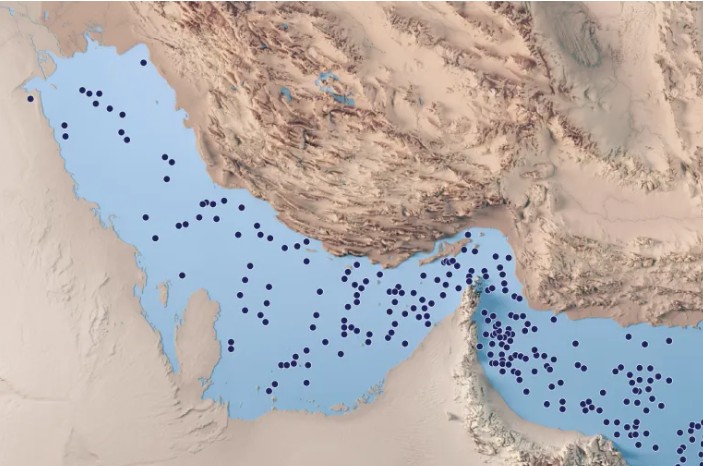

More than 200 mine-like objects have reportedly been cleared from the main shipping lane of the Strait of Hormuz, but U.S. officials say only 11 were actual naval mines. If confirmed, the finding suggests Iran may have used a small number of genuine explosives alongside numerous decoys to create enough uncertainty to disrupt one of the world’s most important energy routes.
A surprising detail has emerged from the months-long struggle over the Strait of Hormuz. After an extensive U.S.-led operation to clear suspected Iranian naval mines, American officials say the overwhelming majority of the objects discovered were not real explosive mines.
Axios reported on August 28 that more than 200 mine-like objects had been swept from the main international shipping lane through the strait. According to U.S. officials cited in the report, just 11 were actual mines, and only a few of those had been properly deployed.
The claim raises an intriguing possibility: Iran may have managed to create a major maritime threat using relatively few genuine mines, relying on uncertainty and deception to amplify their effect.
However, the numbers require an important qualification. The claim that only 11 mines were genuine comes from U.S. officials and has not been independently verified in the available reporting.
Why the Strait of Hormuz Became So Important
The Strait of Hormuz is a narrow maritime passage connecting the Persian Gulf with the Gulf of Oman and the Arabian Sea. For global energy markets, few waterways are more important. Before the current conflict, more than 20 million barrels of crude oil, condensate and fuels passed through the strait each day on average, according to data cited by Reuters. Qatar also sends much of its liquefied natural gas exports through the route.
That made control of the strait one of Iran’s most powerful strategic tools after the war began in February 2026. Shipping through Hormuz fell dramatically as attacks on vessels and fears of naval mines increased. By August 25, provisional Vortexa data cited by Reuters showed oil transit had dropped to approximately 5 million barrels per day, compared with more than 20 million barrels per day before the war.
Iran Allegedly Ordered Mines Into Main Shipping Lane
According to Axios, U.S. and Israeli officials say Iran ordered naval mines to be deployed in the Traffic Separation Scheme, or TSS, the main internationally recognised shipping lane through the Strait of Hormuz. The reported decision was attributed to the then-commander of the Islamic Revolutionary Guard Corps Navy, General Alireza Tangsiri.
Combined with Iranian warnings and attacks on vessels, the threat of mines contributed to commercial shipping largely withdrawing from the area. The danger was considered credible. Earlier in the conflict, Reuters reported that Iran’s use of drones and naval mines had effectively shut much of the critical waterway, which normally handles roughly a fifth of the world’s oil and LNG flows.
More Than 200 Objects Cleared
After attempts to reopen the strait through diplomatic arrangements faltered, the U.S. military intensified efforts to restore navigation. The mine-clearing operation reportedly involved Navy divers, Navy SEALs, underwater drones, surface drones and private contractors tasked with locating and neutralising suspected mines. On August 25, U.S. President Donald Trump announced that mines had been removed or detonated from international waters in the Strait of Hormuz.
Reuters independently reported Trump’s announcement, including his warning that vessels attempting to lay new mines would be targeted. Axios reported separately that U.S. Navy underwater drones had systematically scanned the Traffic Separation Scheme and initially located more than 100 objects suspected of being mines. Private companies were then brought in to help remove or destroy them.
The number of mine-like objects eventually cleared reportedly exceeded 200. Then came the surprising finding. U.S. officials told Axios that only 11 of those objects were genuine mines. Even among those 11, officials said only a few appeared to have been properly deployed.
Were Hundreds of Iranian Mines Really Fake?
This is where the story needs careful interpretation. It would be premature to state as established fact that Iran deliberately planted approximately 190 fake mines. What is currently supported is narrower: U.S. officials say more than 200 mine-like objects were removed and only 11 proved to be actual mines.
Publicly available reporting does not establish that every other object was deliberately planted by Iran as a decoy. Reuters has independently confirmed the broader mine-clearing operation and Trump’s announcement that mines had been removed from the international waters of the strait, but its August 25 report did not independently establish the subsequent figure of 11 genuine mines.
Therefore, describing the entire minefield as “fake” without attribution would overstate what has been verified. The more accurate conclusion is that the suspected minefield appears to have contained far fewer genuine explosive mines than initially feared, according to the latest U.S. assessment.
Why Fake Mines Can Still Be Effective
If some of the objects were deliberately deployed as decoys, the strategy would illustrate a fundamental characteristic of naval mine warfare. A suspicious object does not necessarily have to explode to disrupt shipping. A commercial tanker carrying millions of dollars’ worth of oil cannot safely assume that an object resembling a naval mine is harmless. Naval forces must investigate it, shipping companies have to assess the danger, insurers have to price the additional risk and crews may refuse to enter waters considered unsafe.
Mixing even a handful of genuine mines among numerous convincing decoys could therefore force military planners to treat every suspected object as a potential explosive. In that sense, uncertainty itself becomes a weapon.
The Threat Had Real Economic Consequences
Whatever proportion of the mine threat was genuine, its economic impact was real. Shipping through the strait collapsed after the conflict began. Reuters reported that hundreds of vessels were left waiting outside the waterway during the early stages of the conflict, while oil prices climbed sharply. The disruption continued for months.
Even after Washington announced the mine clearance, commercial traffic remained significantly below normal. On August 26, Reuters reported that only five commodity vessels had passed through Hormuz the previous day, compared with a 10-day average of 15. The figures were based on preliminary Kpler shipping data and could be affected by vessels switching off their tracking transponders.
That suggests clearing the mines alone will not immediately restore normal shipping.
Strait Declared Cleared, But Risks Remain
U.S. Central Command commander Admiral Brad Cooper said internationally recognised sea routes through the strait were free of Iranian sea mines and that shipping lanes were open. But that does not mean the Strait of Hormuz is completely safe. Reuters reported that attacks on vessels continued even as Washington announced the mine-clearing operation. On August 25, an oil tanker was struck by an unidentified projectile near the entrance to the strait, according to the United Kingdom Maritime Trade Operations.
Iran and Oman have meanwhile discussed establishing a temporary joint navigation corridor and clearing mines as part of efforts to restore safer passage through the waterway. Shipping therefore remains exposed to risks beyond mines, including drones, missiles and other projectiles.
What the Discovery Means for Iran
The reported discovery could change how Iran’s months-long strategy in Hormuz is assessed. If U.S. officials are correct, Iran may have achieved considerable disruption without needing to saturate the shipping lane with hundreds of functioning explosives.
Only 11 genuine mines, combined with more than 200 suspicious objects and the continuing possibility of drone or missile attacks, may have been sufficient to make commercial operators unwilling to risk the passage. That represents an example of asymmetric warfare, where a comparatively inexpensive threat can force an adversary to deploy far greater resources to counter it.
The United States reportedly used specialised naval personnel, drones, contractors and military protection to restore shipping. Meanwhile, the perceived threat helped restrict the movement of tankers through a route responsible for a major share of global energy trade.
A Psychological Weapon as Much as a Physical One
The most important lesson from the episode may therefore not be that Iran’s minefield was “fake.” Instead, it may be that a minefield does not need hundreds of live explosives to achieve its purpose. A small number of genuine weapons can make every suspicious object dangerous.
For commercial shipping companies, there is little practical difference between knowing that 200 objects are mines and knowing that 11 mines are hidden among 200 objects when there is no reliable way to distinguish between them from a passing vessel. The uncertainty forces ships to stay away until military specialists can clear the route. And that uncertainty appears to have helped Iran disrupt the Strait of Hormuz for months.