

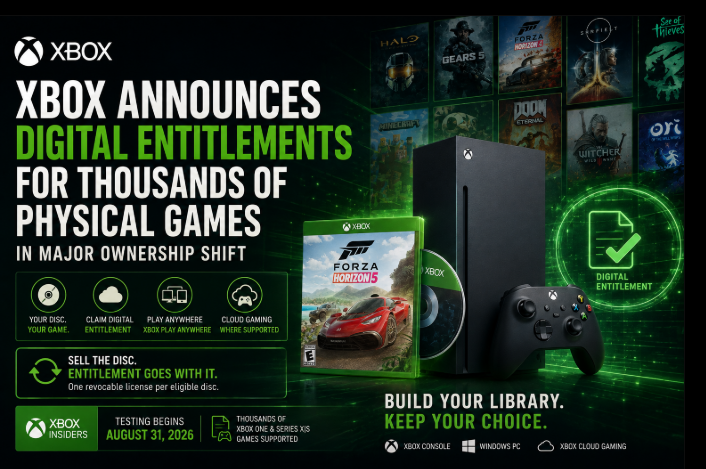

Microsoft is bringing physical Xbox libraries deeper into the digital era with a new Disc-to-Digital feature that lets owners of supported Xbox One and Xbox Series X games claim digital entitlements from their existing discs. The program begins testing with Xbox Insiders on August 31, 2026.
Xbox has announced one of its most significant changes to physical game ownership in years, introducing a system designed to combine the permanence and resale flexibility of physical discs with the convenience of digital gaming. Announced around Gamescom 2026, the new Disc-to-Digital feature allows players to insert a supported physical Xbox game into an Xbox One or Xbox Series X console and claim a corresponding digital entitlement.
Once claimed, players can access eligible digital features such as Xbox Play Anywhere and Xbox Cloud Gaming where those services are supported by the game. Importantly, Microsoft says the original physical disc will continue to function normally.
The announcement could have significant implications for game preservation and Microsoft’s next generation of Xbox hardware as the gaming industry increasingly moves toward digital distribution.
How Xbox Disc-to-Digital Works
Microsoft’s concept is relatively straightforward.
A player inserts a supported physical game disc into an Xbox One or Xbox Series X console and launches the game. The system then allows a digital entitlement associated with that particular disc to be claimed. That entitlement gives the owner many of the advantages normally associated with purchasing a game digitally.
Microsoft says this can include Xbox Play Anywhere, allowing supported games to be accessed across Xbox and Windows devices, as well as Xbox Cloud Gaming where available. The physical disc itself does not become unusable after the entitlement is activated.
Instead, it continues functioning as a physical game. This creates an unusual hybrid ownership system: the disc remains the underlying physical asset while a linked digital entitlement provides greater flexibility over how the game can be accessed.
Thousands of Games Will Be Supported
One important correction to early coverage concerns the number of games involved. The Gamescom interview transcript refers to the ability to provide digital entitlement for around 1,000 physical titles. Microsoft’s subsequent official announcement, however, uses broader language.
Xbox says the program will begin with “thousands of titles”, rather than exactly 1,000. It also says that most Xbox One and Xbox Series X disc-based games support the feature, although not every title will be available when testing begins. Microsoft intends to expand support over time.
For that reason, the most accurate current description is that Xbox is launching Disc-to-Digital support for thousands of physical games, not limiting the program to exactly 1,000 titles.
You Won’t Necessarily Need the Disc Every Time You Play
Perhaps the biggest benefit is what happens after the entitlement has been claimed. Players will be able to access the digital version without inserting the physical disc every time they want to play, according to reporting on Microsoft’s implementation.
That matters because it removes one of the major practical differences between physical and digital ownership. Traditionally, buying a disc means the console must verify ownership by reading that disc whenever the game is played. A digital purchase instead ties the licence to an account.
Xbox’s new system attempts to connect those two approaches. Players can retain the physical copy while gaining much of the flexibility associated with digital ownership. There is, however, an important safeguard preventing one disc from creating unlimited permanent digital copies.
What Happens If You Sell Your Physical Game?
This is where Microsoft’s approach becomes particularly interesting.
The digital entitlement is linked to the physical disc, rather than becoming an entirely independent second copy of the game.
Microsoft’s terms describe one revocable licence per eligible disc. If ownership of the disc changes, the digital entitlement can therefore move to another account. The Gamescom interview explains the concept in similar terms. The executive says that if the physical disc is sold, the associated digital entitlement goes with it.
This prevents a situation where someone buys a game once, claims a permanent digital version and then sells the disc while retaining full ownership. In practical terms, the disc remains the transferable proof of ownership. That distinction is important because describing the program simply as giving players a “free digital copy” can be misleading.
It is more accurately described as a digital entitlement linked to the physical game.
Xbox Says Physical Media Still Matters
The announcement arrives at a time when the future of physical games is increasingly being debated. Digital downloads, subscription services and cloud gaming have steadily reduced the industry’s dependence on physical media.
Xbox, however, is presenting its new system as a way of preserving existing physical collections rather than immediately abandoning them.In the Gamescom interview, the company stressed that players should have a choice between physical and digital media and that game libraries should be able to move forward with players regardless of how they originally purchased their games.
Microsoft echoed that position in its official announcement. The company said players have spent decades building Xbox libraries across both physical and digital formats and that making those collections easier to carry forward is part of its broader commitment to game preservation.
Why This Matters for Game Preservation
Game preservation has become an increasingly complicated issue as consoles, storefronts and distribution technologies change. A physical collection can potentially survive long after the hardware generation for which it was originally purchased. But if future consoles no longer include compatible optical drives, those discs become harder to use.
Microsoft’s Disc-to-Digital system offers one possible solution. Instead of forcing players to purchase their games again, supported physical games can effectively establish digital ownership that works within Microsoft’s modern ecosystem. Jason Ronald, Xbox’s Vice President of Next Generation, said preserving access to games people already own is becoming increasingly important as devices, technology and distribution models evolve.
The system could therefore become an important bridge between Xbox’s physical past and its increasingly digital future.
What About Older Xbox and Xbox 360 Discs?
There is an important limitation.
Microsoft’s official announcement specifically refers to Xbox One and Xbox Series X disc-based games. It does not currently promise the same Disc-to-Digital process for original Xbox or Xbox 360 discs. This does not mean Microsoft is abandoning backward compatibility.
The company has separately been expanding its preservation work, including efforts to bring older Xbox games to PCs and newer devices. But consumers should not assume that every physical Xbox game ever released will immediately qualify for Disc-to-Digital. Compatibility will depend on the title and Microsoft’s supported catalogue.
Xbox Insiders Get Access First
The feature is not immediately rolling out to every Xbox owner. Microsoft says Xbox Insiders will begin testing Disc-to-Digital on August 31, 2026. The testing phase will allow Microsoft to evaluate how the system works across different discs, games, accounts and hardware configurations before a wider release.
The Verge reports that Microsoft plans a broader rollout to Xbox One and Xbox Series X consoles in the coming months. Microsoft has not yet published a definitive list covering every supported game.
Could This Be Preparing Xbox for a Disc-Free Future?
The timing has inevitably raised another question: What does Disc-to-Digital mean for Microsoft’s next-generation Xbox? Microsoft is developing its next-generation platform under the codename Project Helix.
The company confirmed earlier this year that Helix is designed to play both Xbox console and PC games and will use a custom AMD system-on-chip. Microsoft plans to provide alpha hardware to developers beginning in 2027. At Gamescom, Xbox leadership described Helix as part of a next-generation “family of devices”, but declined to confirm whether the future hardware will include a physical disc drive.
That makes the new Disc-to-Digital system particularly significant. If future Xbox hardware eventually moves away from built-in optical drives, Microsoft’s new entitlement system could provide a mechanism for players to carry supported physical libraries forward.
For now, however, that connection remains partly speculative. Microsoft has not confirmed that Project Helix will be disc-free, so claims that the Disc-to-Digital program proves the next Xbox will abandon physical drives would go beyond the available evidence.
Physical and Digital Gaming Are Starting to Converge
For decades, buying a physical game and buying a digital game represented two clearly different forms of ownership. Xbox is now attempting to blur that distinction. A physical disc can remain something players collect, lend or sell while simultaneously unlocking some of the conveniences traditionally associated with digital purchases.
That could prove particularly attractive to players with large physical libraries who want to use newer devices, PCs or cloud gaming without purchasing the same games again. It also provides Microsoft with a potential pathway for maintaining backward compatibility even as gaming hardware changes.
A Major Shift, but Physical Discs Aren’t Disappearing Yet
Xbox’s Disc-to-Digital initiative should therefore not be interpreted as Microsoft eliminating physical games. At least for now, it represents something different: an attempt to make physical ownership compatible with an increasingly digital gaming ecosystem.
Xbox is starting with thousands of supported titles, with more expected to be added over time. Xbox Insiders will begin testing the feature on August 31 before Microsoft moves toward a broader rollout. The biggest innovation may not be simply turning a disc into a digital entitlement.
It is Microsoft’s attempt to preserve something that has traditionally made physical ownership valuable: the ability to transfer the game itself. If the system works as intended, players could gain digital convenience without completely giving up the ownership model that has defined console gaming for decades. As Xbox prepares for its next generation, that bridge between physical and digital gaming could become one of the most important elements of Microsoft’s evolving platform strategy.