

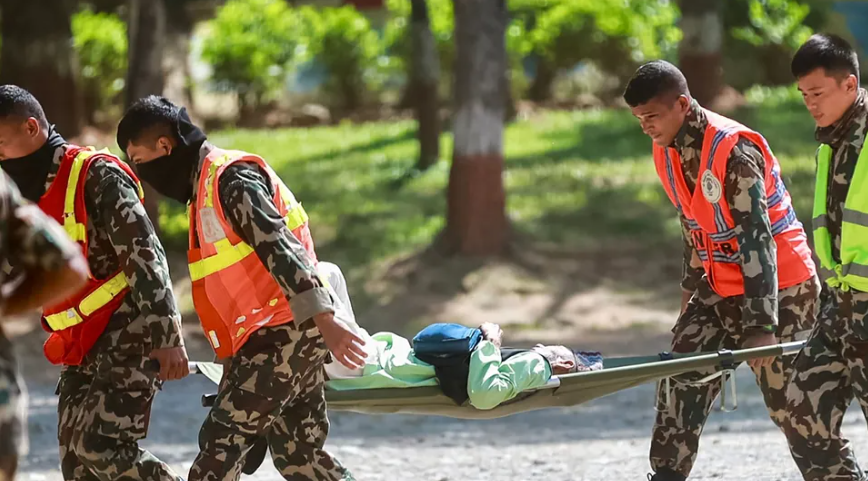

Hundreds of workers and local residents have been rescued from a hydropower tunnel in Nepal’s flood-hit Rasuwa district, while rescue teams continue trying to reach more than 100 people believed to remain trapped amid mud, damaged access routes and unstable conditions.
A major rescue operation is continuing at the Upper Trishuli hydropower project in Nepal after catastrophic flash floods swept through the Himalayan country’s northern border region, leaving communities cut off and severely damaging roads, bridges and power infrastructure.
The Nepali Army successfully rescued 350 workers and local residents who had been trapped inside a tunnel at the hydropower project after flooding struck the area on August 26. Nepal’s Prime Minister’s Office said the operation was conducted in extremely difficult conditions, with adverse weather and fast-moving floodwaters complicating efforts to reach those inside.
But the operation was far from over. Authorities said more than 100 people were still believed to be trapped inside the tunnel as military teams continued efforts to reach them.
350 People Brought to Safety
The tunnel rescue has become one of the most significant survival stories to emerge from the devastating Nepal-Tibet floods. According to Nepal’s state-run Radio Nepal, the Nepali Army rescued 350 workers and local residents from the Upper Trishuli Hydropower Project tunnel in Rasuwa. The operation continued despite difficult weather and substantial risks around the site.
Nepal News separately reported the same figure and said a military team led by Warrant Officer Bhaktajan Basnet was involved in the operation. The distinction between “workers” and “local residents” is important. Initial reports sometimes described all 350 people as workers, but official and local reporting indicates that the group included both hydropower workers and local people.
More Than 100 Believed to Remain Trapped
After bringing hundreds to safety, attention turned to the people who remained inside. Nepal Army spokesperson Raja Ram Basnet said helicopter teams were working to rescue people trapped at the hydropower project. Two helicopters were dispatched, but reaching the tunnel was particularly difficult because mud and flood damage had made it challenging to identify some of its entry points.
The Prime Minister’s Office said the army was continuing efforts to safely evacuate more than 100 people from the tunnel.
Local reports similarly put the remaining number at around or above 100, meaning the figure should be treated as an estimate rather than an exact count.
Soldiers Crawl Through Mud to Reach Tunnel
Images and video released from the disaster zone illustrate the extraordinary conditions facing rescue personnel. Footage attributed to the Nepali Army showed a military team rappelling from a helicopter before soldiers crawled across thick mud toward the tunnel. People could also be seen sheltering inside the structure.
The surrounding landscape has been transformed by mud, rocks and flood debris, making conventional access extremely difficult. Basnet said finding the tunnel’s entry and exit points was complicated because the area had been covered by mud. This has forced authorities to combine helicopter operations with ground teams attempting to navigate unstable terrain.
Flood Triggered by Himalayan Glacier Collapse
The tunnel emergency is part of a much larger catastrophe affecting Nepal and neighbouring Tibet. The disaster struck on August 26 after a glacier collapse in the Himalayas unleashed a huge torrent of ice, rock, mud, water and debris through mountain river systems.
Reuters reported that the flood swept through villages and destroyed critical infrastructure along the route connecting Kathmandu with Lhasa in Tibet. Roads and bridges were washed away, while entire communities were left inaccessible.
The scale and speed of the event made rescue operations particularly difficult. Rather than behaving like a conventional slowly rising river flood, the disaster sent a powerful mixture of water and debris through narrow Himalayan valleys.
63 Indians Reported Among Those Rescued
The rescue operation is also significant for India because Indian nationals were among those caught in the disaster. Indian media reported that 63 Indian nationals were among the approximately 350 people rescued from the hydropower tunnel.
However, this figure requires attribution.
The initial statement from Nepal’s Prime Minister’s Office did not provide a nationality breakdown for either those rescued or those remaining inside the tunnel. AFP also noted that the government statement did not specify their nationalities. The most accurate formulation is therefore that Indian media reported 63 Indians among those rescued, rather than presenting the figure as part of the initial Nepali government statement.
Hundreds More Evacuated Across Rasuwa
The hydropower tunnel is only one part of the enormous rescue effort underway across Rasuwa.
Nepal News reported that another military team moved 533 people from high-risk and remote locations, including Syabrubesi, Timure, Mailung, Thulo Haku and Hakubesi.
Combined with the tunnel operation, military personnel had evacuated 883 people across affected areas of Rasuwa by that stage of the emergency.
The overall rescue operation has since expanded substantially as helicopters and ground teams continue reaching isolated communities.
Fresh Flood Risk Complicates Rescue Efforts
Rescuers are also confronting the possibility of additional flooding.
The original catastrophe left huge quantities of debris across the Himalayan river system. This material blocked waterways and contributed to the formation of temporary lakes, raising concerns that accumulated water could suddenly breach natural barriers.
On August 28, rescue operations in some areas were temporarily interrupted because of concerns about additional water and debris moving downstream. Authorities have therefore been forced to balance the urgency of reaching trapped survivors with the safety of rescue personnel. That uncertainty remains one of the biggest challenges facing teams operating around the Trishuli and Bhote Koshi river systems.
Disaster Highlights Risks to Himalayan Hydropower
The Upper Trishuli rescue also highlights the vulnerability of hydropower infrastructure in mountainous regions. Hydropower projects depend on rivers and elevation differences to generate electricity, placing facilities, tunnels and associated infrastructure close to waterways.
In the Himalayas, those same locations can be exposed to flash floods, landslides, glacial hazards and massive debris flows.
The latest disaster damaged hydropower facilities alongside roads, bridges and settlements. Once the immediate emergency is over, the destruction is likely to raise questions about flood modelling, emergency shelters, communications systems and evacuation procedures at major infrastructure projects across vulnerable Himalayan valleys.
Rescue Operation Continues
The successful evacuation of 350 people represents a significant achievement for rescue teams working in extremely difficult circumstances.
However, the situation remains fluid. As of the latest reporting, search operations were continuing at the Upper Trishuli project, with more than 100 people potentially still trapped in mud-filled tunnel areas. AP reported on August 29 that rescuers remained focused on the site as the wider Nepal-China flood rescue entered its fourth day.
At the same time, Nepal’s government said thousands of survivors had been rescued across the wider disaster zone, with helicopters operating between several affected locations. For families waiting for news from the Upper Trishuli site, however, the number that matters most is the number of people still waiting to be reached.
The rescue of 350 people has provided a rare moment of hope amid one of the region’s most destructive natural disasters. The focus now remains on reaching everyone still trapped and bringing them safely out.