

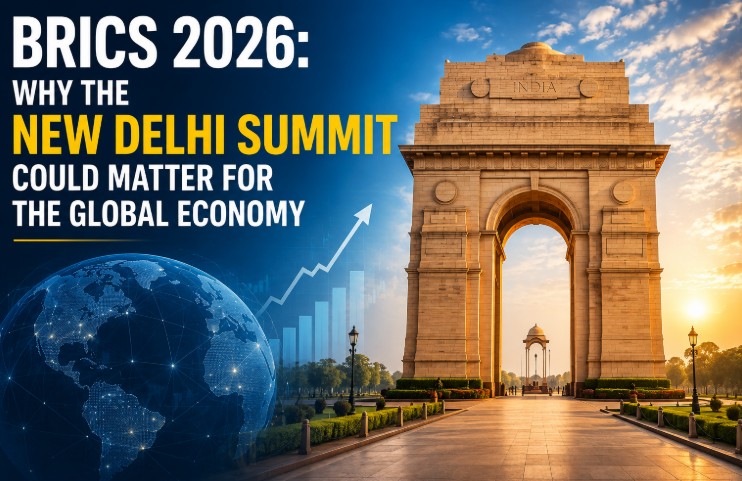

The BRICS Summit will take place in New Delhi from September 12 to 13, 2026, with the country holding the summit as it holds the BRICS chairmanship. The event is taking place at a time of trade tensions, supply-chain disruptions, concerns about energy security, and an increasing debate over how emerging economies should be represented in global institutions.
For India, the summit is not simply a diplomatic event but also a chance to promote more practical BRICS cooperation in trade, investment, energy, technology, resilient supply chains, and opportunities for the Global South.
BRICS Is Much Larger Than It Used to Be
BRICS was originally composed of Brazil, Russia, India, China, and South Africa and has expanded considerably since then.
In 2026, the group consists of 11 members: Brazil, China, Egypt, Ethiopia, India, Indonesia, Iran, Russia, Saudi Arabia, South Africa,, and the United Arab Emirates.
The Indian government states that as one, these countries represent nearly half of the world’s population and about 40% of global GDP.
The fact that the scale exists means that the decisions made within BRICS become important not only to the member countries themselves.
India Is Putting Economics at the Center
The theme of India’s term as Chairman in 2026 is “Building for Resilience, Innovation, Cooperation and Sustainability”.
The economic agenda has already been made clearer as a result of the meetings held before the summit.
At the meeting of the BRICS Trade Ministers held in Jaipur, India, priorities were identified, comprising a more robust multilateral trading system, more stable global value chains, better access to finance for small businesses, and easier access. A number of particular significance shows the opportunity. A particularly important number illustrates the opportunity.
The amount of merchandise trade among the BRICS countries was approximately $1.17 trillion in 2024, a sharp increase from $84 billion in 2003, the India Ministry of Commerce states.
The cThe current challenge is to turn that level of scale into more extensive commercial integration.ll Businesses Could Become a Major Part of the BRICS Story
One of India’s most important goals is to help smaller companies take part in international trade. trade. The trade ministers of BRICS have supported efforts to improve access to credit for small and medium-sized enterprises engaged in exports, as well as the exploration of mechanisms to simplify invoice financing. India has also advocated cooperation designed to assist smaller businesses in joining global value chains. chains.
This is important since global trade is still controlled by large companies which have better access to financing, logistics and international markets.
If the BRICS can establish viable systems that reduce these barriers for MSMEs, the group’s impact could extend far beyond diplomatic statements.
Energy Security Is Another Major Issue
The BRICS countries are among the world’s largest producers and consumers of energy, which is why energy cooperation is one of the group’s most economically significant areas.
At the BRICS Energy Ministers’ Meeting held in India in June, the countries focused on energy security, affordability, critical minerals, resilient supply chains, smart grids, energy storage, hydrogen, biofuels, and other emerging technologies.
India has also established a BRICS Digital Center of Excellence for Smart Grids and Energy Storage in order to facilitate cooperation, knowledge sharing, and pilot projects among the member countries.
The discussion among developing countries, where electricity demand is increasing, isn’t just about clean energy; it is also about ensuring reliable, affordable energy as economies grow.
Digital Cooperation Could Become a Bigger Economic Driver
India is also working on making BRICS more practical in the field of technology.
The agenda for 2026 has covered cybersecurity, digital skills, next-generation communications, strong digital infrastructure, startups and entrepreneurshiBecause of its experience with large-scale digital systems, India has a natural interest in promoting cooperation concerning digital services and technology-driven development.enFor the wider BRICS economy, more smooth cross-border digital services could eventually help companies to sell software, financial services, professional expertise and other digitally delivered products in the various member markets.ets.
Supply Chains Are Becoming a Strategic Issue. What recent global disturbances have shown is that countries can end up being vulnerable when the key products they need rely on just a few suppliers or transport routes.tes.
India has accordingly made resilient and diversified global value chains one of its trade priorities.
The BRICS members are discussing working together across a range of fields, including pharmaceuticals, food security, logistics, and investment promotion.
If the talks result in actual investment and manufacturing partnerships, BRICS could grow in importance when nations seek to diversify their supply chains without abandoning global trade.
Why the Summit Matters for the Global South
India has always presented BRICS as a platform on which emerging and developing economies can obtain a greater voice in international economic decision-making.
It by no means implies that BRICS is taking the place of organizations such as the IMF, the World Bank or the WTO; on the contrary, India’s trade position in 2026 explicitly advocates a rules-based multilateral trading system with the WTO at its heart and calls for reforms which better reflect the interests of developing countries.
That distinction is important.
BRICS is becoming more important not because it is necessarily aiming to establish a completely separate global economy, but because it provides the major emerging markets with another forum in which to coordinate their positions on trade, finance, energy and development.
What to Watch in New Delhi
The key aspect of the September summit will not be the photographs or the political symbolism. It will be a matter of whether member countries can agree on initiatives that have measurable economic consequences.
Issues worth watching include:
– Progress on the BRICS Economic Partnership Strategy 2030
– Financing mechanisms for MSMEs
– Cooperation on stable global supply chains
– Digital services and technology standards
– Energy security and critical minerals
– Investment and infrastructure financing
– The role of the New Development Bank
– Greater economic representation for the Global South
India has already advanced the discussions in several of these areas during its term as Chair in 2026. Greater Role for India
The fact that India is hosting the summit provides it with an opportunity to influence the discussions concerning BRICS at an important point in the global economy. India maintains relationships with Western economies while also working closely with Russia, the Middle East, Africa and other emerging markets. That position allows New Delhi to argue for stronger Global South representation without presenting economic cooperation as a simple choice between rival geopolitical blocs.
The New Delhi summit might thus act as an important test of what BRICS aims to be. If the group continues to be mainly a platform for making political statements, its economic influence will be limited. If the members of BRICS are able to turn talks on trade, finance, energy, technology, and supply chains into concrete cooperation, then BRICS could become increasingly important with regard to the structure of the global economy.
For India, the BRICS meeting in 2026 could present the key opportunity to turn a large and diverse political alliance into a more effective forum for economic cooperation.