

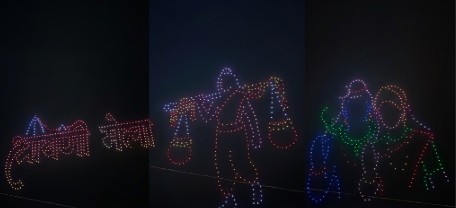

For many generations the religious fairs in India have been characterised by rituals, processions, devotional music, the use of lamps and the presence of large numbers of pilgrims. Another element is now beginning to appear above the crowds: hundreds of synchronized drones which are shining through the night sky.
At the Shravani Mela 2026 in Sultanganj, Bihar, a drone display turned the well-known symbols of devotion into big-scale formations above. This event shows that technology is establishing itself beside centuries-old traditions, rather than replacing them, by presenting these traditions in a new kind of visual language.
Drones Take to the Sky at Shravani Mela
Shravani Mela is one of the major religious festivals in eastern India, and during the pilgrimage period, devotees collect water from the Ganga at Sultanganj before beginning their journey to Baidyanath Dham in Deoghar. For the 2026 edition the Bihar tourism authorities intended to introduce a series of attractions based on technology. According to the official tender records of the Bihar State Tourism Development Corporation (BSTDC), the government had individual tenders placed with different companies for the drone show, the laser show, the water-screen musical fountain, and the motif/theme lighting for the Shravani Mela in 2026.
Before the mela, Bihar Tourism Secretary Lokesh Kumar Singh also stated that a drone show and a laser show near the Baba Ajgaibinath Temple in Sultanganj would be among the attractions at the event.
The drone display later turned into one of the most visually notable features of the mela. The reports from Sultanganj spoke of drones that were illuminated and which displayed images related to the pilgrimage and Lord Shiva, such as a damru and a kanwar, over the night sky.
Ancient Symbols, New Medium
What is interesting about these programmes is not just the technology. The technology is being used in order to display it. Rather than forming general geometric patterns, the drones can be programmed to display images which are familiar within a cultural context. At a religious gathering, technology thus becomes another medium for presenting traditional stories and symbols to visitors. The fundamental experience of the festival is still based on faith and involves pilgrimage, but the way it is presented is changing. For those younger people who are used to smartphones, short-length videos and visually oriented social media, a large drone display also provides traditional events with a kind of show that can extend well beyond the actual location.
A display that lasts only a few minutes can be photographed and posted online for viewing by audiences in India and around the world.
Sultanganj Is Not an Isolated Example
The application of drone displays at Indian cultural events is not limited to the Shravani Mela. In 2026, before that time, the Maru Mahotsav held in Jaisalmer had as one of its new features a planned light display involving 200 drones, along with folk performances, events concerning camels, traditional competitions and cultural programmes. That combination is significant.
The folk music, the costumes, the religious practices, and the local traditions still form the core of these events, with technology incorporated alongside them to improve the visitor experience. Traditional fairs in India still draw a great deal of interest, and the official tourism websites are currently promoting a variety of events, including the Kota Dussehra Fair in Rajasthan and the Janmashtami melas, which are regional religious gatherings and cultural festivals held all over the country.
Technology Is Changing More Than Entertainment
The technological transformation of large gatherings in India is not solely about what visitors see in the sky.
Technology has also been made use of by the authorities for the management of the crowds and traffic at the Shravani Mela. When organising the mela’s final Monday at Baidyanath Dham in 2026, the officials employed CCTV cameras and queue-monitoring systems because of the large number of devotees.
That shows that technology has two quite different roles at traditional gatherings.
There are visible: drones, lasers, lighting and digital spectacles. The second kind is mostly unseen: it includes surveillance systems, the monitoring of crowds, traffic management and communications infrastructure all designed for the purpose of managing events that attract large numbers of people. They are slowly altering the way in which large festivals are organized and experienced.
A New Opportunity for Cultural Tourism
There is as well a aspect to tourism. In today’s age when people find out about destinations using Instagram, YouTube and other digital platforms, Indian fairs are competing for attention and a highly visual event leads to a large amount of user-generated content.
This presents an opportunity for the state’s various tourism departments. Since the festival is traditional, it has a historical background, genuine characteristics, and cultural importance; its modern presentation might therefore enable it to be made known to audiences who had previously known very little about the event.
It isn’t necessary to turn a religious gathering into a technology exhibition; technology could instead be used to retell a traditional story in a different format.
Can technology and tradition exist together?
It is necessary to keep an important balance. The religious fairs in India are important because of the communities, beliefs, and traditions that gave rise to them; although a drone display may draw attention, it cannot replace the cultural significance of the event itself.
Technology functions at its most effective level when it supports that identity rather than dominating it. Sultanganj is an interesting example since, although the drones were modern, the images they produced were closely linked to the pilgrimage itself. The fact that new technology is being used to display old symbols might explain why drone displays are becoming more suitable for India’s festival environment.
From Diyas to Drones
The fairs in India have always been dynamic, changing with developments in transportation, electricity, broadcasting, and tourism, as well as shifts in visitors’ expectations. Drone technology is just one stage in that process of evolution. The scene of Lord Shiva and a damru appearing above Sultanganj through a series of points of light might seem entirely modern, but the stories displayed in the sky are hundreds of years old. The contrast could soon become more familiar at festivals in India: age-old customs on the ground and digital technology in the sky. And rather than indicating the disappearance of tradition, it could provide another way for India’s cultural heritage to reach a new generation.