

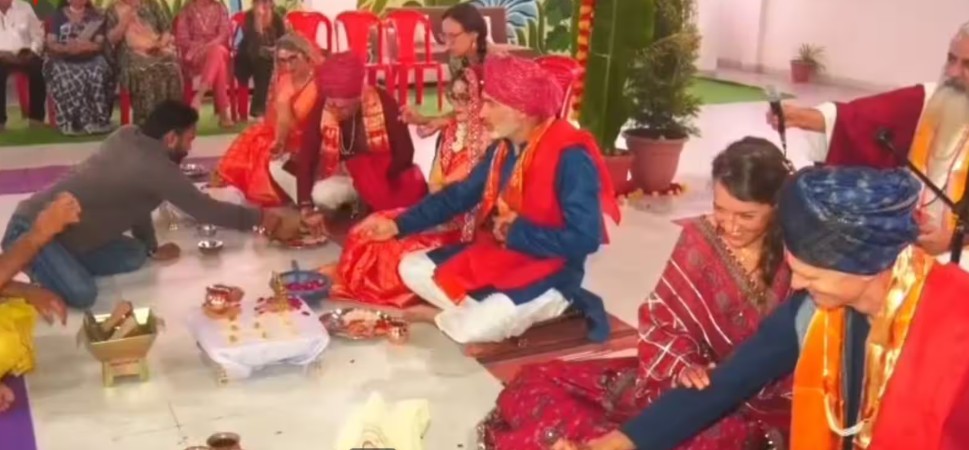

India has long been linked with destination weddings because of its palaces in Rajasthan, beaches in Goa and luxury resorts. However, another aspect of wedding tourism in the country is now drawing attention: weddings based on Indian traditions, spirituality and old rituals from century ago.
Recently in Ujjain, in Madhya Pradesh, three foreign couples took part in traditional Vedic wedding ceremonies at the Anandmay Ashram on August 22, 2026.
For India such ceremonies provide an opportunity which extends well beyond ordinary destination weddings, international couples coming not only to make use of the spectacular locations but also to enjoy something that cannot easily be found elsewhere—an experience based on India’s living cultural traditions.
From Destination Wedding to Cultural Experience
Modern destination weddings are increasingly concerned with more than simply choosing a beautiful setting.
There is a strong desire among couples for the venue to form an integral part of their wedding story, and India has a special benefit in this regard since its destinations are able to combine welcoming hospitality and beautiful scenery with local food, clothing, music, architecture and ceremonial traditions.
The Indian government has realised that there is potential.
In 2023 the Ministry of Tourism started a campaign aimed at establishing India as a wedding destination for couples coming from all over the world and at first featured around 25 destinations, promoting a variety of options such as royal, beach, nature and Himalayan weddings.
The ministry subsequently stated that its “India Says I Do” campaign makes use of digital marketing, social media, influencers and various other promotional activities in order to present India around the world, and it also collaborated with Rajasthan Tourism and FICCI on a “Wed in India” expo in Jaipur which gathered wedding planners, tour operators and other industry participants from both within and outside India.
What is special about a Vedic wedding?
A typical Vedic or Hindu wedding may consist of a number of ceremonies rather than just one exchange of vows. The rituals may include those surrounding a sacred fire, chanting Sanskrit mantras, the saptapadi (seven steps), the exchange of garlands, and the receipt of blessings from family members and priests.No single ceremony represents all Indian weddings, since the rituals differ greatly from region to region, community to community, and family to family.
The diversity can contribute to India’s attractiveness. A couple from abroad who are truly interested in Indian culture could have an experience quite different from that of holding a Western-style wedding in an Indian luxury hotel by having their ceremony in Ujjain, in Rajasthan, or in Uttarakhand or in another place of cultural significance.
Sacred Destinations Are Part of the Appeal
Interest in wedding sites that have spiritual significance is not confined to Ujjain. The Triyuginarayan Temple in Uttarakhand, although traditionally linked to the marriage of Lord Shiva and Goddess Parvati, has also become a popular choice for couples seeking weddings with both religious and cultural significance. Regrowing interest indicates that temple ceremonies are a choice for those seeking an alternative to conventional luxury wedding venues.
It also points to another feasible avenue for Indian wedding tourism: sacred destination weddings.
Places and areas like Ujjain, Varanasi, Uttarakhand and certain parts of Rajasthan have histories and traditions which cannot be merely reproduced by an overseas resort. For couples who are attracted to Indian spirituality or culture, authenticity can be just as important as luxury.
India Already Has the Infrastructure. Culture by itself is not sufficient for creating an international wedding destination.ation.
People who are traveling between countries also need hotels, transport, event planners, photographers, catering, guest management, and reliable links to the main airports. The destination wedding ecosystem in India has been growing to meet those requirements. Rajasthan, Goa, Kerala, and Uttarakhand are increasingly associated with destination weddings, and hotels and event companies have developed increasingly sophisticated wedding services.
In 2024, industry research estimated that the destination-wedding market in India was worth about $16.25 billion and anticipated it would rise to $55.39 billion by 2033. Although these figures are commercial estimates rather than official government statistics, they do indicate the industry’s expectations of significant growth.
Beyond Palaces and Five-Star Hotels
The potential for wedding tourism in India could ultimately be much broader than that associated with luxury. A couple might choose Rajasthan for a royal atmosphere, Kerala for its scenery, Goa for its coastal location, Uttarakhand for the Himalayas, or a city of cultural significance if they opt for a more traditional ceremony.
The first wedding tourism campaign organized by the government was intended to extend India’s image beyond lavish royal weddings and to promote nature, beaches, mountains, traditions, food, and heritage as part of the experience.
That approach matters internationally. India need not compete with Italy, Greece, Thailand, or the Maldives by offering the same type of destination wedding. It can offer something. It has the potential to be rather Indian.r Local Economies
Destination weddings aThe practice of having weddings at a destination also divides the expenditure among a number of industries.ation and transport. Weddings employ caterers, decorators, photographers, musicians, makeup artists and event planners. A ceremony built around local traditions can also create work for priests, artisans, performers, and other community-based service providers.
One of the reasons the government has included wedding tourism in its general tourism promotion is that the Ministry of Tourism has stated that individual states and Union Territories are mainly in charge of developing wedding-tourism destinations, with the Center providing support for their promotion.
International wedding guests might also choose to stay longer to visit other places, which could turn the wedding into a more extensive tourism experience.
Tradition Needs to Remain More Than a Backdrop
There is another important point to consider since traditional ceremonies are becoming involved in tourism.
An aesthetic theme is not what a Vedic wedding is. The rituals have a religious and cultural significance; therefore, the couples who choose them should understand what they mean rather than regard the sacred customs simply as props for photographs. This gives the wedding industry in India an opportunity to provide international couples with an experience that remains both accessible and respectful by explaining the ceremonies, making appropriate adjustments to the arrangements, and thus assuring that the traditions are represented authentically.
India Has Something Difficult to Replicate
The example of three foreign couples getting married in Ujjain according to Vedic traditions offers an interesting view of what the wedding tourism industry in India can offer. It would be premature to describe foreign Vedic weddings as a nationwide boom. There is not yet reliable public data demonstrating such a trend.
But the ingredients for growth are clearly present. India has heritage destinations, sacred cities, palaces, beaches, mountains, an established hospitality sector and an extraordinary variety of wedding traditions. The government is also actively trying to introduce those possibilities to international couples.
For some overseas couples, the attraction may therefore be more than getting married in India. It is the possibility of experiencing a wedding that feels distinctively Indian.