

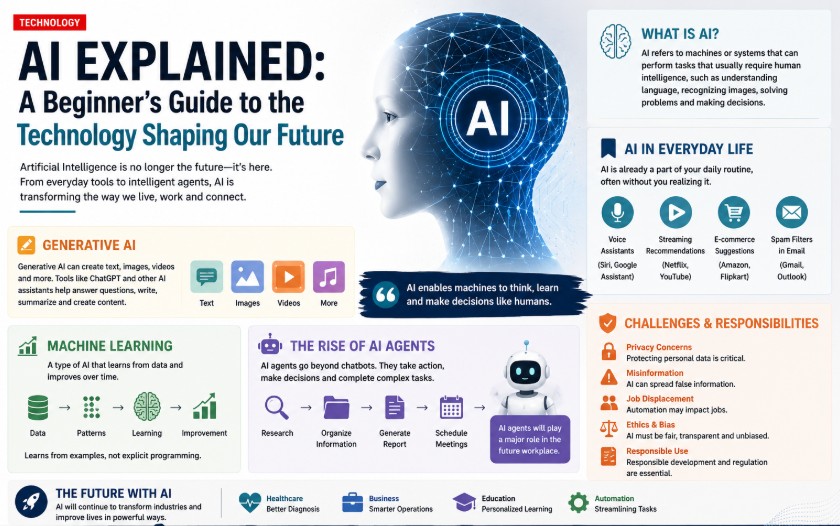

Artificial Intelligence (AI) has appeared as a prominent technology globally. Applications range from chatbots and virtual assistants to self-driving cars and medical research, shaping work, education, commerce, and communication across various sectors. However, for many beginners, AI remains complex due to specialized terminology. Importantly, understanding AI does not require a technical background.
At its core, Artificial Intelligence is technology that enables computers to perform tasks that normally require human intelligence. These tasks include understanding language, recognizing images, solving problems, making predictions, and even creating content.
One of the reasons AI has gained so much attention in recent years is its capacity to process enormous amounts of information quickly. While humans may take hours to analyze thousands of documents, AI systems can review and organize data within minutes. This ability makes AI valuable across industries spanning from healthcare and finance to education and entertainment.
AI is integrated into many daily activities, often without users’ awareness. Voice assistants such as Siri and Google Assistant utilize AI to interpret spoken commands. Online streaming services recommend media content depending on user preferences. E-commerce platforms suggest products aligned with customer interests. Additionally, email spam filters employ AI to detect and filter unwanted messages.
A key innovation in recent years is the emergence of generative AI, which can produce text, images, videos, and other forms of content. Tools such as ChatGPT and similar AI assistants are capable of answering questions, composing articles, summarizing information, and assisting users with diverse tasks. These developments have increased the accessibility of AI to the general public.
Machine learning is another frequently encountered term. It refers to a method that enables AI systems to improve performance via analyzing data and identifying patterns. Rather than being explicitly programmed for every scenario, these systems learn from examples and increase their effectiveness over time.
The emergence of AI agents represents a significant trend in 2026. As opposed to traditional chatbots that only respond to queries, AI agents are capable of executing multiple actions to accomplish complex tasks. For instance, an AI agent may research a topic, organize information, generate a report, and schedule meetings with very little human intervention. Experts expect that AI agents will play a substantial role in future workplaces.
In spite of its benefits, AI also brings up critical questions. Issues regarding privacy, misinformation, workforce displacement, and ethical use continue to be discussed by governments, businesses, and technology experts. As AI becomes more powerful, responsible development and regulation are becoming increasingly important.
For beginners, the most important thing to remember is that AI is a tool designed to assist people rather than replace human creativity and judgment. Like any technology, its effect depends on how it is used.
In the future, AI is expected to become increasingly integrated into daily life. Applications may include assisting physicians in diagnosing diseases, supporting business operations, boosting educational outcomes, and streamlining routine tasks. Artificial intelligence is set to influence the future in ways that are only beginning to be realized.
Acquiring fundamental knowledge of AI enables individuals and organizations to make informed decisions as the technology continues to transform society in 2026 and beyond.