


The Firefly Petunia represents a significant advancement in contemporary horticulture by merging the aesthetic appeal of traditional flowering plants with natural bioluminescence. Unlike conventional petunias, this cultivar emits a soft green glow under low-light conditions, producing a distinctive visual effect that appeals to gardeners, scientists, and plant enthusiasts. Its introduction constitutes a notable milestone in plant biotechnology and exemplifies the transformative potential of scientific innovation in horticultural practices.
Petunias are widely recognized as ornamental plants for their vibrant flowers, ease of maintenance, and adaptability to diverse environments. The Firefly Petunia retains these attributes while introducing natural illumination as an additional feature. This plant emits light autonomously, without the need for batteries, electrical power, or external lighting systems. The luminescence results from intrinsic biological processes within the plant.
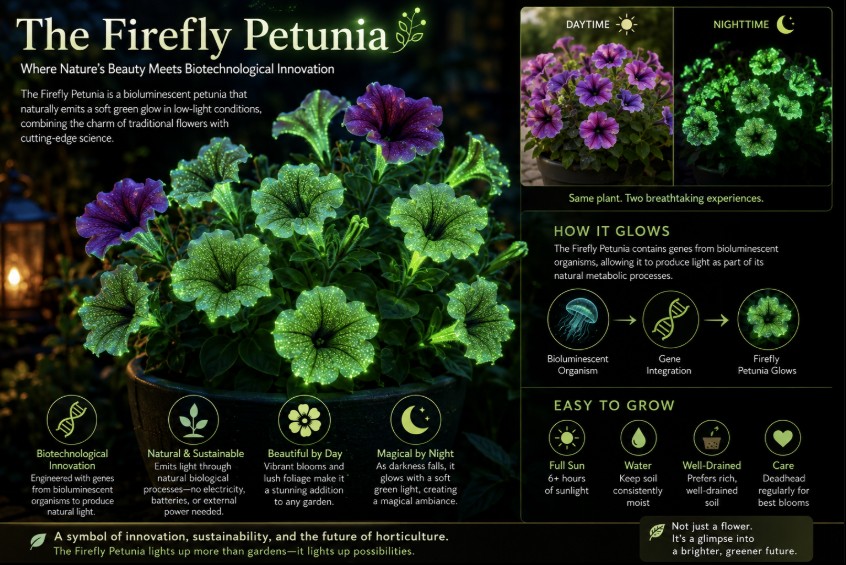
The luminescence of the Firefly Petunia is achieved through genetic engineering. Researchers have incorporated genes from bioluminescent organisms, enabling the plant to produce light as part of its metabolic processes. This mechanism is analogous to the natural bioluminescence observed in specific fungi, insects, and marine species. Consequently, the plant emits a gentle glow that is most prominent during evening hours and in low-light environments.
The Firefly Petunia is notable for its integration of aesthetic qualities and technological innovation. During daylight hours, it resembles conventional petunias with colorful blooms and dense foliage. As ambient light diminishes, the plant exhibits its distinctive bioluminescent trait, producing a subtle glow that can enhance gardens, patios, balconies, and interior environments. This feature provides a novel approach to experiencing ornamental plants.
In addition to its visual attributes, the Firefly Petunia exemplifies the expanding influence of biotechnology in horticulture. Ongoing research focuses on developing plants with enhanced traits such as increased resilience, disease resistance, and environmental adaptability. The Firefly Petunia demonstrates how scientific advancements can introduce novel characteristics while preserving the inherent aesthetic value of plants.
The Firefly Petunia has prompted discussions regarding the potential of sustainable lighting solutions. While its current luminosity does not suffice to replace conventional lighting systems, the concept of naturally glowing plants has generated interest in environmentally sustainable alternatives for decorative illumination. Advancements in bioluminescent technology may facilitate the development of brighter and more practical applications in the future.
Cultivation requirements for the Firefly Petunia are comparable to those of other petunia varieties. The plant thrives in well-drained soil, requires consistent watering, and benefits from exposure to sufficient sunlight. Appropriate care promotes healthy growth and sustains the biological mechanisms underlying its bioluminescent properties.
In summary, the Firefly Petunia represents a notable convergence of natural aesthetics and scientific advancement. Its capacity for natural bioluminescence distinguishes it from conventional ornamental plants and highlights the potential of contemporary biotechnology. As interest in innovative horticultural solutions increases, the Firefly Petunia serves as an emblem of creativity, scientific progress, and the future of plant-based innovation.