

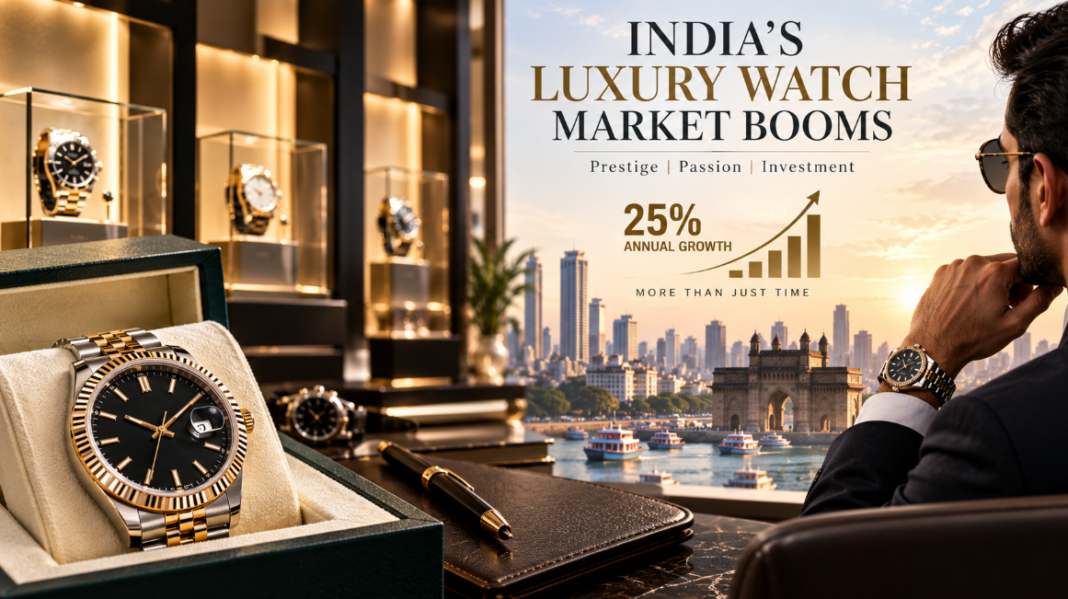

Rising wealth and collector mentality drive Indians to invest in Swiss heritage watches, market grows 25% annually as mechanical timepieces become a status symbol and investment asset
The luxury watch market in India has seen a dramatic change. Rolex, Omega, Cartier, Patek Philippe, and Audemars Piguet are still some of the most desirable luxury watch brands in the country, the increase in collector awareness, higher disposable incomes and greater interest in the secondary market causing demand to grow significantly.
What used to be a small-time hobby has in recent years become a flourishing investment sector. Figures show that almost 28% of Indian customers who buy luxury watches now regard their watches as investment assets, indicating a fundamental shift in how wealthy Indians view mechanical watches.
There has been explosive growth in the numbers. The estimated size of the Indian watch market in 2026 is USD 4.62 billion, which is an increase on the 2025 figure of USD 4.19 billion, and it is projected to reach USD 7.52 billion by 2031, representing a 10.23% CAGR from 2026 to 2031.
India: Fastest-Growing Market for Swiss Watches
India has become one of the most exciting markets in the world for luxury watches, since it is now the fastest-growing market for Swiss watches on a global scale, watch exports having increased by more than 25% year on year while cities such as Bangalore, Chennai, Mumbai and Coimbatore are fostering new generations of watch enthusiasts who research thoroughly before buying.
The rapid growth is indicative of broader economic trends, as higher disposable incomes among India’s upper and middle classes have spurred unprecedented demand for luxury goods. Instead of seeing luxury watches as simple accessories, young professionals, entrepreneurs and well-established wealthy people now regard them as sophisticated investments.
The luxury watch market in India is growing at a faster rate than almost any similar market around the world, and demand for Swiss watches is increasing at a rate which consistently exceeds the amount available, showing that there is structural demand far beyond what is normally seen in consumption patterns.
Investment Psychology Behind Expensive Purchases
The way people in India collect luxury watches is fundamentally different from their approach to fashion. Deciding to wear a mechanical watch on one’s wrist is in itself a philosophical choice, it shows that one places a higher value on craftsmanship than on convenience, on permanence rather than on performance, and on the slow poetry of a sweeping second hand rather than on the strict precision of a digital display.
Serious collectors are drawn to this philosophical shift because the real reason a luxury watch retains its value lies in its heritage, the use of rare materials, and its enduring mechanical versatility, rather than simply its high price.
Today wealthy Indians are able to understand horological concepts which were once the domain of international collector circles. They are now capable of discussing details such as calibre specifications, different types of movements, and the dynamics of the secondary market in a way that was impossible for them a decade earlier.
Trade Policy Removes Price Barriers
The government actively promotes the luxury watch market, since the landmark trade agreement between EFTA and India systematically lowers import duties on genuine Swiss watches, creating previously unseen opportunities for people moving from admirers to collectors.
The reductions in tariffs have fundamentally affected market access, as premium Swiss watches, previously out of reach, are now attractive to a wider segment of the affluent. Watches priced at ₹50 lakh that had to be bought at airport duty-free shops can now be obtained at more stable domestic prices.
Because import tariffs on Swiss watches are falling, luxury watches are becoming increasingly available to people in India, and at the same time premium foreign brands are gradually gaining share in a market which has in the past been dominated by local brands in terms of unit sales.
Heritage Brands Dominate Collector Preferences
Some brands enjoy demand that is far greater than other among Indian collectors, and Patek Philippe, especially models such as the Nautilus Travel Time, is considered the top prize for collectors.
The rare Patek Philippe Nautilus Travel Time, said to be the most expensive watch owned by an Indian, is worth several crores and thus represents the pinnacle of global horology.
Rolex enjoys a legendary position in Indian homes. The relationship between India and Rolex is as much a result of scarcity as of desire, since its limited availability fuels both collectors’ enthusiasm and high prices on the secondary market.
The activity in the second-hand market has become more sophisticated. Nowadays, pre-owned luxury watches are sold via dedicated platforms that serve collectors familiar with the specific valuations of references and historical price patterns.
The Secondary Market Revolution
The sale of used luxury watches gives rise to a completely new set of market conditions. In 2026, when evaluating the purchase of such watches as an Indian collector, the issue is less about which brands are important and more about which specific models, with the pre-owned market being the place where the differences between various models are most clearly demonstrated.
The secondary market is popular with those looking for watches that have a proven ability to retain their value. Since authentic used watches have a documented history, cheaper starting prices, and well-established resale records, they give confidence to new buyers.
When it comes to investing in watches in India in 2026, it is important to purchase from authorised dealers since watches that are factory condition and come with complete documentation retain their value much more than those obtained from the grey market, and one should concentrate on heritage models such as the Omega Speedmaster, Longines Conquest and Rado DiaStar, as these models have established resale markets.
Mechanical Mastery Over Electronic Convenience
More and more collectors are now putting a higher value on craftsmanship than on functionality. In India, the luxury watch market is facing a historic shift, as consumers are moving away from flashy, temporary fashion statements and instead making considerable investments in genuine mechanical expertise, heritage narratives, and long-lasting visual durability.
This is a philosophical revolt against the widespread use of smartphones. Since any portable device can display the correct time, one then has to wear a mechanical watch as a deliberate choice, a statement of values that favor permanence over performance.
A luxury watch is much more than just a device for telling time; it serves as a personal statement, anchors the boardroom, and becomes a valuable heirloom that goes beyond any practical need.
Digital Generation Discovering Analog Excellence
It is surprising that the younger generations create a great deal of demand for luxury watches. Because they are digital natives, Gen Z are able to cause a spike in the discovery, comparison, and purchase of watches online via e-commerce websites and social media channels.
Young professionals look around on YouTube, Instagram, and various specialized watch forums before buying watches costing more than ₹50 lakh. This group of well-informed consumers expects authenticity, heritage stories, and evidence of value retention.
The Future of India’s Watch Market
Experts in the industry believe that growth will continue to be strong. The prospects for Indian luxury watch brands appear very promising, driven by innovation, shifts in consumer preferences, and growing international recognition of Indian craftsmanship, with local watchmakers now producing more limited-edition models that attract collectors worldwide.
India’s transformation of the luxury watch market indicates broader economic maturity. Rising affluence, sophisticated collector consciousness, and improved market accessibility create perfect conditions for continued explosive growth in mechanical horology investment.