

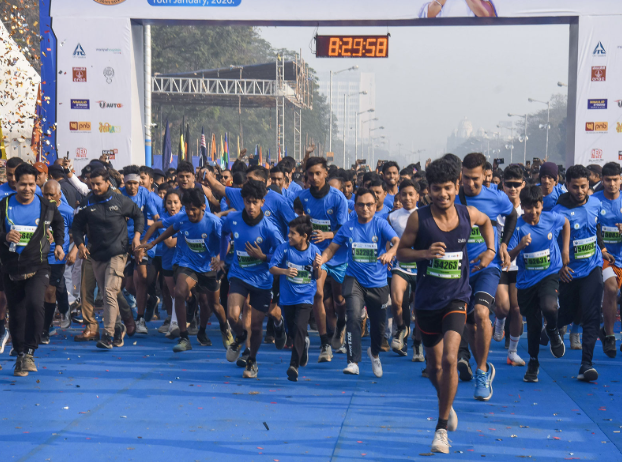

30,000+ runners race through India’s capital as fitness revolution transforms urban culture, Asian Games qualifier draws elite athletes globally
The fitness culture in India had never been on such a large scale. When the 11th Cognizant New Delhi Marathon took place on 22 February 2026, it attracted more than 30,000 participants taking part in four different distances, the full marathon, the half marathon, the 10K and the 5K, so that the event became one of the biggest sporting events in the country, with runners coming from 31 countries and 490 Indian cities.
The marathon shows an exceptional level of involvement in urban areas; since participants came from 32 states and union territories in India, the event has illustrated a running culture that spans economic, geographic, and demographic boundaries and has thus turned the Delhi Marathon from a regional affair into a genuine national sporting celebration.
The marathon both began and ended at the famous Jawaharlal Nehru Stadium and passed by some of Delhi’s historical sites such as the Red Fort, Chandni Chowk, and India Gate, enabling the runners to enjoy the capital’s cultural heritage as they pursued their own fitness objectives on a beautifully arranged route.
Elite Athletes and Asian Games Qualification
Indian distance runners clearly exhibited their excellence. Among India’s top marathon runners were Anish Thapa, Belliyappa, Man Singh, Gopi T, Dr. Karthik, Akshay Saini, Bhagirathi Bisht, Nirmaben Thakor, and Ashwini Jadhav, who showcased the country’s best distance-running talent as they competed for spots at the Asian Games.
Kartik Karkera and Nirmaben Thakor won the title at the national level, Karkera achieving the Asian Games 2026 qualifying time of 2:15:04 in the men’s race and thus putting Indian marathon runners in a position to have a continental display in Japan in late 2026.
The qualification barrier was still difficult. Although all three top men’s finishers met the Asian Games qualifying times, India’s women long-distance runners failed to meet the Asian Games standard of 2:31:52; still, Nirmaben Thakor’s 02:41:15 showed considerable progress in women’s distance running.
Historical Records and National Benchmarks
The men’s marathon national record remains impressive; Shivnath Singh’s 2:12:00, set in Jalandhar in 1978, has not been broken and sets an aspirational standard for current long-distance runners.
The women’s record has remained unaltered since 2015. OP Jaisha’s national women’s marathon record of 2:34:43, set in 2015, still stands, illustrating the gap in competitive opportunities and the development of long-distance running between men and women in India, and the difficulty Indian female marathoners face in establishing new records.
Running Culture Transformation in Urban India
Participation in fitness shoots up dramatically. The Delhi Marathon 2026 signaled a wider fitness revolution reshaping urban Indian culture, as running moved from a small-scale athletic activity to a popular lifestyle choice adopted in professional, recreational, and community settings.
Youth involvement has increased greatly. Participation by younger people rose significantly, so that those in their 20s and 30s now make up the largest share of participants, this indicating that a sense of fitness levels among generations is taking over sedentary lifestyle patterns in urban India.
Participation by companies rose, as many firms arranged teams, turning marathons into workplace wellness programs designed to promote employee fitness, corporate social responsibility, and involvement within the organization.
International Participation and Global Recognition
International athlete participation has increased. With 31 countries participating, the Delhi Marathon is now recognized as an international event, drawing in the global running community and giving the New Delhi Marathon credentials similar to those of major international marathons with worldwide participant numbers.
The international runners praised the race facilities in Delhi, the climate, and the scenic route, and this had the effect of placing the New Delhi Marathon favorably within the highly competitive global marathon circuit, since runners select races on the basis of the quality of the course, the standards of organisation, and the cultural experiences offered.
Accessibility along with Inclusive Participation
The importance of disability inclusion was stressed, as the marathon included events for vision-impaired people and wheelchair users, showing a commitment to inclusive participation that goes beyond common assumptions about able-bodied people and permits individuals with disabilities to take part in ordinary sporting events.
By offering senior-citizen running categories and accessible race distances, older runners could take part in a wider range of events as they pursued their fitness goals, turning marathons into festive events that brought together people of different ages rather than keeping them as competitions for elite athletes only.
Course Design and Race Infrastructure
The flat and fast nature of the course draws in top-level runners. The New Delhi Marathon course consisted of fairly level ground and broad streets suited to fast times, which is why it attracts elite marathon runners striving to achieve personal bests and set records over tough competitive distances.
Starting early in the morning helped avoid the summer heat while also accommodating international participants’ time zones; this logistical coordination demanded sophisticated event management across multiple operational areas.
Post-Race Community and Celebration
Hospitality for participants was a top priority. After the race, breakfast was served hot, offering comfort and the nourishment needed for recovery, turning the race day experience from a competition into a community celebration that prioritizes participants’ wellbeing and shared achievement.
Environmental Protection Commitment
Green initiatives were incorporated everywhere. The event showed strong support for sustainability through waste-reduction programs, environmentally friendly initiatives, and encouragement of public transit, making the marathon an environmentally conscious sporting event that minimizes ecological impact while maximizing community benefits.
Running’s Cultural Significance
Marathon culture has altered Delhi’s character. What started as an athletic event has become a cultural trend, indicating increasing concern for fitness in urban India and showing how structured sporting activities can promote lifestyle change, foster community unity, and raise national awareness of sport at the same time.
Future Momentum and Growth Path
Running industry expansion continues. Multiple Delhi-based marathons, including the Airtel Delhi Half Marathon, Vedanta Delhi Half Marathon, and Tuffman Half Marathon, are scheduled throughout 2026, demonstrating sustained growth. The Delhi Marathon 2026 constitutes a turning point. With record participation, international recognition, and outstanding performances by elite athletes, the New Delhi Marathon has become India’s top running event, symbolizing the country’s shift from fitness as a minor pastime to a mainstream cultural phenomenon shaping urban Indian lifestyle and identity.ty toward a mainstream cultural phenomenon shaping urban Indian lifestyle and identity.