

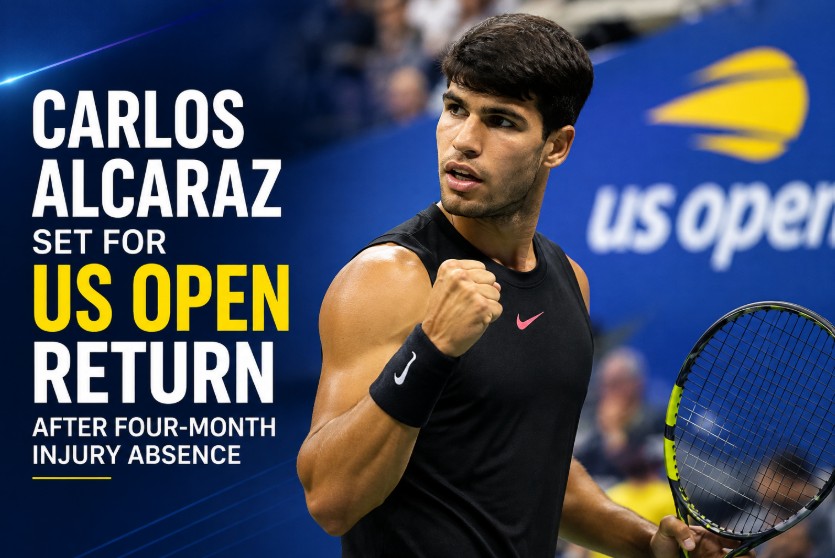

Carlos Alcaraz is officially heading back to competitive tennis.
The Spanish star has confirmed that he will compete at the 2026 US Open, ending a four-month absence caused by a right wrist injury that disrupted much of his season. The return puts the defending champion back on one of tennis’s biggest stages, but it also raises a significant question: how quickly can one of the sport’s most explosive players rediscover his best form after months without competitive matches?
Four Months Away From Competition
Alcaraz has been sidelined since April after suffering problems with his right wrist. His last competitive appearance came at the Barcelona Open, where he won his opening match against Otto Virtanen before his tournament ended because of the injury.
The problem ultimately cost him a substantial part of the 2026 season.
Alcaraz withdrew from the Rome Masters and French Open, where he would have been attempting to defend his title. His recovery then took longer than initially hoped, forcing him to miss Queen’s Club and Wimbledon as well.
He subsequently remained out of the North American hard-court events in Toronto and Cincinnati, meaning he will arrive in New York without the competitive preparation players would normally want before a Grand Slam.
“Here We Go”
Alcaraz finally confirmed his return on August 20 in an announcement made with football transfer journalist Fabrizio Romano.
Using Romano’s famous transfer catchphrase, Alcaraz declared that he was returning with a simple message: “Here we go.”
The unusual announcement quickly attracted attention, but behind the playful presentation was significant news for men’s tennis.
Alcaraz is not simply returning to another ATP tournament. He is going directly into a Grand Slam after four months away.
A Strong Start to 2026 Before Injury Struck
The injury interrupted what had been an impressive season.
Alcaraz began 2026 by winning the Australian Open, completing the career Grand Slam at just 22 years old. He also captured the title in Doha and reached the Monte Carlo final. According to the US Open, he compiled a 22-3 record during the first four months of the season.
His Australian Open victory was particularly significant. It made him the youngest man to win singles titles at all four Grand Slam tournaments.
Then came the wrist problem.
Instead of competing through the heart of the clay and grass seasons, Alcaraz spent months focusing on rehabilitation.
Returning to the Place Where It All Changed
There is added significance to Alcaraz choosing the US Open for his comeback.
Flushing Meadows was where he captured his first Grand Slam championship in 2022, a victory that also helped make him the youngest men’s world No. 1 in ATP history.
He returned to the top in New York last year, defeating Jannik Sinner in the 2025 US Open final to claim the championship. He will therefore enter this year’s tournament as the defending men’s singles champion.The circumstances surrounding his title defense, however, could hardly be more different.Last year he arrived as one of the dominant forces in men’s tennis. This time, he enters having spent approximately four months away from competition.
Sinner’s Withdrawal Changes Everything
Alcaraz’s comeback became even more significant following another major development: world No. 1 Jannik Sinner has withdrawn from the 2026 US Open because of a right knee injury.
Sinner had been one of Alcaraz’s biggest obstacles to successfully defending his title. His absence substantially changes the men’s draw and places even greater attention on the returning Spaniard.
Alcaraz is currently ranked world No. 2, and despite the uncertainty surrounding his match fitness, Sinner’s withdrawal puts him firmly among the leading contenders in New York. Alexander Zverev, Novak Djokovic, Taylor Fritz and Ben Shelton are among the other players who could benefit from a more open draw.
The Biggest Question Is Match Fitness
Being medically cleared to play and being ready to win seven best-of-five-set matches are very different things.
Alcaraz has been increasing the intensity of his training and recently practised with Holger Rune in Spain. But training cannot fully reproduce the physical and psychological demands of Grand Slam competition. His wrist will also face an immediate test. Alcaraz’s game relies heavily on acceleration, aggressive forehands, rapid changes of direction and the ability to generate extraordinary racquet-head speed. Even if the injury itself has healed, returning immediately to five-set tennis after such a long absence represents a considerable challenge.
His early rounds could therefore be especially important. A few relatively straightforward matches would give him valuable court time; an early five-set battle could test his recovery immediately.
A US Open With Even Higher Stakes
There is another incentive waiting in New York.
The 2026 US Open has announced a record $108 million in total player compensation, a 20% increase from 2025. The men’s and women’s singles champions will each receive $5.5 million, the largest winner’s payout announced for a Grand Slam.
For Alcaraz, however, the bigger prize may simply be proving that the injury is behind him. At 23, he is already a seven-time Grand Slam champion. Before his wrist problem interrupted the season, he appeared positioned for another year near the top of men’s tennis. New York will show whether that momentum can be restarted immediately.
From Rehabilitation to Title Defense
Alcaraz’s US Open return is therefore more than an ordinary comeback. He is returning after four months out, without the benefit of competitive warm-up tournaments, directly into a Grand Slam where he is the defending champion. Sinner’s withdrawal has opened the draw, but it has also increased expectations. The talent has never been in question. The wrist has recovered sufficiently for him to compete. Now comes the part that cannot be answered in training.
Can Carlos Alcaraz go from four months on the sidelines to defending a Grand Slam title in New York?
The US Open is about to provide the answer