

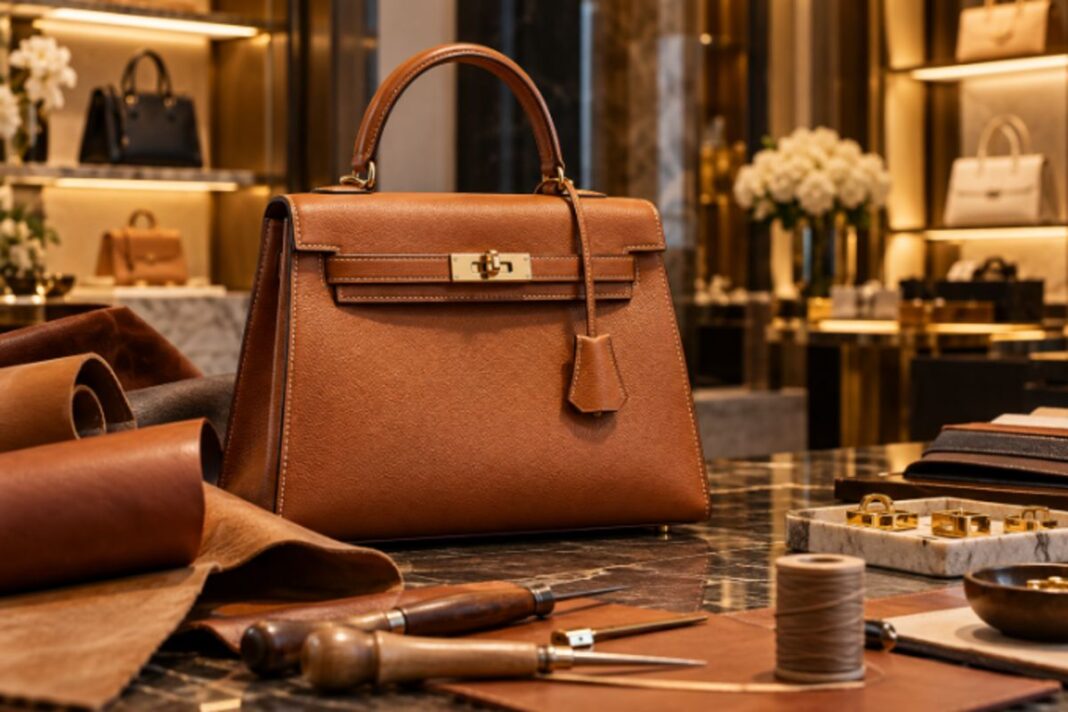

A luxury handbag may cost more than a laptop, a holiday or even a small car, but the leather and the hardware alone seldom account for a price tag that goes into thousands of dollars. The high price of a luxury bag is based not only on skilled handcraftsmanship and the use of expensive materials but also on limited supply, the presence of prestigious stores, marketing efforts and the brand’s decades of history.
The figure of a luxury boutique can be quite surprising.
A relatively simple-looking leather handbag made by a well-known fashion brand can cost several thousand dollars, and rarer or highly desired models can fetch much higher prices, especially in the used goods market.
At first glance, this raises an obvious question:
Could it really cost that much to make a handbag?
The answer is more complex than that of just totaling up the amounts of leather, thread, and metal.
The price that someone pays for a luxury bag includes the product itself, the craftsmanship, the exclusivity, the brand’s reputation and the experience associated with it.
1. Luxury Bags Can Require Extensive Handcraftsmanship
A major difference between mass-market handbags and high-end handbags is the method of their production.
Specialist leatherworkers are often employed by luxury houses, having spent years acquiring the skills which cannot easily be taken over by automated production.
For example, Hermès states that each Kelly bag is made up of about 40 separate pieces of leather, which are assembled by skilled leatherworkers. The company employs its traditional method of saddle stitching, consisting of passing the two ends of the same thread through the leather by hand. Hermès also claims that its bags are handcrafted in France and that its leather goods workshops place great reliance on specialist artisanal knowledge.
Producing in this way is fundamentally unlike manufacturing thousands of identical bags using a highly automated line.
The cost is increased by training artisans, by keeping the workshops running, and by the large amount of labour time spent on each product.
But craftsmanship by itself still does not explain the whole retail price.
2. Materials Matter – But They Aren’t the Whole Story
Premium handbags can make use of high-grade calfskin, lambskin, exotic skins, specially developed canvas, custom metal hardware and carefully chosen linings.
Because companies have the right to reject materials that do not meet the required standards for appearance or durability, the process of sourcing them becomes more expensive than buying leather in bulk.
Certain materials also need specialist processing and supply chains.
For example, Hermès covers a range of sourcing expertise, this including knowledge of French leatherworking, Mongolian cashmere, Scottish wool and specialist watchmaking in Switzerland throughout its entire product range.
It is necessary to make an important distinction.
Just because a bag costs $5,000 does not mean that it contains physical materials worth near $5,000.
The material is just one part of the overall price.
3. You Are Paying for the Brand
It is in this case that luxury differs from ordinary retail.
Suppose you look at two finely made leather bags which are the same size and made from the same materials. In that case, people might rate them very differently if one is made by a manufacturer that has been around for a century and the other is from an unknown company.
Why?
Luxury brands take decades to establish their recognition, heritage, and cultural significance.
The Monogram of Louis Vuitton, the interlocking Cs of Chanel and the Birkin of Hermès have become symbols which are widely recognized outside the fashion industry.
All these things, fashion shows, the personal relationships of celebrities, architectural flagship stores, advertising campaigns, exhibitions, and creative directors, have an effect on that perception.
And keeping it costs a lot of money.
The company LVMH, whose brands include Louis Vuitton, Dior, Fendi, Celine and a number of other luxury labels, runs more than 6,000 stores around the world as part of its various business operations. In the first six months of 2026, the Fashion and Leather Goods division achieved an operating margin in excess of 34 percent, showing that high luxury pricing not only enables large profits but also takes into account both product and operating costs.
One part of what the customer purchases is intangible, that is, the name on the bag.
4. Scarcity Can Make a Bag More Desirable
Luxury is different from a great many other businesses.
Normally a manufacturer wants to sell as many units as possible.
Luxury brands need to keep sales going while at the same time maintaining exclusivity.
If it were possible for every individual to at once purchase every prestigious handbag in all the colours, then part of the sense of rarity would vanish.
Some models therefore have a limited availability due to production capacity, material limitations, or intentional product strategies.
This may make them more difficult to get, and therefore more desirable.
Scarcity is particularly noticeable in the case of bags like the Hermès Birkin and Kelly, since the demand for some sizes, colours and materials can go beyond the supply.
What one gets is unusual in that some customers will be willing to pay more just because a product is hard to obtain.
5. The Store Experience Is Included in the Price
Luxury brands are also offering an experience.
The cost of running prime shopping areas in major cities such as Paris, Milan, London, New York and Dubai is very high.
Within the stores, brands put a great deal of money into the architecture, interior design, private shopping areas, skilled sales staff, and personal service.
For example, Louis Vuitton has been increasingly turning its main locations into cultural destinations rather than simply acting as ordinary shops, while LVMH emphasizes the special in-store experiences as part of its luxury image.
The customer will not be charged separately for the chandelier, the fashion show or the flagship building.
The costs are finally borne by the products which are sold.
6. Some Luxury Bags Hold Their Value Surprisingly Well
A further factor influencing the way consumers think regarding expensive bags is the resale value.
Certain designer bags unlike ordinary handbags which after several years may become almost worthless retain a meaningful proportion of their original value.
Certain very desirable models can in fact sell for more than their original retail prices based on their condition, rarity, and demand.
The RealReal, a luxury resale platform, points out that some bags, such as Hermès Birkins, have in the past shown strong demand when resold, while other older styles can once again become valuable when fashion trends come back.
It doesn’t mean that every luxury handbag is a good investment.
Fashion trends change and resale fees are important since a great many designer bags lose their value after they have been bought.
However, a working resale market does lead people to believe that some bags are durable luxury items rather than disposable accessories.
Are luxury bags really worth their price?
It all depends on the meaning of ‘worth’.
If someone asks whether it is worthwhile to pay a price of several thousand dollars simply on the basis of the leather, the thread and the metal, they are generally not taking into account the way luxury pricing functions.
The customer is paying for much more:
craftsmanship, design, quality control, scarcity, heritage, marketing, the retail experience and brand prestige.
Certain of those things are physical.
There are others who exist purely in the realm of perception.
And that is perhaps the most important thing to understand about luxury fashion.
A designer bag does not become expensive simply because it costs a lot to manufacture. It becomes expensive because a brand has convinced enough people, sometimes over generations, that owning that particular object means something.
That combination of real craftsmanship and perceived value is ultimately why a handbag can sell for thousands, and why customers continue to buy them.