

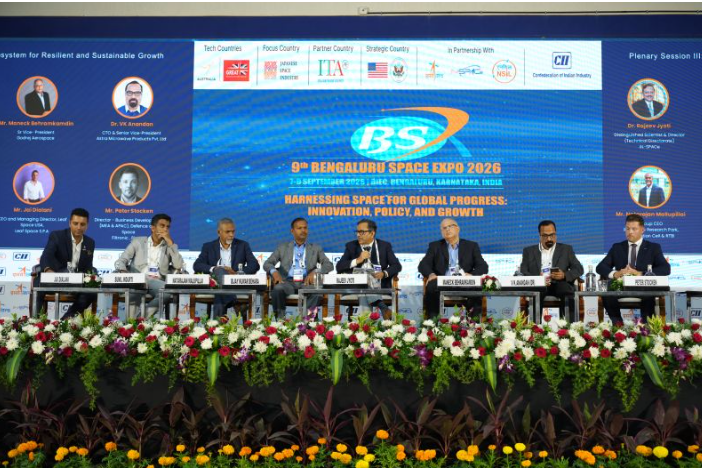

Bengaluru Space Expo 2026 brings ISRO, global space organizations, startups and private companies together as India targets a $44 billion space economy by 2033
Bengaluru has now become the center of India’s rapidly expanding space ambitions, with the Bengaluru Space Expo (BSX) 2026 getting underway on 7th September at the Bangalore International Exhibition Center (BIEC). The three-day international exhibition and conference is bringing together government agencies, private space companies, startups, researchers, policymakers, and international participants to examine the next phase of the global space economy.
The ninth Bengaluru Space Expo, taking place from 7th to 9th September 2026, is being organized by the Confederation of Indian Industry (CII) in cooperation with the Indian Space Research Organization (ISRO), the Indian National Space Promotion and Authorization Center (IN-SPACe), and NewSpace India Limited (NSIL).
The theme of this year’s event, “Harnessing Space for Global Progress: Innovation, Policy, and Growth”, reflects India’s attempt to move beyond its image as a government-led spacefaring nation and to establish a more extensive commercial space ecosystem that includes startups and the private sector.
Bengaluru Space Expo 2026 Brings Global Space Industry Together
A high level of participation from both international parties and the industry as a whole is expected for BSX 2026.
The official website for the event says that the exhibition will have approximately 250 exhibitors and that about 12,000 business visitors and 1,000 conference delegates are expected. Participation will come from people arriving from around 20 countries over the three-day event.
The exhibition features a number of rapidly developing areas within the space economy, including Earth observation, remote sensing, geospatial intelligence, satellite communications, launch vehicles, human spaceflight, space exploration, and emerging technologies.
Other important areas include space policy and regulation, financing, commercialization, space sustainability, and the reduction of orbital debris.
The range of subjects shows clearly how much the definition of the “space industry” has widened. It is no longer limited to rockets and satellites; nowadays, space-based technologies are having an ever-greater impact on telecommunications, agriculture, weather forecasting, navigation, disaster management, defense, and infrastructure planning.
India’s Private Space Industry Takes Center Stage
One of the main subjects at the Bengaluru Space Expo 2026 is the increasing role of India’s private sector.
Since 2020, India has carried out a series of reforms that have enabled greater private participation in its space sector. This has led to rapid growth in space technology start-ups and commercial companies that produce a variety of products, such as satellites, propulsion systems, launch systems, and space data platforms.
The official BSX overview states that India now has more than 300 space-tech startups, illustrating the rapid development of the ecosystem alongside ISRO’s traditional government-operated program.
On the first day of the program, it reflects this change by addressing how ISRO’s research and development can be aligned with economic growth and examining how private companies can contribute to the sector’s expansion.
There is also a session on next-generation satellites and their potential applications.
It is increasingly evident that ISRO does not have to design and carry out all its activities for the Indian space program to grow.
Instead, private companies can handle more of the commercial and routine aspects of the work, while ISRO allocates its greater resources to advanced research programs and ambitious exploration projects.
ISRO Reassures Employees Amid Privatization Concerns
There is also a major discussion about what the future holds for ISRO since private companies are playing a greater role.
Employee groups have recently requested an explanation of the potential effects of greater private-sector involvement on ISRO’s responsibilities and staff. Such concerns exist because manufacturing and operations-related capabilities are increasingly being transferred to Indian industry.
At the Bengaluru Space Expo 2026, V. Narayanan, Chairman of ISRO, emphasized that the organization remains a government body and that greater private involvement is intended to develop India’s entire space ecosystem, not to diminish ISRO’s role.
Pawan Goenka, who is the chairman of IN-SPACe, has also said that ISRO will remain the “bedrock” of India’s space sector.
The debate clearly shows the extent of the changes which are currently taking place, with India attempting to set up a commercial space industry without reducing the role of the organization responsible for some of its most important scientific and strategic achievements.
India Targets $44 Billion Space Economy
There is a much larger economic ambition situated behind the exhibition.
The space sector in India is estimated at about $8.4 billion, accounting for roughly 2-3 percent of the global space economy. The country’s long-term strategy aims to grow its domestic space economy to $44 billion by 2033, with approximately $11 billion of that from exports.
It shows an increase of more than fivefold compared to the industry’s current estimated size.
To achieve the target, India would need not only successful ISRO missions but also globally competitive private companies capable of manufacturing satellites, launch systems, and components, and of providing downstream applications to customers worldwide.
Events such as Bengaluru Space Expo therefore serve a commercial purpose alongside their scientific role.
The exhibition features business-to-business meetings designed to link together companies, investors and international partners, which may lead to opportunities for partnerships, technology collaborations and joint ventures.
From Chandrayaan-3 to a Commercial Space Ecosystem
When India enters the BSX in 2026, it will have considerable momentum in its space program.
The country’s recent achievements include Chandrayaan-3, Aditya-L1, SpaDeX and NISAR, alongside continued development of launch vehicles, satellite systems and India’s human spaceflight ambitions.
The next phase of India’s space program might well be judged not simply on the basis of accomplished missions.
It will also depend on whether India can transform its tech capabilities into a sustainable commercial ecosystem.
The global opportunity is enormous. The official Bengaluru Space Expo website cites the Space Report 2025 Q2, which estimates the global space economy at $613 billion in 2024, while projections from the World Economic Forum and McKinsey imply it could reach approximately $1.8 trillion by 2035.
For Indian manufacturers, engineers, start-ups, and technology companies, there would be considerable opportunities if they secured an even larger share of that market.
Bengaluru Reinforces Its Position as India’s Space Capital
Bengaluru is well suited to this kind of transformation.
The city has long been closely associated with India’s aerospace and space programs and today combines ISRO’s institutional presence with a growing network of startups, engineering companies, research institutions and technology talent.
Bengaluru Space Expo 2026 brings those different parts of the ecosystem together under one roof.
The exhibition reflects the wider shift occurring in India’s space program, moving from a period when government missions had almost entirely dominated to one in which ISRO, startups, established companies, and international partners all function as part of a larger space economy.
As BSX 2026 continues through September 9, discussions around private participation, satellite technologies, international partnerships, and forthcoming exploration are likely to shape the conversation.
India has already demonstrated its ability to reach the Moon and carry out complex space missions. The next challenge for it, however, is to translate its many years of scientific expertise into one of the world’s most competitive space economies.