


Akshay Kumar, Saif Ali Khan, and Kunal Kemmu films compete for September viewers, biggest weekend in Indian cinema faces split audience verdict
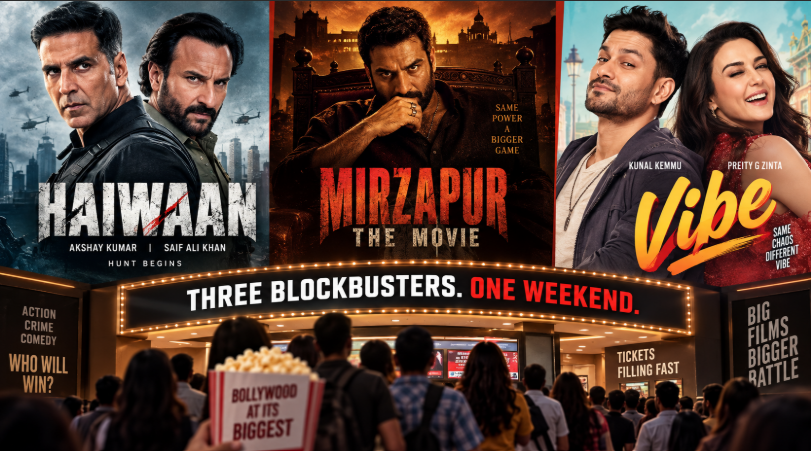
In September 2026, there will be unprecedented competition in the Bollywood industry, with three major film releases hitting the Indian box offices at the same time, Haiwaan (starring Akshay Kumar and Saif Ali Khan), the crime drama Mirzapur: The Movie, and Vibe (with Kunal Kemmu and Preity Zinta), thus producing what is being described as the highest-stakes multiplex weekend in recent cinema history.
Releasing the films at the same time could divide the audience. Whether Indian audiences are willing to have three major releases at once is a topic industry analysts are debating, as is whether having the audience split this way results in lower box office collections for all three films than with spread-out releases.
Haiwaan: Action-Packed Akshay Kumar Vehicle
The film Haiwaan, starring Akshay Kumar, is meeting high expectations. Since it is being promoted as a fast-paced action drama featuring Akshay Kumar and Saif Ali Khan, it promises to include spectacular scenes, complex set pieces, and the appeal of having the two stars to draw in Akshay Kumar’s regular audience.
The production budget shows what kind of ambition a project has; the estimated ₹150 crore that has been allocated to production and marketing at Haiwaan involves a considerable financial risk and therefore demands a very strong performance at the box office in order to become profitable, this in turn puts pressure on the targets for the opening weekend.
The early response from audiences seems promising, since advance ticket bookings have shown Haiwaan taking up 35 per cent of the available screens in multiplexes in the major cities, which shows that the cinema chains believe there to be strong public demand and that the film will be commercially viable.
Mirzapur: The Movie’s Streaming-to-Cinema Transition
Mirzapur is an example of an experimental release strategy. When Prime Video adapted its popular series for the big screen, it tried something never done before by moving from streaming to cinema, on the basis that the loyal fan base acquired over three seasons of OTT content would also show up in cinemas.
The production quality remains higher than that of streaming services. The theatrical film had a production cost of ₹80 crore and included cinematic scope, longer action sequences, and an improved visual presentation that goes beyond what is possible with streaming television, this being the reason for the higher prices charged in cinemas.
There is apparently strong excitement among people before the release. The buzz on social media about Mirzapur: The Movie suggests that fans are looking forward to it enthusiastically, with dedicated viewers of the series deciding to go to the cinema even though other films are coming out at the same time.
Vibe: Dark Comedy Featuring Preity G Zinta
The film Vibe, by Kunal Kemmu, provides a tonal contrast. Although it is promoted as an action-comedy featuring physical humor, clever dialogue, and surprising plot twists, it is aimed at viewers who want something lighter than the serious action-drama offered by its two rivals.
The fact that Preity G Zinta is making a return causes a great deal of interest; her comeback to the screen after a long break appeals to audiences who are nostalgic for the earlier phase of her career while at the same time bringing her talent to the attention of younger people who are not familiar with her filmography.
The fact that Vibe’s production budget is ₹45 crore suggests that the film has a moderate level of risk when compared with its competitors, since break-even can be achieved by combining theatrical box office receipts with the sale from digital streaming rights after the theatrical run.
Screen Allocation and Theater Competition
Multiplex chains have to make difficult decisions regarding allocations. The big theater chains, such as PVR, IMAX and Cinepolis, spread their premium screens over three film releases, so that the competitive box office performance of each film depended on how the screens were allocated in terms of quality and seating capacity.
Observers in the industry noticed that the screens had been allocated strategically in a way that showed the level of confidence held by the distributors, with 40% of the premium screens going to Haiwaan, 35% going to Mirzapur, and 25% going to Vibe, thus establishing different advantage levels that have an impact on collection potential.
Expert Predictions and Box Office Forecasts
Industry analysts expect the results to be split. The predictions for box office takings vary greatly, since in the more optimistic cases the total weekend earnings are expected to be between ₹120 and ₹150 crore (together), whereas the more pessimistic estimates cautions that the takings might fall short if audience fragmentation stops any one film from gaining strong momentum.
Trade analysts are especially worried regarding the effect on the box office revenues of smaller towns, since single-screen cinemas cannot show three films at the same time and are therefore forced to decide which of the competing films to show on their single screen.
Audience Sentiment and Consumer Interest
Analysis of social media shows what people prefer, with the engagement figures on Instagram, Twitter, and YouTube indicating that the most interest was shown for Mirzapur: The Movie (85 million video views), then Haiwaan (72 million views) and finally Vibe (45 million views), this suggests that public interest influences market performance in a pyramid structure.
Engagement figures do not always match with box office receipts, since different audience groups have different preferences about whether to watch content via streaming or in theatres.
Marketing Expenditure and Promotional Blitzes
The amount spent on marketing exceeds the cost of production. The total marketing expenditure across three films amounts to ₹95 crore, achieved through television advertisements, digital advertising, theatre promotions, and celebrity appearances, this has led to a situation in which the audience may be confused or the individual message of each film may be diluted.
An analysis of the promotional strategies shows that each film is aimed at a different demographic group, Haiwaan at the general public, Mirzapur at millennial OTT users, and Vibe at families who prefer comedy, thereby lowering direct competition.
Weekend Collection Dynamics along with Performance Tracking
The trajectory will be determined on Friday; the first-day box office figures provide important indications of momentum, since daily collections exceeding ₹15 crore (for individual films) point to strong audience acceptance and, in turn, aim at sustainable retention during the second weekend.
The industry participants will keep a close eye on collection patterns, obtaining data regarding the best theatrical release spacing, audience demand for simultaneous releases, and the market feasibility of streaming-to-cinema transitions.
Long-Term Industry Implications
The results this weekend have considerable significance in terms of establishing a precedent. Should all three films do well, the industry might adopt simultaneous major releases, thus disrupting traditional release patterns and leading to continuous competition for multiplex allocations.
On the other hand, if films released to divided audiences have disappointing box office results, the studios might revert to phased release strategies so that each film receives undivided audience attention and can maximize its box office potential.
Word-of-Mouth and Post-Weekend Momentum
Critical reviews have a significant effect on sustainability. If a film receives strong critical reviews, it will be able to maintain its collections over the weekend periods following its opening, whereas bad reviews cause a quick loss of audience, making Monday through Wednesday retention an important indicator of the final box office figures.
The performance during the second weekend will definitely show which film has managed to attract audiences, keep them pleased through word-of-mouth, and sustain audience loyalty throughout its theatrical run.
Conclusion: Bollywood’s Simultaneous Release Gamble
The three-film clash is a bold industry experiment. September 2026’s Bollywood weekend will offer definitive answers regarding market capacity for simultaneous major releases, audience segmentation potential, and the optimal strategic release timing to maximize theatrical profitability.