

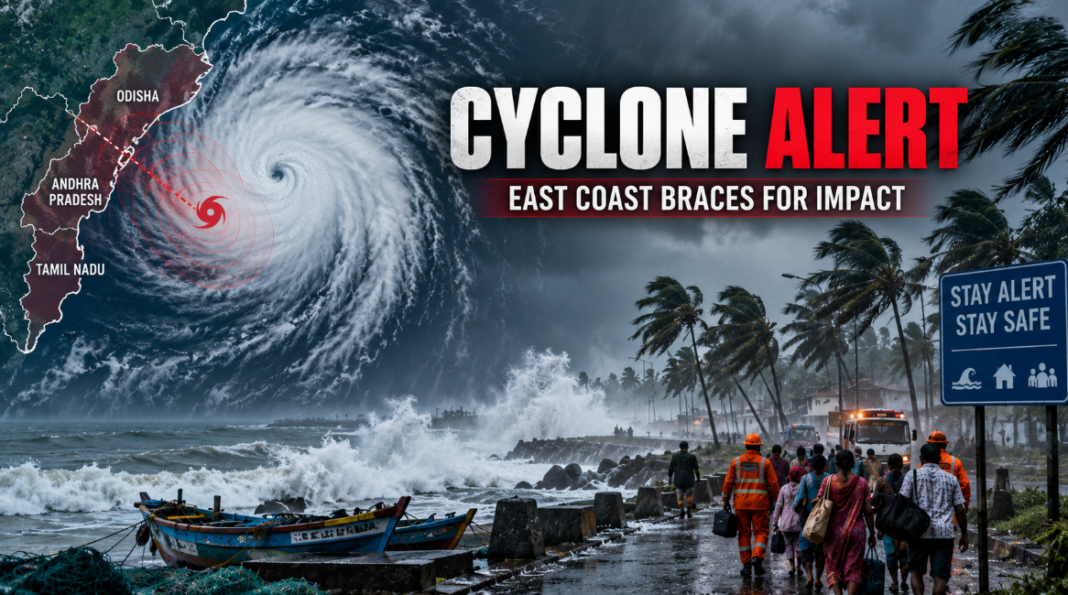

Severe cyclone expected September 10-12, authorities issue evacuation alerts as 2 million residents prepare for extreme weather
There is an immediate danger of a cyclone along India’s east coast. The India Meteorological Department has issued a red alert cyclone warning for the coastal areas of Odisha, Andhra Pradesh and Tamil Nadu, forecasting that a severe cyclone will arrive between 10th and 12th September, the winds possibly going above 150 km/h and a storm surge posing a threat to coastal populations.
The threat grows very quickly. Meteorological modelling shows that the cyclone will become stronger as it nears Indian waters since the climatic conditions are suitable for rapid intensification, bringing the level of catastrophe well above the forecasts that had been made 48 hours earlier.
The authorities put into effect the emergency procedures. The state governments, the National Disaster Management Authority (NDMA), and the Indian Navy arranged their resources in order to carry out evacuations, rescue operations, and disaster response, being ready to deploy about 50,000 personnel in the affected areas.
Evacuation Operations Commence Immediately
Coastal areas are required to relocate their people. The district administrations have begun evacuating about 2 million residents from low-lying coastal regions, prioritizing vulnerable groups such as elderly people, pregnant women, and people with medical conditions requiring provision of specialized healthcare during disasters.
Evacuation centers have been set up. The government opened 8,000 relief camps in three states, offering evacuated families food, water, medical care, and temporary accommodation, an effort that involved coordination among several administrative teams responsible for logistics for millions of people.
The difficulties associated with transportation make operations more difficult since train services were stopped, highway traffic was diverted, and air operations were suspended in the affected areas, which led to bottlenecks during evacuations as the limited transportation capacity had to handle millions within a short period of time.
Fishing Community Warnings
The fishermen were told to stop their activities. Maritime authorities released prohibitory instructions requiring all fishing vessels to go back to harbour, halt their deep-sea fishing operations, and secure their boats in protected marina facilities, measuring the threat to the livelihoods of about 500,000 fishing families who depend on daily catches.
Fishing groups have warned that economic ruin could result, since a three-day ban on fishing halts income during the peak harvesting season and may cause financial difficulties for fishing families with very little financial backup.
Storm Surge and Flooding Projections
Coastal flooding poses a serious danger; meteorological forecasts suggest that low-lying coastal areas could experience a storm surge of 2 to 3 meters, putting agricultural land, settlements, and infrastructure at risk and leading to complex disaster situations involving wind damage, flooding, and saltwater intrusion.
The agricultural damage forecasts suggest that crop losses could amount to between ₹5,000 crore and ₹10,000 crore, with rice-growing areas most affected, as they base their harvesting times on monsoon patterns, thus worsening the economic damage beyond that caused by the cyclone itself.
Power Infrastructure and Supply Chain Disruption
The supply of electricity is likely to be disrupted. As a precaution, the power distribution authorities have disconnected the overhead power lines in areas susceptible to damage, carried out load shedding, and deployed emergency teams to repair the damage, since the infrastructure is expected to sustain extensive damage and will therefore take several days to restore.
The communication infrastructure is in danger. To prepare for possible service interruptions of between 24 and 48 hours that could impact emergency coordination capabilities, telecommunications companies have carried out network redundancy checks, tested their backup generators, and tested their emergency communication procedures.
Hospital Preparedness and Medical Response
The healthcare systems took action. The hospitals along the coast made more beds available, stockpiled medical supplies, set up emergency operations centers, and sent out mobile medical units, all in preparation for a rise in injuries caused by the cyclone, weather-triggered medical emergencies, and disease outbreaks that would follow.
To ensure that antibiotics, pain relievers, and drugs used in the management of chronic diseases remained available despite disruptions expected during the cyclone’s passage, pharmaceutical supply chains accelerated deliveries to impacted areas.
Educational Institution Preparedness
Schools and universities were closed, and the educational authorities declared that all schools and colleges should remain closed during the cyclone warning period, turning them into disaster-response centers to coordinate the emergency response, manage casualties, and carry out post-cyclone recovery operations.
Damage Prevention Measures
Measures are currently being taken to protect the infrastructure. The public works departments carried out emergency maintenance on the bridges, dikes, and coastal embankments to reinforce vulnerable infrastructure before the cyclone arrived, bringing extremely strong winds and high water levels.
The agricultural authorities distributed crop-protection materials, advised farmers on emergency measures, and provided guidance on protecting both livestock and agricultural equipment from damage caused by the cyclone.
Economic Impact Projections
The insurance sector is preparing to handle claims. To that end, insurance companies have established claim adjustment teams, emergency helplines, and automated compensation systems, since they expect a large number of claims related to property damage, agricultural losses, and vehicle destruction in the affected areas.
Economic forecasters expect the cost of the cyclone to lie between ₹20,000 crore and ₹30,000 crore, depending on its actual path, strength, and duration, which will affect the states’ budgets, GDP growth forecasts, and the nation’s economic performance indicators.
Weather Updates and Live Monitoring
Meteorological updates are still being issued. The India Meteorological Department publishes cyclone position updates every three hours, along with adjustments to the track and reassessments of intensity, this allows authorities to alter their evacuation plans and disaster response strategies as the situation changes.
It is possible to track cyclones accurately using real-time satellite imagery, but because cyclones sometimes deviate from predicted paths, ongoing surveillance and flexible emergency response procedures remain necessary.
International Coordination and Support
Regional countries arrange to provide aid. In the case of Bangladesh, Myanmar and Sri Lanka, coastal evacuations and emergency measures were put into action since the cyclone’s track forecasts indicated it could affect several areas of the countries.
International humanitarian organizations had relief supplies ready in advance, worked with the Indian authorities on the reconstruction efforts after the cyclone, and set up volunteer networks to carry out emergency response operations.
Social Media and Public Communication
The spread of information was important. Government agencies used WhatsApp, Twitter, and local radio broadcasts to issue evacuation orders, provide details on shelter locations, and share emergency contact numbers, reaching the population via multiple channels to ensure the public was fully informed.
Critical Response Timeline
The time frame available for evacuation is getting smaller. Since a cyclone is expected to reach the area within 36 to 48 hours, the evacuation procedures must be completed within this very short period, which in turn requires extraordinary coordination, community participation, and administrative efficiency to successfully move the population.
The time it takes to recover from the cyclone will be several weeks or even months, depending on the extent of the damage, this calls for a continued humanitarian response, the reconstruction of infrastructure, the restoration of people’s livelihoods, and the provision of psychological counseling for affected communities.
The cyclone warning is India’s most serious emergency; survival will depend on the swift execution of evacuations, the public’s cooperation with the authorities, and effective coordination of the disaster response, this will decide whether a tragedy becomes a manageable disaster or a catastrophic humanitarian crisis touching millions.