

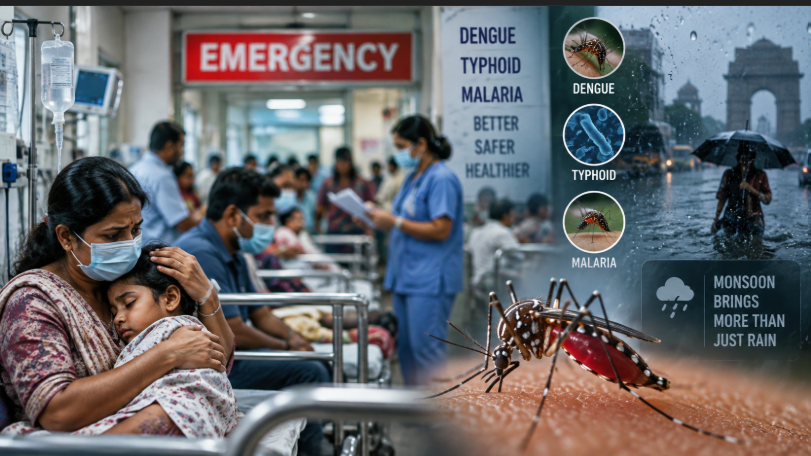

Hospitals overwhelmed as dengue, typhoid, and malaria cases surge during peak monsoon season; disease experts alert of crisis without immediate action
The Indian healthcare system is under unprecedented pressure as the monsoon season worsens across the country. The National Center for Vector-Borne Disease Control states that India sees 1.5 million cases of vector-borne diseases each year during the monsoon period, the majority of which are due to malaria, dengue, chikungunya, and Japanese Encephalitis.
The surge is putting tremendous pressure on hospital facilities across the country, with emergency departments filled with patients with monsoon-related illnesses and medical staff having to work extra hours to handle the high volume of admissions in various cities.
Each monsoon season, the emergency departments of large hospitals become much busier, with families coming in with fevers lasting three days, children who have stopped eating, and adults who have not sought medical attention early enough.
Dengue Fever Cases Spike Alarmingly
Dengue fever is the greatest health problem during the monsoon season. In 2024,, India recorded more than 230,000 confirmed cases of dengue, and Mumbai has always been one of the most affected cities. The Aedes aegypti mosquito, which transmits dengue fever, lays its eggs in clean standing water in coolers, flowerpots, buckets, and blocked drains.
The quick progression of the disease leads to hospital emergencies; between days 3 and 7 of the illness, there is a danger period during which patients may feel better just before their platelet count drops sharply, this causes families to incorrectly think that recovery has started and results in dangerous delays when seeking hospital treatment.
Healthcare experts caution that when the platelet count drops below 1 lakh, it is necessary to go to hospital at once; failing to do so may lead to serious complications or death.
Hospitals Functioning Beyond Capacity
In India, occupancy rates at major hospitals exceed 90 percent during the peak monsoon months, and pediatric wards, since they deal with children’s fevers and illnesses that occur in the rainy season, experience particular pressure because younger patients tend to worsen more quickly than adults.
Hospitals have set up separate pediatric outpatient departments. This keeps children from waiting in general lines. It also helps young patients with childhood fever get seen and treated faster during the rainy season.
Waiting lists are now regularly introduced in emergency departments, and patients with non-critical cases have to wait between 6 and 8 hours before being seen by a doctor.
Typhoid and Waterborne Diseases Surge
The number of typhoid cases rises significantly during the monsoon period from June through September. In different regions of India, during the four-month monsoon period stretching from June to September, the numbers of cases of dengue, malaria, typhoid and gastroenteritis all increase greatly.
Waterborne diseases increase when stagnant water contaminates the city’s water supplies, and in its 2024 “Climate and Health” bulletin, the India Meteorological Department attributes 70 percent of waterborne disease outbreaks to the monsoon season from June through September.
The demand for treatment exceeds the pharmaceutical supplies available in hospitals, resulting in shortages of essential antibiotics and diagnostic materials.
Child Fever and Monsoon Season Challenges
The cases involving children are especially worrying. Fever in children during the rainy season is one of the main reasons parents go to hospital from July through September, even though the majority of these cases do not require hospitalization. Pediatric teams observe that children can worsen more quickly than adults.
It is common for parents to put off seeking medical help on the assumption that a fever will go away on its own. This delay often leads to complications that need intensive medical treatment.
Prevention Strategies Reduce Burden
Health experts stress the importance of prevention in managing outbreaks of monsoon-related diseases. Basic precautions can greatly reduce the risk of infection.
Indian families can follow these monsoon health tips such as emptying any stagnant water from coolers, buckets and containers once a week; drinking only water that has been boiled or filtered; not leaving cut fruit at room temperature for over one hour; avoiding the use of leftover antibiotics as a means of self-treatment; and wearing clothes with long sleeves during the evening when mosquito movement is at its peak.
General testing procedures aid in the prompt detection of the condition. If monsoon fever develops, doctors advise starting with a CBC combined with a platelet count, since this diagnostic test gives an initial indication of dengue, malaria, typhoid, and bacterial infections, and then further tests, such as the NS1 test, the Typhidot test, and a malaria smear, are suggested according to the results of the first test.
Hospital Preparation and Checkup Packages
Forward-thinking medical organizations offer health check-up packages for the monsoon season to detect possible risks before serious illnesses occur. Healthcare providers offer comprehensive monsoon health checkups that include a full blood count, blood sugar testing, tests to assess kidney and liver function, a urine analysis, and a consultation with a doctor to detect diseases at an early stage.
These precautionary packages enable early intervention and help reduce hospital admissions and emergency department congestion.
Healthcare Infrastructure Needs
The seasonal surge indicates broader weaknesses in the medical system. When planning hospital capacity, it is necessary to account for a 5- to 10-fold increase in cases of certain diseases during the monsoon months. Sufficient staffing, pharmaceutical supplies, and diagnostic equipment must be in place at all times of the year.
Urgent Action Required
Medical experts have cautioned that if the healthcare system is not immediately strengthened, the crises during the monsoon season will worsen. There is an immediate need to increase the number of hospital beds, make more trained medical staff available, and expand diagnostic facilities.
Famous healthcare providers stress the importance of teaching the public how to prevent and treat monsoon-related diseases, since although the monsoon season is refreshing and vital for the environment, it also brings considerable health problems that cannot be ignored.
Coordinated community health campaigns, vaccination programs, and improved disease surveillance are essential elements in dealing with India’s monsoon healthcare crisis.