


A decade ago, paying a roadside vendor, splitting a dinner bill, or wiring money to family meant scrambling for exact change, typing out 16-digit account numbers, or waiting on clunky bank portals.
Today, it takes all of three seconds and a quick camera scan. Marking a full decade since its public rollout, the Unified Payments Interface (UPI) has completely transformed India’s economic fabric. What started as an ambitious technical framework to connect bank accounts has grown into the undisputed backbone of everyday trade.
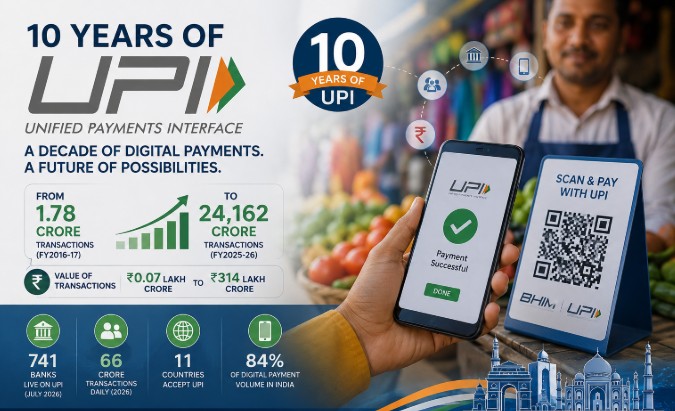
The shift in volume tells the real story. According to Finance Ministry data, annual UPI transactions surged from just 1.78 crore in FY2016–17 to an eye-watering 24,162 crore in FY2025–26. In rupee terms, total processed value skyrocketed from ₹0.07 lakh crore to ₹314 lakh crore over the same stretch. From 21 Banks to a Nationwide Highway
Long before laminated QR codes became a fixture at every tea stall and corner store, UPI was just an idea built around open interoperability.
Engineered by the National Payments Corporation of India (NPCI), the platform was designed so users wouldn’t get locked into a single banking app or proprietary wallet. On April 11, 2016, then-RBI Governor Raghuram Rajan kicked off a pilot with 21 member banks. By August 25 of that year, NPCI officially took the system live for the general public.
Fast forward to July 2026: 741 live banks now run on the UPI rail.
The real magic was removing friction. It didn’t matter if a customer banked with HDFC and used PhonePe, while the merchant banked with SBI and displayed a Paytm standee. UPI quietly handled the handshakes in the background, making money move seamlessly between rival apps and banks.
The Scale of Everyday Transactions
Few growth curves in modern finance match UPI’s run:
- FY2016–17: ~1.78 crore transactions (₹0.07 lakh crore)
- FY2025–26: ~24,162 crore transactions (₹314 lakh crore)
- July 2026 Peak: 2,366 crore monthly transactions worth ₹29.88 lakh crore
- Daily Run Rate (2026): Roughly 66 crore payments processed every 24 hours
Digital payments are no longer reserved for e-commerce checkouts or monthly utility bills. Instead, micro-transactions dominate the network auto fares, chai cups, fresh vegetables, and quick convenience runs. Today, UPI accounts for roughly 84% of all digital payment volume across the country.
The Lowly QR Code Won the War
UPI’s crowning achievement didn’t happen in corporate boardrooms or glossy retail malls; it happened on the street. Before QR codes, accepting digital money meant buying, charging, and maintaining a dedicated POS card swipe machine an expense and logistical headache no small vendor wanted. A printed QR standee changed the equation entirely. Zero hardware maintenance, zero setup friction.
“Bhaiya, QR code dena” evolved from an occasional question into the default way millions of Indians settle transactions every day.
Exporting the Infrastructure
UPI is no longer confined to the subcontinent.
With acceptance live across 11 countries, India is actively pushing its real-time payment architecture into international travel corridors and cross-border remittance routes. Beyond convenience for Indian travelers abroad, global financial institutions have taken note. In 2025, UPI handled roughly 49% of all global real-time payment transactions, earning praise from the International Monetary Fund (IMF) as the world’s largest retail fast-payment system by sheer volume. It has quietly become one of India’s most effective digital exports.
Why It Worked
UPI didn’t succeed through a top-down mandate alone. It took off because several pieces fell into place at the right moment: cheap mobile data, widespread smartphone adoption, zero-balance bank accounts, and an interface simple enough for anyone to pick up instantly. Typing IFSC codes and adding beneficiaries created friction; typing a four-digit PIN after scanning a code removed it.
Looking Ahead
In 2016, processing billions of instant transactions each month sounded like an engineering pipe dream. By 2026, it became routine background noise.
As UPI enters its second decade, the priorities will shift from raw volume growth to tightening fraud defense, expanding credit integration, improving system uptimes, and building deeper cross-border payment links. But its primary legacy is already secured: it fundamentally changed the way an entire nation handles money.