

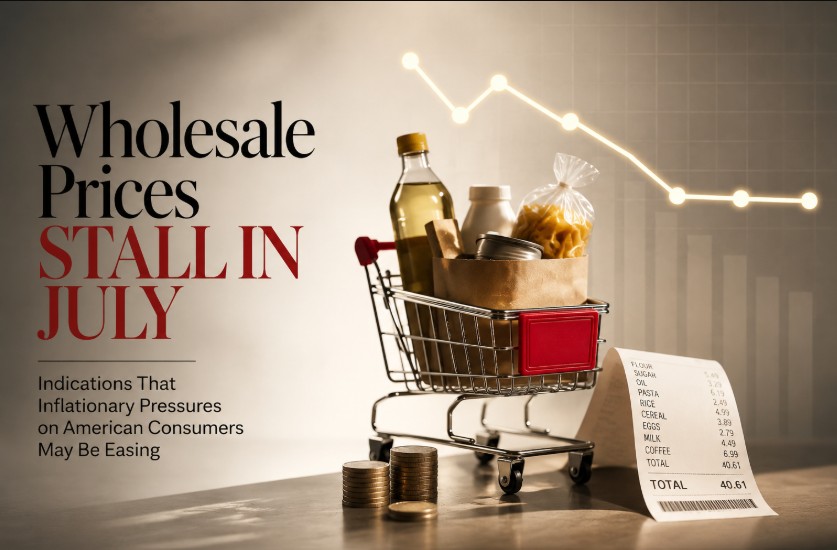

Stable wholesale price data raises expectations for consumer relief as price pressures moderate throughout the economy.
Wholesale prices remained unchanged in July, representing a notable departure from the persistent increases observed in previous months that have strained household budgets nationwide.
The stagnation in wholesale price inflation, which was below economists’ expectations of a 0.2% increase, indicates that businesses may be reaching the limit of their capacity to transfer rising costs to consumers. For households facing elevated expenses for groceries, rent, and energy, this development may signal the onset of meaningful relief.
However, the inflation outlook remains complex, and the apparent positive news may obscure underlying economic challenges that could temper consumer optimism.
The Wholesale Price Surprise
Wholesale prices, defined as the costs businesses incur for goods prior to retail distribution, serve as a leading indicator of consumer inflation. Increases in wholesale prices are typically followed by corresponding rises in retail prices within weeks or months. Conversely, when wholesale inflation stabilizes, slower growth in consumer prices is generally anticipated.
The unchanged wholesale price reading for July is significant as it interrupts a sustained trend of upward pressure that has defined inflation since 2021. For seventeen consecutive months, wholesale prices increased each month. Even as the broader inflation narrative shifted from a crisis to a persistent challenge, wholesale data consistently reflected rising input costs for businesses.
The current data indicates that this prolonged trend may be reversing.
What’s Driving the Stall?
Several converging factors have contributed to the flat wholesale price reading. Energy prices, which increased earlier in the summer due to geopolitical tensions, have moderated. Agricultural commodity prices remain subdued due to abundant supply. Manufacturing costs have stabilized as supply chain disruptions affecting American industry have largely been resolved.
Most notably, consumer demand appears to be declining. After months of elevated prices, consumers have reduced discretionary spending. Restaurants have reported decreased patronage, and retail sales growth has slowed. When businesses are unable to increase prices due to diminished consumer willingness to pay, wholesale inflation ceases.
This dynamic is direct and effective: consumer spending patterns have clearly signaled reduced tolerance for higher prices.
The Consumer Implications
If wholesale prices remain stable or decline in the coming months, retail prices are likely to follow. This development could offer substantive relief for households affected by cumulative price increases. Grocery retailers, in particular, may experience reduced pricing pressure, potentially enabling families to restore their food budgets.
Energy costs, historically volatile, appear to be stabilizing at elevated but manageable levels. Utility bills, while higher than 2020 levels, may stop climbing as rapidly.
However, any relief is expected to be gradual. Retailers frequently maintain elevated prices even after wholesale costs decrease, which contributes to the continued perception of financial strain among consumers despite improving inflation data.
The Economic Paradox
The situation is complex: stable wholesale prices may indicate a slowdown in economic growth. Businesses refrain from raising prices not out of benevolence, but due to weakening demand. As demand declines, businesses reduce hiring, wage growth stagnates, and unemployment may increase.
Recent employment data already hints at this dynamic. While unemployment remains historically low, the pace of job creation has slowed. Wage growth, when adjusted for inflation, has actually declined. Americans are working, but earning less in real terms than they were a year ago.
The challenge of inflation may be transitioning into concerns regarding employment.
The Federal Reserve’s Dilemma
The Federal Reserve is confronted with a complex policy dilemma. If inflation is moderating and demand is weakening, reducing interest rates may become necessary to support economic growth. However, since inflation remains above the Federal Reserve’s 2% target, premature rate cuts could reintroduce inflationary pressures.
Policymakers are attempting to balance easing financial conditions to prevent a recession with maintaining sufficient policy restraint to avoid a resurgence of inflation. While stable wholesale data may support consideration of rate cuts, it does not constitute a definitive mandate.
Financial markets will closely monitor the Federal Reserve’s forthcoming policy decisions. A shift toward interest rate reductions could bolster stock prices and economic growth, but may also signal that inflation remains the central concern, potentially disappointing stakeholders seeking more assertive measures.
What Happens Next?
Economists maintain cautious optimism while acknowledging ongoing risks. A single month of stable wholesale data does not indicate that inflationary pressures have been fully resolved. Global energy markets remain susceptible to shocks, supply chain disruptions could reemerge, and consumer demand may increase if confidence is restored.
Nevertheless, current trends suggest a more favorable outlook. Should wholesale prices decline or remain stable in the coming months, consumers may experience significant price relief by autumn. Mortgage rates, which reflect long-term inflation expectations, could stabilize or decrease. Elevated credit card debt may become more manageable if interest rate reductions occur.
The outlook remains uncertain; however, for the first time in nearly two years, potential outcomes include both positive and negative scenarios.
For Your Wallet
What July’s wholesale data means for you:
* Grocery shopping: Expect slower price growth in coming months, but existing high prices won’t drop immediately
* Utility bills: Energy costs may stabilize but remain higher than pre-2021 levels
* Interest rates: Watch for the Fed to consider cutting rates if inflation data continues improving
* Hiring: Job growth may slow as businesses face weaker demand; seek stable employment
* Savings: With inflation cooling, savings accounts and CDs become more attractive
* Investments: Stock market volatility may decrease if rate-cut expectations firm up
The Bigger Picture
Stable wholesale prices in July represent a significant turning point. After years of businesses transferring rising costs to consumers, this pattern appears to be changing. It remains uncertain whether this shift will result in substantial consumer relief or contribute to an economic downturn.
It is evident that the period of persistent price increases is concluding. Whether this transition results in a soft landing characterized by stable prices and moderate growth, or a more severe outcome involving rising unemployment and weak demand, will shape the future trajectory of the American economy.
For consumers affected by prolonged price increases, July’s data provides cautious optimism that relief may be forthcoming. However, this optimism is not assurance, and the resolution of inflation will only be confirmed retrospectively.
Key Takeaway:
The stabilization of wholesale prices in July constitutes a significant milestone in the context of inflation. If this trend persists, consumers may anticipate slower price growth in the coming months, potentially providing relief for household budgets. However, the factors contributing to reduced inflation, such as weakening demand and economic slowdown, also present inherent risks.
The narrative surrounding inflation in the United States is shifting from efforts to control it to considerations of future developments. The outcome will significantly influence the economic circumstances of millions of households in the coming months.