

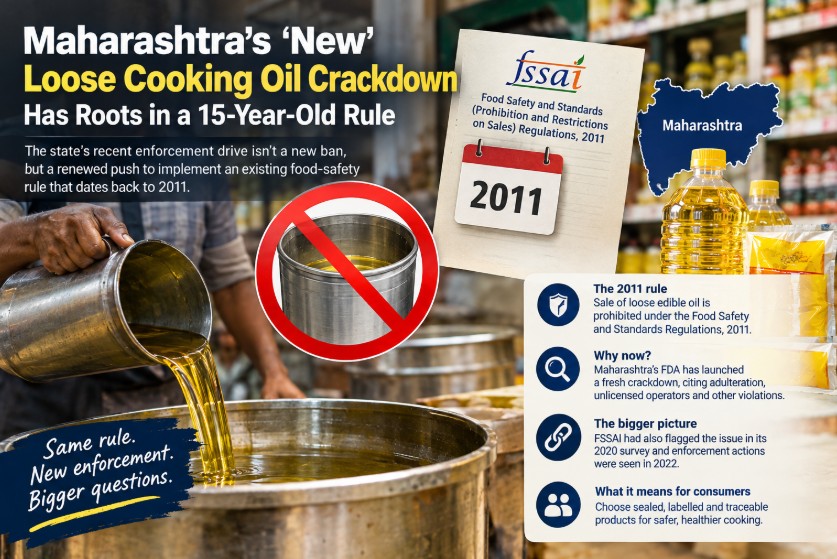

Maharashtra’s crackdown on loose edible oil has made headlines as a major new food-safety measure. But there is an important detail behind the announcement: the underlying restriction is not new. On August 20, 2026, the Maharashtra Food and Drug Administration issued a statewide compliance and enforcement order covering the edible-oil supply chain, including manufacturers, distributors, retailers, supermarkets and online sellers. The FDA also urged consumers not to purchase loose or unsealed edible oil.
What is new, therefore, is the renewed and intensified enforcement drive. The regulatory foundation behind it goes back much further.
The Rule Goes Back to 2011
The Food Safety and Standards Authority of India has previously stated that the sale of loose edible oil is prohibited under the Food Safety and Standards (Prohibition and Restrictions on Sales) Regulations, 2011.
The historical record is particularly important here.
In its Edible Oil Survey 2020, FSSAI noted that some loose samples had been collected during its survey, indicating that edible oils continued to be sold in unpackaged form. It subsequently recommended that state authorities crack down on the practice, describing the sale of loose oil as prohibited under Regulation 2.3.15. This means Maharashtra’s 2026 action should not simply be understood as the state suddenly inventing a prohibition on loose oil. It is better understood as a major enforcement push around food-safety requirements that have existed for years.
Why Is It Making Headlines Now?
On August 20, Maharashtra FDA Commissioner Tukaram Mundhe announced a comprehensive compliance order for the edible-oil sector and urged consumers to avoid loose or unsealed oil. The scale of the enforcement drive helps explain why the issue has suddenly attracted attention. According to figures disclosed by the Maharashtra FDA, 1,247 edible-oil samples were collected during the 2025–26 financial year. Of the 1,142 samples analysed, 77 were found to be substandard and 15 were reportedly misbranded.
Authorities also seized approximately 3.20 lakh kilograms of edible-oil stock valued at ₹5.31 crore.
The FDA said inspections had identified several types of violations, including adulteration, unlicensed operations, improper packaging, high acidic values and excessive trans-fat levels. Cases involving mustard oil allegedly being mixed with other oils were also identified.
Loose Oil Creates a Traceability Problem
One of the FDA’s strongest arguments against loose edible oil is not simply that the oil is unpackaged. It is that its origin can become difficult to establish. A properly packaged edible-oil product carries information that can help identify its manufacturer, batch and other details. If authorities discover a problem, that information can help trace the product through the supply chain.Loose oil can remove much of that visibility. If oil passes through several wholesalers and retailers before reaching a consumer without adequate packaging or documentation, determining exactly where it originated becomes significantly more difficult.That creates opportunities not only for adulteration but also for misbranding and other quality-control problems.
This Is Not the First Crackdown
There is further evidence that authorities were acting against loose edible oil well before 2026. During an FSSAI surveillance campaign conducted in August 2022, authorities collected thousands of samples of edible oils, vanaspati and multi-source edible oils across India.The official report also recorded seizures connected with the sale of loose edible oil in several states.The 2026 Maharashtra action is therefore part of a much longer regulatory story.
A New Order, But an Old Problem
There is an important distinction to make.Maharashtra’s August 2026 compliance and enforcement order is new.The broader regulatory effort to prevent the sale of edible oil in prohibited loose forms is not.
That distinction matters because describing the development simply as a “new ban” can give consumers the impression that loose edible oil was freely permitted until Maharashtra suddenly changed the law in 2026.
The regulatory history tells a more complicated story.
Rules existed. Enforcement existed at various points. But loose oil continued to reach consumers.
The real question is therefore not simply:
Why did Maharashtra ban loose cooking oil?
It is:
Why has a food-safety problem that regulators identified years ago continued for so long?
And that may ultimately be the most important part of Maharashtra’s latest cooking-oil crackdown.