

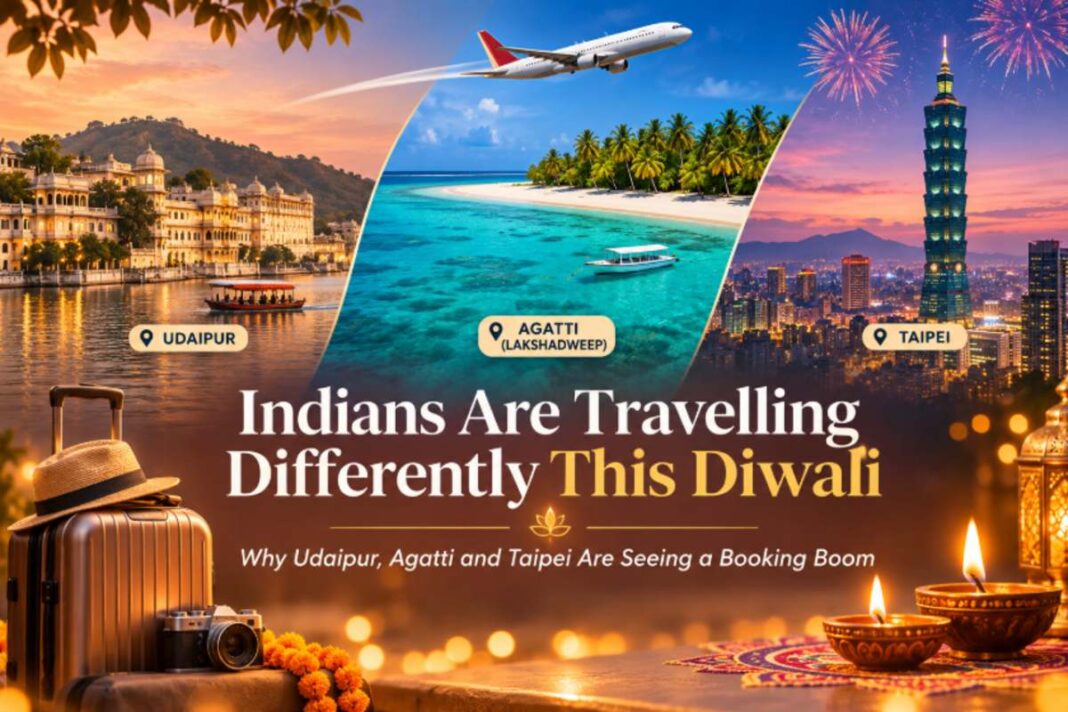

Diwali in India has always been about getting home, buying new clothes, giving and receiving gifts and celebrating with the family. In 2026 it appears that an increasing number of Indians are using the break for a holiday. Cleartrip’s data shows Diwali leisure hotel bookings are up 135% on last year (Udaipur up 316%). A whole host of destinations have seen huge growth in bookings with Agatti, Dimapur, Taipei and Cebu all among the fastest growing. It’s a clear sign of a broader shift in the festive economy in India where experiences are clearly now a big part of the Diwali celebration.
For years the classic Diwali travel rush in India was all about one thing: getting home.
Flights, trains and buses were all full as the workers and students came home to their families.
That’s still the case. Cleartrip’s latest PeekABoo travel trends tracker actually points to a different kind of festive travel on the rise – Diwali travel.
Leisure hotel bookings are up 135% for Diwali so far (they’re therefore at 2.35x last year’s level). Navratri hotel bookings are up 66% by comparison.
And some of the places seeing the biggest increases are quite removed from the standard Goa-Manali-Dubai holiday route.
Agatti Is India’s Fastest-Growing Flight Destination
Of the domestic destinations that Cleartrip has highlighted, Agatti in Lakshadweep has seen the highest growth (bookings up 130% year on year).
Gaya 98%, Dimapur in Nagaland 80%.
That means the three fastest growing domestic flight destinations in the data are quite different.
Agatti has the islands and lagoons.
Gaya is one of India’s most important religious and heritage sites, right up the road from Bodh Gaya.
Dimapur is the gateway to Nagaland and the wider Northeast.
The common denominator is that none of them are a traditional mass market festive holiday destination.
Other cities are seeing growth as well: Udaipur +59%, Dibrugarh +37%, Gorakhpur +34%, Jabalpur +29%, Imphal +24% and Dehradun +9%.
The new travel map is therefore a whole lot more diverse than India’s traditional holiday circuit.
Udaipur Is the Big Winner in Hotel Bookings
Flights only tell half the story.
For hotels, Udaipur is by far the best.
Cleartrip say Diwali hotel bookings in the Rajasthan city are up 316% on last year’s level. So booking volumes are over four times what they were last year.
Bengaluru up 189%, Jaipur up 174%.
Udaipur’s appeal is completely obvious.
The city has its heritage hotels, its lakes, its palaces. It’s absolutely a city for weddings and the advantage of being in November is that it’s considerably cooler. It’s also a city that’s very well suited to the type of short break you can take in the middle of a festive break.
Interestingly the boom isn’t restricted to the expensive resorts.
Cleartrip’s data shows budget hotel bookings up 201% (vs 162% for luxury, 148% for mid-range and 114% for premium).
That suggests it’s not just the case of the wealthy Indian simply substituting their Diwali shopping for a five star holiday.
Festive travel is now spread right across the price spectrum.
Indians Are Also Choosing Unexpected International Destinations
The international figures are probably even more interesting.
Taipei had the biggest increase in international flight bookings in Cleartrip’s data (146% year on year).
Cebu in the Philippines up 117%, Dublin up 110% and Phu Quoc in Vietnam up 106%. Osaka up 74%.
These are not the places you’d normally think of as destinations for Indian festival tourism.
Dubai, Bangkok, Singapore and Bali have all been long beneficiaries of Indian holiday demand.
The fact that Taipei, Cebu and Phu Quoc are all emerging as popular destinations points to the experienced traveller looking beyond the normal range of destinations for something a little different.
Improved connectivity, easier online discovery and the rise of social media have also meant that destinations which would previously have been quite obscure are now a lot easier to research and book.
Gen Z Is Driving the Change
Age is probably one of the biggest indicators of what’s going on.
Flight bookings with the 15-24 age group up 60%, the 25-34 age group up 6% according to Cleartrip.
That difference is striking.
For the younger set, festivals don’t have to be a choice between tradition and travel.
A Diwali break can include both.
Someone can celebrate with the family and then go on a short trip, or indeed turn the extended festive break itself into a holiday.
Social media also changes what younger travellers are looking for. An off the beaten track island, a unique cultural destination or an obscure international city can be far more appealing than going back to the same old tourist spot over and over again.
Is India’s Festive Budget Moving From Products to Experiences?
This is where the trend really becomes interesting for businesses.
There is evidence that Indian consumers are becoming more selective with their festive budgets.
A LocalCircles survey of over 67,000 responses has estimated that urban household discretionary festive spend could be down 6% year-on-year to ₹1.97 lakh crore in 2026. Of those households who do plan to spend however, 45% have travel and holidays as a spending category, with experiences sitting alongside home appliances and furniture.
At the same time D2C brands are seeing more selective buying and higher customer acquisition costs, despite the fact that many still expect overall festive growth.
That doesn’t prove that the Indians are taking the money they spent on the products and instead buying airline tickets.
But it does suggest the festive wallet is being divided differently.
A new phone, a new piece of jewellery or a new piece of clothing now has to compete not just with another product but with a weekend in Udaipur, a beach in Lakshadweep or an international flight to Vietnam.
Diwali Is Becoming an Experience Economy
Perhaps the biggest change is therefore not where Indians are travelling.
It is what they increasingly consider worth spending on.
The festive economy was all about the products – the clothing, the sweets, the jewellery, the electronics and the gifts.
Those categories remain enormous.
But travel is becoming part of the same spending conversation.
And the Cleartrip data shows that consumers aren’t just going to the obvious places. They’re discovering islands, smaller cities, religious destinations and emerging international markets.
Diwali is still about home, family and tradition for millions of Indians.
But for a growing group of travellers, the festival also provides something increasingly valuable:
Time to go somewhere new.