

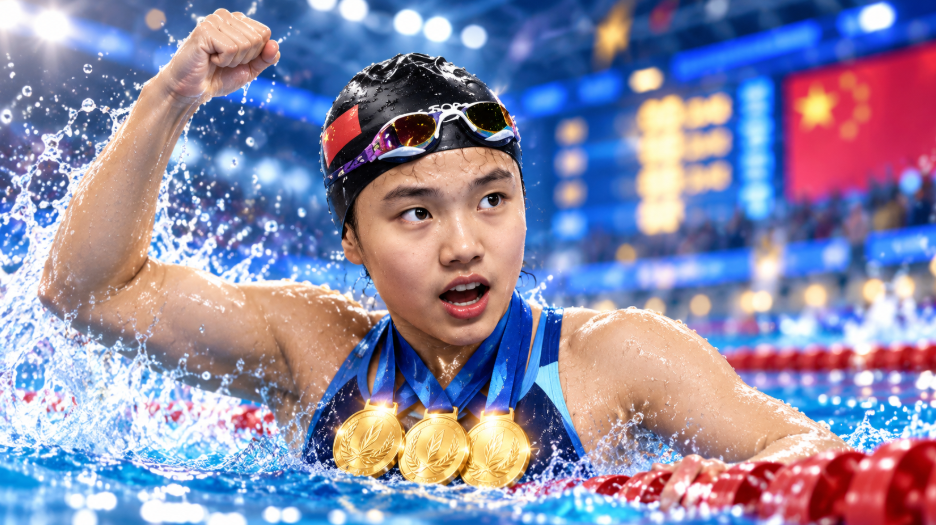

The thirteen-year-old Chinese swimmer Yu Zidi has completed her first Asian Games with three individual gold medals, three Games records and an Asian record. She was subsequently awarded the title of the Games’ most valuable player, thus becoming the youngest ever to receive that honour in Asian Games history. Her performances have certainly led to comparisons with the world’s top swimmers – but the most impressive aspect of Yu’s achievements is the fact that she still has the potential to get faster.
There were three races and three gold medals.
For the majority of athletes, that would be the culmination of their careers.
For Yu Zidi it occurred before she had reached her fourteenth birthday.
At the Tokyo Aquatics Center, the Chinese swimmer became one of the leading athletes at the 2026 Aichi-Nagoya Asian Games, winning the women’s 200-meter butterfly, the 200-meter individual medley and the 400-meter individual medley.
And she won without merely winning.
She kept rewriting the record book.
Three Golds and Three Asian Games Records
Yu’s remarkable campaign started on September 20 in the women’s 200 metre butterfly.
She reached the wall in 2 minutes and 5.08 seconds, breaking the Asian Games record and winning her first gold medal of the event.
A day later a swim that was even more impressive appeared.
Yu won the 200 metre individual medley with a time of 2:06.10, thereby setting a new Asian Games record and a new Asian record.
She ended up being remarkably near the very top of the rankings in global swimming, since the official reports from the Games stated that her time was just 0.40 seconds behind the world record held by the Canadian athlete Summer McIntosh at that time.
On September 23 Yu finished her sweep.
She swam the 400m individual medley from beginning to end, winning with a time of 4:28.56, a further Games record, and coming in almost four seconds ahead of her Chinese teammate Ke Wenxi.
By the time her Asian Games programme was over, Yu had taken part in three individual events and had won all of them.
Yu Zidi Was Already Making History at 12
Yu’s introduction to international swimming was not through the Asian Games.
She was the youngest swimmer ever to win a medal at the World Championships at the event in Singapore a year earlier, in 2025.
When she took part in the heats of the women’s 4x200m freestyle relay event in China, Yu was 12 years old. China then secured a bronze medal in the final, which made Yu eligible for the medal since she had taken part in the preliminary round.
Her separate results could have been even more revealing.
In the 200 metre individual medley, the 200 metre butterfly and the 400 metre individual medley, Yu came fourth and thus just missed out on a medal in each of these three events against some of the world’s top adult swimmers.
She was not just a gifted child taking part in an elite competition.
She was just as competitive as the best in the world.
How Good Is Yu Zidi Compared With Elite Swimmers?
In swimming, a sport, differences of tenths, at times hundredths, of a second distinguish champions from all the other competitors.
It is therefore quite notable that Yu achieved this 200m medley time.
According to World Aquatics, her time of 2:06.10 set an Asian record and brought her within less than half a second of the world record, while her 400m medley swim, clocked at 4:28.56, made her the fifth-fastest athlete in that event at the time.
She is reaching those times at an age when most top swimmers are still some years from attaining their physical peak.
It doesn’t ensure that the athletes will dominate at the Olympics in the future since young athletes grow in different ways and improvements are usually not straight-line.
This is the reason that Yu is already being mentioned in the same breath as swimmers like Summer McIntosh, the Canadian superstar who has set world records in a number of events.
Zhang Yufei, who is China’s Olympic champion, stated to Reuters that Yu seems to achieve a new level in each competition and added that it would be interesting to see how far she could go.
Could Yu Zidi become a star at the 2028 Los Angeles Olympics?
The very next question that arises is the Los Angeles 2028 Olympics.
When the Games start, Yu will still have only reached the age of 15.
But if she continues on her present course, she might end up in Los Angeles as a true medal hopeful rather than just a young prospect.
The fact that a potential rivalry with McIntosh is so interesting is due to the fact that both swimmers are strong in the individual medley and butterfly events.
Reuters has already begun to predict that Yu will have future clashes with the Canadian player.
Yet two years represents a very long time in elite sport.
Changes take place. The athletes grow. Injuries occur. New swimmers appear.
For Yu the following stage will be just as much concerned with managing expectations as it is with reducing times.
Her Age Also Raises a Bigger Question
The fact that Yu has been successful has once again sparked talk regarding the way in which young athletes should be handled at the top level of sports.
For its main events, World Aquatics usually establishes minimum age rules, but younger swimmers may still qualify if they achieve exceptional performance standards.
When Yu took part in the World Championships at the age of 12, the officials recognised that her case might lead to a further examination of whether further safeguards are needed for very young competitors.
The question isn’t whether it is right to prevent talented children from succeeding.
This is the way in which sporting organizations manage the demand for exceptional ability alongside education, physical development, media exposure, and the psychological pressures associated with global fame.
If Yu keeps on winning, then those questions could become more important.
The Youngest Asian Games MVP
Yu eventually obtained another historic distinction as a result of his performances in Japan.
On the weekend when the Games were closing, the Olympic Council of Asia awarded her the title of Female Most Valuable Player, giving Puripol Boonson of Thailand the men’s award.
The people in charge of the Aichi-Nagoya event have confirmed that Yu attained the title of youngest MVP in the history of the Asian Games.
However, Yu has opposed the language used to describe her remarkable rise.
After the performances, she still spoke of the areas in which she wished to improve, and after winning her third gold medal she stated that there were still things she had not done well and that she intended to go over them when she got back home.
That is certainly the most interesting point of all.
By age 13, Yu Zidi has already secured three gold medals at the Asian Games, set continental records, and raced alongside some of the fastest swimmers in the world.
It has not yet been established whether she will become China’s next great swimming superstar.
But now the question no longer seems premature after what she has produced in Japan.