

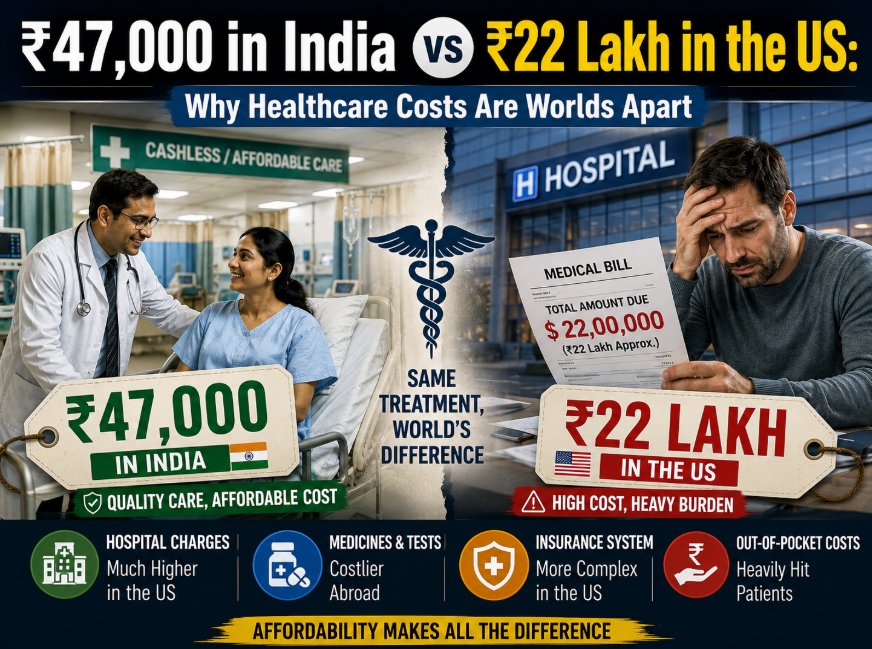

The healthcare costs in India and those in the United States are often quite different; a medical procedure or instance of care that costs around ₹47,000 in India might in the United States reach several lakhs or even go beyond ₹22 lakh, the amount varying according to the treatment, the hospital, the location and the insurance coverage.
The figure of ₹47,000 compared to ₹22 lakh does not imply a fixed price ratio, since medical expenses vary greatly in both countries; it nevertheless reveals a much greater truth: healthcare in the United States is considerably more expensive than in India for many kinds of treatment.
Healthcare is therefore a major consideration in the financial plans of Indians who are considering moving abroad, of NRIs who are thinking of returning to India, and of families that are comparing the quality of life in the two countries.
Why Healthcare Costs More in the United States
The healthcare system in the United States is among the most expensive in the world.
According to the US Centers for Medicare & Medicaid Services, national health expenditure in 2024 was $5.3 trillion, that is approximately $15,474 per person, and healthcare spending accounted for about 18 percent of the country’s gross domestic product.
It does not indicate that each American spends $15,474 a year, since that figure includes spending by individuals, insurers, employers and government programmes.
It illustrates the enormous amount of money that goes through the American healthcare system.
The cost of hospital bills, trips to specialists, diagnostic tests, the medicines prescribed and emergency treatment can all be high. In addition, the administrative expenses coupled with the complexity of the country’s insurance-based healthcare system contribute to the overall financial burden.
India operates in a very different cost environment.
It is usually possible to get consultations, diagnostic tests, hospital admissions, and a large number of medical procedures at considerably lower prices, particularly when Indian private hospitals are compared with American healthcare providers.
The Biggest Difference: How Patients Pay
Comparing healthcare in India and America is complicated because patients finance their treatment differently.
It is still usual in India to pay directly for a doctor’s consultation, for tests or for medicine. If a patient goes to a private specialist, they pay the consultation fee and then buy the medicines separately.
In the United States, healthcare and insurance are closely linked.
Many people obtain their health insurance through their employers, while others purchase it themselves or are eligible for government programs like Medicare or Medicaid.
A patient who is insured might have to pay only a part of a bill which an American hospital could issue for tens of thousands of dollars.
After agreeing on renegotiated hospitals and healthcare providers, patients will still have to pay deductibles, copayments or coinsurance u,ntil they have reached the reach limit specified in their job that this means is that if a hospital bill is imagined to be ₹22 lakh it does not follow that the patient has to pay the full amount of ₹22 lakh personally.
Medical care in the United States can be quite costly for someone without adequate insurance.
Doctor Consultations Highlight the Difference
Routine medical consultations are a prime example of the difference between the two countries.
In many cities in India, middle-class families will not find it financially difficult to consult experienced private doctors and specialists.
The way healthcare is arranged in America differs from that of other countries in the field of pricing.
Even for normal appointments, substantial fees may still be charged before the insurance adjustment is made, and the overall cost can be greatly increased by specialist consultations, laboratory tests, and diagnostic imaging.
The difference is even clearer when looking at emergency rooms.
Even before any major treatment has been received an emergency visit to a hospital in the United States might result in very high bills, and the cost of ambulance transport can also increase these expenses.
Consequently, the American system will be a considerable shock to Indians accustomed to relatively cheap consultations.
Hospitalization and Surgery Can Create an Even Wider Gap
The cost difference is especially significant when surgery or hospitalisation is required.
India now boasts an extensive system of private hospitals that provide complex treatments, including cardiac surgery, joint replacements, cancer treatment, and organ transplantation, at costs that are generally much lower than those charged in developed countries.
Its lower cost has enabled India to establish itself as an important destination for medical tourism.
People from other countries go to Indian cities to have operations which could cost many times as much in their own countries. Meanwhile, the United States combines advanced medical technology and the expertise of specialists with some of the highest treatment costs in the world; the overall bill will cover the cost of hospital accommodation, the surgeon’s fee, anaesthesia, diagnostic testing, medications, and follow-up treatment. The difference between the two countries for major procedures is therefore several lakhs of rupees.
Lower Costs Do Not Mean India’s Healthcare System Is Perfect
The fact that India has an affordability advantage does not mean that its healthcare is accessible to all.
The quality and availability of healthcare can vary quite a lot depending on the place you are in, the particular hospital involved, and the economic conditions.
Worldwide-recognized hospitals and highly specialized doctors can be found in major cities such as Delhi, Mumbai, Bengaluru, Chennai and Hyderabad. On the other hand, smaller towns and rural areas may not have similar access to specialists or to advanced medical facilities.
The amount one has to pay out of pocket is still a serious issue.
A hospital bill may appear cheap when compared with prices in America, but poor health insurance within Indian families can still place a heavy strain on their household finances.
A procedure which costs ₹2 lakh might appear to be an affordable price when compared with the much larger bill from a US hospital, but it could still represent months or years of savings for an average Indian household.
Healthcare affordability must therefore always be considered in relation to local incomes.
Salaries Change the India-US Comparison
You cannot compare healthcare prices on their own.
Average incomes in America are much higher than those in India, which means that a professional in the United States is likely to have greater purchasing power and be entitled to employer-provided health insurance that covers a large portion of their medical expenses.
Which is why simply converting an American hospital bill into Indian rupees would result in a distorted picture.
At the same time, higher pay does not, in itself, eliminate worries about healthcare.
US residents may pay insurance premiums even after they have met their deductibles, copayments, and coinsurance. When preparing their budget, families should consider these expenses along with the amounts they need to spend on housing, childcare, education, and transportation. Therefore, an Indian professional wishing to compare an American salary with an Indian salary must go beyond the exchange rate. Perhaps the more appropriate question is: How much money do you have left after you’ve paid for the essentials?
Why India Attracts Medical Tourists
The fact that healthcare costs differ has given India an economic opportunity.
More and more patients from other countries are now looking to India as a treatment option, since it offers private healthcare of a high standard at greatly reduced prices. India has the advantage of having a large number of English-speaking medical professionals, a supply of specialists with international training, modern private hospitals, and procedures that are relatively affordable.
Medical tourism also illustrates an important aspect of healthcare pricing: lower costs do not necessarily indicate a lower level of medical capability.
The technological equipment and departmental procedures used by international institutions are employed by many of the hospitals in India to perform complex operations.
When considering medical tourism they should still look at the hospital’s accreditation, the individual doctors, the need for follow-,up vi and the possible comp,lications rather than basing their solely about a treatment simply on the price.
Which country has the better healthcare system?
There is no definite winner.
The United States has some of the most well-known hospitals, research institutions, medical technologies, and specialists in the world and continues to lead in pharmaceutical development, advanced surgery, and medical research.
The biggest advantage of India is its low cost.
Private healthcare is frequently much cheaper for routine consultations, diagnostic procedures, and surgeries, yet can still offer high-quality treatment.
The two systems also face great difficulties.
America has great difficulty with very high spending and with its complicated insurance arrangements. India still suffers from inequalities in access, regional infrastructure disparities, and the financial burden of out-of-pocket spending.
The Real Meaning Behind ₹47,000 vs ₹22 Lakh
A comparison like ₹47,000 in India versus ₹22 lakh in America may make for a striking headline, but it cannot be taken as a general rule.
The treatment won’t always cost 40 or 50 times as much in the United States.
The cost will vary depending on the procedure, city, hospital, doctor, insurance network, and other factors.
What the comparison does illustrate is a genuine and important difference between the two countries.
India is still one of the countries where a wide variety of private medical treatments are available at reasonably affordable prices, while the United States provides some of the most advanced healthcare in the world but within a system that is considerably more expensive and heavily dependent on insurance.
For anyone comparing life in India and America, healthcare therefore deserves as much attention as salary, housing and taxes. While a higher income can improve the quality of life, the cost of remaining healthy can become just as significant as the amount on a monthly payslip if a serious medical issue arises.