

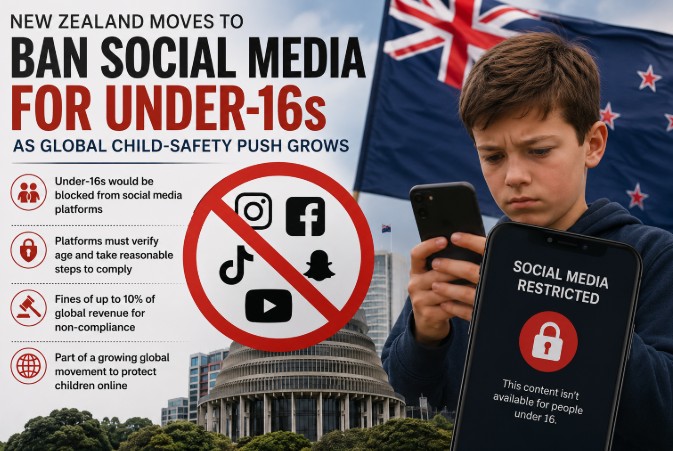

New Zealand is moving toward one of the world’s toughest approaches to children’s use of social media, with the government introducing legislation that would prevent children under 16 from accessing major social-media platforms. Prime Minister Christopher Luxon’s government announced the Online Safety Bill on August 24, 2026, saying technology companies should bear greater responsibility for protecting young people from online harm.
Under the proposal, social-media companies would be required to take reasonable steps to determine whether users are at least 16 years old. Platforms that fail to meet their obligations could face penalties of up to 10% of their global revenue. The proposal places New Zealand within a rapidly expanding international debate: How young is too young for social media?
Why New Zealand Wants an Under-16 Social Media Ban
The government argues that social media is exposing children to risks they may not yet be equipped to manage. Announcing the legislation, Luxon pointed to concerns surrounding young people’s mental health, sleep, education and family life, arguing that the benefits of social media must be weighed against its potential harms.
“We simply cannot accept the harm being done to a generation of New Zealand children,” Luxon said in announcing the bill. The government’s approach represents a significant shift in responsibility.
Rather than relying primarily on parents to prevent children from creating accounts, the proposed framework would require technology companies themselves to establish systems designed to keep under-16 users off covered platforms. That could make age verification one of the most consequentialand controversialparts of the legislation.
How Would Social Media Companies Verify Age?
Simply asking users to enter their birthday would be unlikely to satisfy the proposed requirements. According to Reuters, platforms could potentially rely on methods including existing account information, facial age-estimation technology and digital identity documents to establish whether a user meets the age requirement.
The proposal therefore creates a difficult technological balancing act. Platforms would need sufficiently reliable systems to distinguish children from adults while simultaneously addressing questions around privacy, personal data and accessibility.
The legislation does not mean every user would necessarily be required to upload a passport or other identification document. The focus is instead on requiring platforms to take reasonable age-assurance measures.
Tech Companies Could Face Enormous Fines
One of the most striking features of New Zealand’s proposal is the potential penalty for companies that fail to comply. The transcript states that platforms could face fines of up to 10% of their global revenue. That figure is accurate and has also been reported by Reuters.
A revenue-based penalty is significant because it scales with the size of the technology company involved. For global platforms generating billions of dollars annually, 10% of worldwide revenue could theoretically represent an enormous financial exposure. The approach signals that the government wants compliance to be treated as a serious corporate responsibility rather than simply another cost of doing business.
Australia Has Already Gone Further
New Zealand is not acting in isolation.
Neighboring Australia became the first country to implement a nationwide prohibition preventing children under 16 from holding accounts on designated social-media platforms. Australia’s restrictions took effect in December 2025 and cover major services including Instagram, Facebook, TikTok and YouTube.
New Zealand’s proposed legislation therefore represents part of a wider shift in how governments are approaching children’s relationship with technology. Instead of focusing exclusively on removing individual pieces of harmful content, policymakers are increasingly considering whether children below a certain age should be using some social platforms at all.
That represents a fundamentally different regulatory philosophy.
The Debate Is Spreading Beyond Australia and New Zealand
Other governments are also examining tighter age restrictions and online-safety measures for children.
The broader trend reflects mounting concern about addictive platform design, exposure to inappropriate material, cyberbullying and the effects that intensive social-media use may have on children’s lives. New Zealand’s parliamentary Education and Workforce Committee had already examined the issue before the latest government announcement. In March 2026, an inquiry into online harm recommended introducing age restrictions for social-media platforms and progressing consideration of restrictions specifically for under-16s.
New Zealand had also previously seen a separate Social Media (Age-Restricted Users) Bill, introduced as a member’s bill in October 2025, aimed at regulating social-media access for people under 16.
The latest government-backed Online Safety Bill therefore builds on an issue that has already been developing politically for some time.
Not Everyone Agrees With the Ban
Despite the child-safety arguments, the proposal is politically contentious.
New Zealand First, a member of Luxon’s governing coalition, opposes the legislation. Party leader Winston Peters has argued that regulating children’s social-media use should remain primarily a parental responsibility and has criticized government intervention in this area.
However, an important development occurred on August 25. New Zealand’s main opposition Labour Party announced that it would support the legislation, potentially giving the government a path to pass it despite opposition from coalition partners.
That makes the proposal considerably more politically viable than it appeared when first announced. Still, parliamentary support does not eliminate the broader debate. Critics of age-based restrictions question whether children will simply find ways around verification systems. Others worry that stronger age verification could require platforms to collect more information about all users, including adults.
Supporters counter that imperfect enforcement does not mean governments should leave children exposed to potentially harmful digital environments.
A Bigger Question About Childhood in the Digital Age
The New Zealand proposal reflects a much larger shift in the debate surrounding children and technology.
For years, the responsibility for managing children’s screen time largely rested with families. Parents were encouraged to set limits, monitor apps and teach children how to behave safely online. Governments are now increasingly asking whether that approach is sufficient when children interact with platforms designed and operated by some of the world’s largest technology companies. New Zealand’s proposal effectively argues that online safety cannot be a responsibility carried by parents alone.
Platforms themselves would have legal obligations. That distinction could become increasingly important as governments determine how far technology regulation should extend into children’s digital lives.
Could Under-16 Become the New Global Standard?
It is too early to describe 16 as an international standard for social-media access.
But momentum is clearly building around that age threshold.
Australia has already implemented an under-16 restriction, New Zealand is pursuing its own legislation, and other governments are considering tougher protections for minors. Whether these policies ultimately reduce online harm will depend heavily on enforcement, the effectiveness of age-assurance technology and how young people respond to the restrictions.
There are also questions policymakers will have to confront: Will teenagers migrate to smaller or less-regulated platforms? Can age verification work without excessive collection of personal information? And how should regulators distinguish between harmful social networks and digital services that provide educational or social benefits?
Those questions will become increasingly important if more countries follow Australia and New Zealand. For now, New Zealand’s Online Safety Bill represents another major step in a growing international experiment: shifting responsibility for children’s online safety away from families alone and toward the technology companies that build the platforms young people use.