

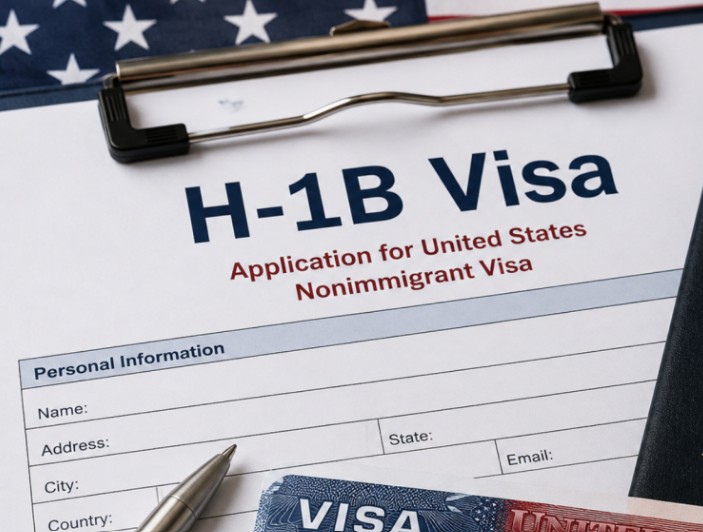

The cost of hiring skilled foreign workers in the United States could rise dramatically under a new Trump administration proposal that would impose an additional $103,265 fee on H-1B petitions subject to the annual visa cap.
The Department of Homeland Security announced the proposal on August 24, 2026, potentially reshaping one of the most important pathways used by American employers to recruit highly skilled international professionals.
The implications could be particularly significant for India. Indian-born professionals accounted for 71% of approved H-1B petitions in fiscal year 2024, according to U.S. Citizenship and Immigration Services data. But the proposed six-figure charge is not yet final. It has entered the federal rulemaking process and could still face changes and legal challenges before implementation.
What Exactly Is the Trump Administration Proposing?
DHS is proposing a $103,265 fee for all cap-subject H-1B petitions, including petitions eligible for the advanced-degree exemption.
Crucially, the $103,265 would not replace the other fees employers already pay. DHS says it would be charged in addition to all other applicable fees or payments and collected when the petition is filed. That distinction makes the financial implications considerable.
An employer seeking to sponsor a worker through the cap-subject H-1B process could potentially face more than $100,000 in additional government charges before considering other expenses associated with recruitment, immigration attorneys and relocation. However, the proposed fee would not apply to H-1B petitions that are exempt from the annual cap, including certain petitions from institutions of higher education, nonprofit research organizations and governmental research organizations.
Why $103,265?
The administration says the fee is intended to recover part of the federal government’s broader costs associated with administering the legal immigration system. According to DHS, those costs extend beyond processing an individual H-1B petition. They include immigration-benefit adjudication, fraud detection, national-security vetting, technology modernization, immigration court operations, consular processing and labor-standards enforcement.
DHS estimates the fee could generate approximately $8.8 billion annually, based on an estimated 85,000 cap-subject H-1B petitions each year. The H-1B program generally has an annual statutory cap of 65,000, with an additional 20,000 slots available under the U.S. advanced-degree exemption.
Why H-1B Matters So Much to Indian Professionals
Few countries have as much at stake in changes to the H-1B system as India.
USCIS’s FY2024 report shows that 71% of approved H-1B petitions were for beneficiaries born in India. China was a distant second at approximately 12%. The concentration was even higher among continuing-employment petitions: Indian-born beneficiaries represented roughly 79% of those approvals in FY2024. That helps explain why major changes to H-1B policy receive such close attention in India.
Technology companies have historically been among the largest users of H-1B workers, but the program extends beyond IT. Employers use it to recruit workers in specialty occupations across engineering, finance, healthcare, research and other professional fields. If the proposed fee becomes final, employers could have to reconsider whether sponsoring an overseas candidate makes economic sense for some positions.
Why Is the Fee Being Proposed Again?
The latest proposal follows an earlier Trump administration effort to impose a $100,000 H-1B fee through a presidential proclamation. That measure encountered a significant legal setback. A federal judge ruled against the earlier fee in June 2026, finding that the administration lacked authority to impose it in that manner.
The administration has now taken a different route. Rather than relying solely on a presidential proclamation, DHS has issued a notice of proposed rulemaking seeking to establish the $103,265 charge through the regulatory process.
The proposal was formally published on August 25, with a 30-day public-comment period. That procedural distinction is important, but it does not guarantee that the new rule will survive legal scrutiny. Immigration lawyers and business groups are already questioning the legal basis for such a large fee.
Could It Change How US Companies Hire?
If implemented, the financial calculation surrounding H-1B sponsorship would change substantially. A $103,265 additional fee might be manageable for some employers seeking highly specialized or senior talent. It could be considerably harder to justify for entry- or mid-level positions.
The administration argues that the policy would encourage employers to hire American workers unless foreign workers possess skills sufficiently valuable to justify the additional expense. Critics, however, argue that dramatically increasing H-1B costs could make it harder for American companies to recruit specialized global talent and potentially encourage businesses to expand workforces outside the United States instead.
India’s technology industry has already raised concerns. Industry association Nasscom urged the U.S. government to consider the benefits of the H-1B program, arguing that it helps American businesses address short-term skills shortages. The group also said Indian technology companies have substantially expanded local hiring in the United States.
A Bigger Debate Over Skilled Immigration
The dispute reflects a broader disagreement in the United States about the role of highly skilled immigration. Supporters of the H-1B program argue that American businesses need access to international talent, particularly in areas where specialized skills are scarce.
Critics contend that some employers have used the program in ways that disadvantage American workers or suppress wages. The Trump administration has adopted the latter concern as part of its justification for tightening the system. The proposed $103,265 fee would dramatically raise the financial threshold for sponsoring a new cap-subject H-1B worker, potentially changing the economics of international recruitment.
What Happens Next?
For now, workers and employers should pay particular attention to one word: proposed. The $103,265 charge has not yet become a final permanent H-1B fee. The proposed regulation is undergoing the federal rulemaking process, including a public-comment period. It could subsequently be revised, finalized, challenged in court or blocked. That distinction is particularly important for prospective Indian applicants. Headlines suggesting that every H-1B applicant must now pay more than $100,000 would be misleading.
The proposal applies specifically to cap-subject petitions, and the petitioning U.S. employernot simply the foreign professional personallyis at the center of the H-1B sponsorship process. If the proposal ultimately survives both the regulatory process and expected legal scrutiny, however, it could represent one of the most consequential changes to the economics of the H-1B program in years. For India, where H-1B policy directly affects a large population of technology and skilled professionals, the outcome will be closely watched.
Fact-check verdict on the YouTube transcript
The transcript correctly identifies a new Trump administration H-1B fee proposal, the 65,000 regular cap plus 20,000 advanced-degree exemption, and the outsized importance of H-1B to Indian professionals. The transcript itself says Indians account for more than 70% of beneficiaries. USCIS’s FY2024 data supports that general point, putting the Indian-born share of approved petitions at 71%.
The important error is the amount. The transcript says DHS proposed an additional $13,265 fee. The official USCIS announcement says $103,265.
I would therefore slightly strengthen and clarify your headline to:
Trump Administration Proposes $103,265 H-1B Fee: What It Could Mean for Indian Professionals. That is more searchable, communicates the scale of the development immediately, and importantly retains “proposes” rather than suggesting the fee has already taken effect.