

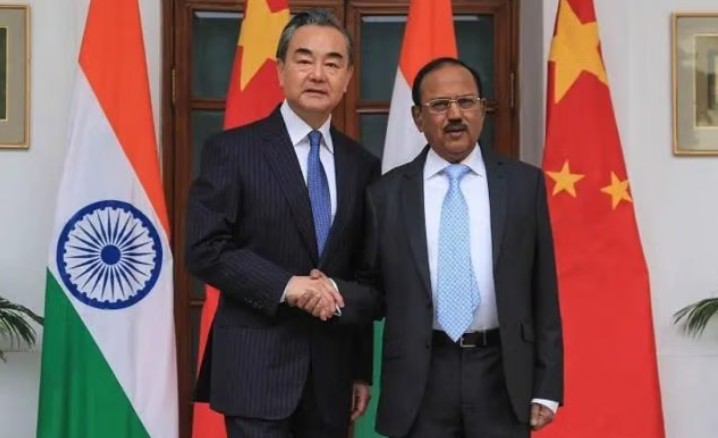

Ajit Doval, India’s National Security Advisor, is in Beijing for another round of high-level discussions with China, as New Delhi and Beijing continue their efforts to resolve their long-standing boundary dispute and stabilize bilateral relations.
Doval reached the Chinese capital on August 24 for a two-day trip and will co-chair the 25th round of the Special Representatives’ Talks on the India-China boundary issue with Wang Yi, China’s Foreign Minister, on August 25. Doval and Wang are the Special Representatives designated by India and China, respectively, under the 2003 arrangement for dealing with the boundary issue.
The meeting puts the India-China border back at the center of diplomatic attention, at a time when both countries are attempting to rebuild engagement following several years of strained relations.
Border Peace Remains Central to India-China Relations
After the military clash in eastern Ladakh in 2020, relations between India and China worsened significantly. The fighting that took place in the Galwan Valley in June of that year, which resulted in 20 Indian soldiers being killed, was the most serious confrontation between the two countries in decades and this was then followed by a long-lasting military standoff along the Line of Actual Control.
Since that time, military and diplomatic talks have aimed to reduce tensions and address areas of friction along the border. New Delhi has, on many occasions, stated that peace and tranquillity in the border regions are necessary for the wider India-China relationship to develop normally.
External Affairs Minister S. Jaishankar reiterated this position ahead of the latest talks, stressing the connection between conditions along the border and the overall state of bilateral relations. The most recent talks, therefore, cover more than just the technical aspects of the boundary dispute, and their results might affect how rapidly India and China can expand their political, economic, and diplomatic interaction.
What Doval and Wang Yi Are Expected to Discuss
The Chinese Ministry of Foreign Affairs has officially confirmed that Wang Yi and Ajit Doval will jointly chair the 25th meeting of the Special Representatives in Beijing on August 25. According to the Chinese Foreign Ministry, the two sides are expected to hold in-depth discussions on the boundary question and exchange views on bilateral relations and regional and international issues. Since its establishment in 2003, the Special Representatives mechanism has served as one of the main diplomatic routes for addressing the boundary issue.
The most recent meeting resulted from the 24th session of the Special Representatives’ talks, which took place in New Delhi in August 2025; at that meeting, the two countries declared a number of understandings regarding border management and bilateral engagement. Doval also has a meeting with Han Zheng, the Chinese vice president, during his visit to Beijing, adding another high-level diplomatic encounter to the trip.
Why the Timing Matters
The discussions are taking place at a significant time for India-China relations. Both governments have taken steps to stabilize their relations after the serious deterioration that began in 2020; nevertheless, disagreements over the border and Arunachal Pradesh continue to complicate relations. The meeting is also taking place before the BRICS summit, which India will host in New Delhi in September 2026.
It is expected that the Chinese President, Xi Jinping, will travel to India for the summit, even though Beijing had not officially confirmed his participation when the talks between the Special Representatives were announced.
If Xi attends, the summit could create another opportunity for high-level engagement between Prime Minister Narendra Modi and the Chinese president. The Doval-Wang talks thus have greater diplomatic significance, since advances in maintaining stability along the border could help create a more conducive environment for greater engagement between the two Asian powers.
From Confrontation to Watchful Engagement
The course of relations between India and China since 2020 shows how greatly the border dispute has affected the overall relationship.
The confrontation in eastern Ladakh led to large-scale military deployments and severely eroded political trust. But subsequent negotiations have gradually created space for renewed diploThe fact that the Special Representatives mechanism is being resumed and continued is important since it shows that both governments are willing to maintain their high-level political channels open even though a final settlement of the boundary issue is still far off.onAt the twenty-fourth round of talks in 2025 ten points of agreement were reached, these comprising constant efforts to preserve peace and tranquillity in the border regions and the reinforcement of the mechanisms for boundary management.aging the boundary.
This round now offers an opportunity to assess progress and decide on any more actions.
A Test for the Next Phase of India-China Relations
India and China remain two of Asia’s largest powers, with extensive economic ties but significant strategic divergences. The boundary dispute is not likely to vanish soon. For now, the important issue is whether both governments can prevent disagreements along the frontier from becoming another major confrontation. For India, the position is clear: stability along the border is closely connected to progress in the wider relationship.
For China, restoring engagement with India could also carry strategic and economic importance at a time of considerable uncertainty in the global economy and international political system. The Beijing trip Doval makes should therefore be seen as going beyond yet another round of talks over the border. It is part of a wider initiative aimed at determining whether India and China can move from managing a crisis to establishing a more stable, though still competitive, relationship.
The outcome of the 25th round may not produce a breakthrough on one of Asia’s most complicated territorial disputes. But even modest progress on border stability could influence the direction of India-China relations as both countries prepare for another period of high-level diplomatic interaction.