


There is a widely circulated claim that India has introduced a “new” rule regarding SIM cards that limits the number of mobile numbers a person can have. While the limit in question is genuine, referring to the rule as “new” is misleading.
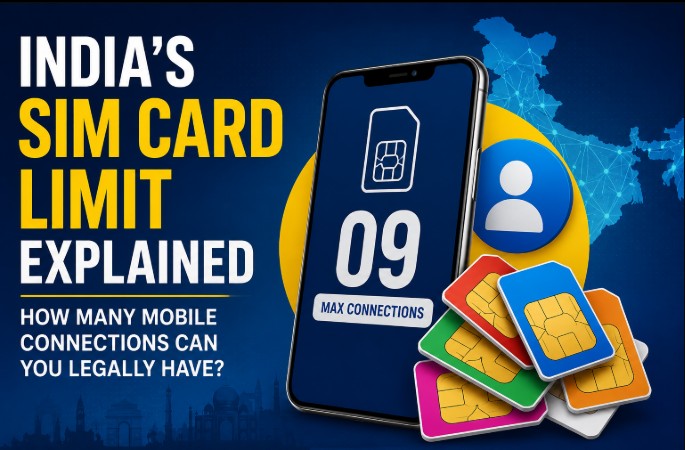
According to the rules of the Department of Telecommunications, a person is generally allowed to have as many as nine mobile connections in their name regardless of the telecom operator or service area. In the case of Jammu & Kashmir, Assam and the North-East service areas, the limit is six connections. The limits originated from instructions issued by the DoT in 2012 and have since been strengthened by further verification and measures aimed at preventing fraud.
What is the real limit?
For most of India:
Maximum mobile connections per individual: 9
For Jammu & Kashmir, Assam and North-East telecom service areas:
Maximum: 6
The limit is applied when looking at all the telecom providers as a group. For example, if a person had five connections with one operator and five with another, this would not enable them to go around the nine-connection cap.
The transcript does in fact refer to the limits for nine and six connections, but it states that the rule is coming into effect “today”. However, that point is wrong since the restriction has been in place for years.
What occurs if the number you have is greater than the allowed number?
The verification guidelines issued by DoT provide that if a person is found to be holding a number greater than the one prescribed, their accounts should be flagged for re-verification. The subscriber will then be asked to state which numbers they would like to keep, give up or disconnect. In the event that the excess connections are not regularised, those numbers acquired at the time of the order will be connected in order that the total number may remain within the allowed limit.
It is more than a theoretical rule; government data indicate that telecom authorities have already severed millions of connections for exceeding the individual limits. By May 2024, the government had reported that 53.86 lakh mobile connections had been disconnected because of a breach of the individual connection limit.
What is the reason that India limits the number of SIM cards?
The policy is mainly related to verifying subscribers, preventing cybercrime and combating telecom fraud. Many cases of fraud involve acquiring SIM cards using false identities or fake documents, or without the knowledge of the person whose identity is being used.
In recent years, the government has employed artificial intelligence and data analytics to find suspicious or fraudulent connections. According to DoT, 78.33 lakh mobile connections that were obtained using false documents were disconnected after re-verification, and an additional 6.78 lakh were disconnected following reports of their involvement in cybercrime.
By limiting the number of personal connections, it becomes easier to identify large clusters of SIM cards linked to a single identity.
How do you check how many SIM cards are registered in your name?
The facility is offered by the government via Sanchar Saathi. The “Know Your Mobile Connections” service enables users to view the mobile numbers registered under their identity and to report those they do not recognize or no longer need. This is especially useful since someone can come across a fraudulent connection made in their name even if they never had that SIM card.
The government states that millions of users have already used the service in order to report unwanted or unrecognized connections. Over 320,000 connections had been disconnected by May 2024 due to “Not My Number” reports, and an additional 115,700 were disconnected after users marked them as “Not Required.”
Does using an eSIM contribute to the limit?
An eSIM is still merely a mobile connection for ordinary mobile service and should not be seen as a way to circumvent the subscriber limit.
The Department of Telecommunications has issued separate regulations concerning machine-to-machine, or M2M, SIM connections. These regulations allow a person to have up to nine M2M SIMs in addition to the standard limit for mobile connections, provided that the relevant telecom rules are observed. This distinction is mainly of concern to users of connected devices and those involved in IoT applications rather than to ordinary smartphone users.
Could this be included in the Telecommunications Act of 2023?
The broader regulatory framework for telecommunications in India has undergone substantial changes as a result of the Telecommunications Act of 2023, with several new rules issued since then.
The nine-connection rule should not be regarded as a provision introduced by the 2023 Act; official documents from the DoT themselves trace the individual limit back to instructions given on August 9, 2012.
What Mobile Users Should Do
For the majority of people there is no difference whether they have one or two mobile numbers.
However, if anyone has obtained a number of connections over the years such as personal numbers, second SIM cards, data connections, or old numbers which were never formally cancelled they should check how many are still registered in their name.
Any connections that you do not know about should be reported via Sanchar Saathi.
The Bottom Line
The headline stating that “India introduces a new nine-SIM limit” would be incorrect.
A more precise description is:
India has already set a limit of nine mobile connections per person, or six in the regions of Jammu & Kashmir, Assam, and the North-East, and the authorities are increasingly relying on digital verification systems to enforce these limits and eliminate fraudulent connections.
The rule is therefore primarily concerned with strengthening identity verification and making India’s telecom system safer from fraud and misuse, rather than with restricting ordinary mobile users.