

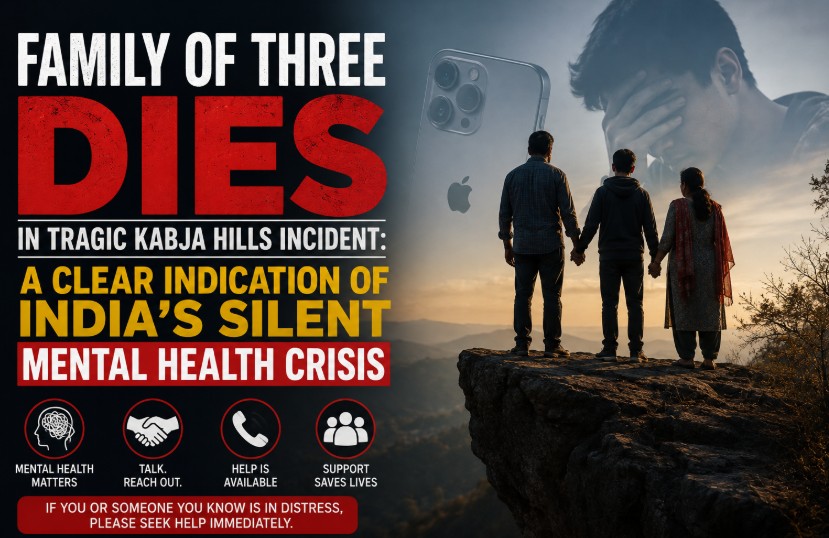

Family of Three Dies in Tragic Kabja Hills Incident: A Clear Indication of India’s Silent Mental Health Crisis
An 18-year-old’s disagreement over buying an iPhone ended in tragedy when he and his family took their own lives. This heartbreaking event shows how urgently we need better mental health services and crisis intervention.
A small village is in shock after a heartbreaking tragedy. Kunal, an 18-year-old, and his parents died after jumping from Kabja Hills. The day started with what seemed like a normal family disagreement, but ended in loss and brought up significant questions about mental health and family conflict.
Over the course of three painful hours, all three family members lost their lives. This tragedy is a clear indication of how quickly small conflicts can turn into something irreversible when mental health services are missing.
A disagreement about buying a smartphone quickly grew into a family crisis that no one, authorities, villagers, or emergency responders, could stop.
The Escalation: From Argument to Crisis
The tragic sequence began around 10:00 AM when Kunal, an 18-year-old, stormed out of his family’s home after his father refused his demand to purchase an iPhone. The teenager’s father, a driver and the family’s sole breadwinner, could not afford the expensive smartphone that his son desired.
To outsiders, this argument may have seemed minor, but for Kunal, it was much more complicated. We don’t know if peer pressure, social comparison, or deeper struggles played a role. What’s clear is that a disagreement about money quickly became a mental health crisis.
Instead of letting things calm down, Kunal walked toward Kabja Hills. Worried neighbors and family followed and found him at the edge of the cliff, clearly in deep distress.
The Agonizing Three-Hour Standoff
What followed was nearly three hours of desperate intervention efforts by villagers, family members, local authorities, and police, attempting to persuade Kunal to move away from the cliff edge.
The village head reportedly offered to personally purchase the iPhone that sparked the initial dispute, a gesture demonstrating the community’s intent to resolve the financial conflict. Emergency personnel from the fire brigade deployed safety nets below the cliff edge in preparation for potential rescue operations.
Even with everyone’s efforts, Kunal kept moving along the cliff edge and stayed in a dangerous spot for hours. As afternoon passed, it became clear that attempts to calm him down were not working.
Around 1:00 PM, as things became desperate, Kunal’s father made a difficult choice. He could not stand to watch his son at the edge any longer, so he ran to try to pull him to safety.
When the father reached his son, both lost their balance. They fell about 300 feet from the cliff, and both died instantly.
The Incomprehensible Second Loss
Just seconds later, Kunal’s mother saw her husband and son fall. Overcome with grief, she walked to the same cliff edge and jumped, joining her family in death.
All three family members, the 18-year-old, his father, and his mother, died on the spot. Rescue and emergency services, despite their preparation and presence, were unable to save any of them.
In just three hours, a family argument about a smartphone turned into the loss of an entire family.
Understanding the Crisis
The tragedy raises urgent questions about mental health intervention, family communication, and the accessibility of crisis support in rural India:
Why did things get worse? Kunal’s reaction to not getting the phone was beyond mere disappointment. He may have been dealing with depression, anxiety, or another mental health crisis. What’s clear is that this situation needed help from mental health experts, not just family support.
Intervention Gaps: While villagers and authorities tried to de-escalate, there’s no indication that trained mental health professionals or suicide prevention specialists were available. De-escalation without professional psychological assessment and support often fails in acute crisis situations.
Family Dynamics: The father’s impulse to physically rescue his son, although understandable emotionally, demonstrates how crisis situations can overwhelm rational decision-making. Professional crisis intervention training focuses on maintaining a safe distance and avoiding actions that might further escalate situations.
Suicide Contagion: The mother’s decision to end her life seconds after witnessing her family’s deaths illustrates the acute psychological effect of traumatic events. Grief, shock, and potential psychiatric conditions may have eliminated rational decision-making capacity in that critical moment.
Mental Health Crisis in Rural India
This tragedy exemplifies broader mental health challenges in rural India:
Limited Professional Access: Small villages usually lack mental health professionals, psychiatrists, or counselors. Crisis situations must be managed by untrained personnel using intuitive approaches rather than evidence-based interventions.
Stigma and Silence: Mental health challenges in rural communities frequently go unreported and untreated due to social stigma. Families may hide psychological distress rather than seek professional help.
Economic Stress: Financial limitations, like Kunal’s family’s inability to afford an iPhone, create stress that may compound existing mental health challenges.
Communication Problems: Family conflicts that might be resolved through counseling can develop into crises when communication breaks down, and professional mediation is unavailable.
India’s Mental Health Crisis: The Greater Perspective
India faces a severe mental health crisis that this tragedy reflects:
* Suicide Rate: India has one of the highest suicide rates globally, with approximately 139,123 suicides reported annually (National Crime Records Bureau data)
* Youth Suicides: Individuals aged 15-29 represent the largest demographic of suicide deaths in India
* Underreporting: Actual suicide rates likely significantly exceed reported numbers due to under-reporting, stigma, and misclassification
* Professional Shortage: India has approximately 1 psychiatrist per 100,000 population, far below WHO recommendations
Mental Health Crisis Hotlines and Support Resources Available in India
If you or someone you know is going through suicidal thoughts, a mental health crisis, or psychological distress, immediate help is available:
National Emergency Hotlines:
AASRA – Association for Suicide Prevention
* Telephone: 9820466726 (available 24/7)
* Email: [email protected]
* Services: Suicide prevention, counseling, emotional support
* Available for: Individuals in crisis, family members seeking support
iCall – Emotional Support and Counseling
* Telephone: 9152987821
* Website: www.icallhelpline.org
* Email: [email protected]
* Services: Free confidential emotional support and counseling
* Available for: Youth, teenagers, adults experiencing stress, anxiety, depression
VANDREVALA FOUNDATION – Helpline for Mental Health
* Telephone: 9999 77 4673 / 9999 77 5673
* Website: www.vandrevalafoundation.com
* Services: Emotional support, suicide prevention, counseling
* Available: 24/7 for individuals in crisis
AASRA – Atma Nirvaan
* Telephone: +91 22 2389 0123
* Services: Crisis intervention, suicide prevention counseling
* Multilingual support available
iCall – Mental Health Crisis Support
* Telephone: 9639331454
* Available: 10:00 AM to 8:00 PM, Monday to Saturday
* Services: Counseling, emotional support, crisis intervention
State-Specific Hotlines:
Befrienders India (Mumbai)
* Telephone: +91 22 5631 5631
* Email: [email protected]
* Services: Emotional support, suicide prevention
Telangana Suicide Prevention Helpline (Hyderabad)
* Telephone: 9885-0011 (Available 24/7)
* Services: Crisis intervention, emotional support
Mangaluru Helpline
* Telephone: 0820-251-3322
* Services: Emotional counseling, crisis support
Chennai Mental Health Services
* Telephone: 044-4158 0900
* Services: Psychiatric support, counseling
Online Mental Health Platforms:
YourDOST
* Website: www.yourdost.com
* Services: Online therapy, counseling sessions with licensed therapists
* Features: Flexible scheduling, private sessions, chat-based counseling
7 Cups Emotional Support (India)
* Website: www.7cups.com
* Services: Free emotional support conversations with trained listeners
* Available: 24/7 online support
Practo Mental Health
* Website: www.practo.com
* Services: Online therapy, psychiatry consultations
* Features: Video consultations, prescription services
Talk to Me India
* Website: www.talktomeinda.com
* Services: Online counseling with qualified therapists
* Available: Flexible scheduling for professionals and students
Specialized Support Services:
NIMHANS (National Institute of Mental Health and Neurosciences) – Bangalore
* Telephone: 080-2699 5005
* Email: [email protected]
* Services: Comprehensive mental health treatment, research-based interventions
* Provides: Outpatient services, inpatient care, crisis intervention
Institute of Mental Health (IMH) – Chennai
* Telephone: 044-2491 1000
* Services: Psychiatric care, mental health counseling, crisis services
Delhi Psychiatric Society
* Telephone: 011-4029 8000
* Services: Mental health referrals, crisis support, psychiatric care
National Mental Health Program (NMHP)
* Website: nmhp.gov.in
* Services: Information, resources, mental health awareness
* Government-supported mental health programs
Support for Specific Issues:
Suicide Loss Survivors Support:
* AASRA: Provides specialized counseling for individuals who have lost someone to suicide
* Vandrevala Foundation: Grief counseling and bereavement support
Youth Mental Health Support:
* iCall: Specialized support for teenagers and young adults
* YouWeCan: Peer support and counseling for youth mental health
Family Counseling Services:
* Multiple NGOs and private practitioners offer family therapy
* Contact NIMHANS or IMH for referrals to family therapists
Crisis Text Support:
* Several organizations offer WhatsApp-based support
* Text-based communication for those uncomfortable with phone calls
What to Do If Someone You Know is in Crisis:
Prompt Measures:
1. Call Emergency Services: Dial 911 or local emergency numbers immediately
2. Contact Crisis Hotlines: Use numbers listed above to speak with trained counselors
3. Stay With the Person: Remain present and supportive, never leave someone alone during crisis
4. Remove Means: If possible, remove objects that could be used for self-harm
5. Listen Without Judgment: Allow the person to express their feelings
6. Encourage Professional Help: Guide them toward mental health professionals
7. Follow Up: Continue providing support after the crisis passes
For Family Members and Loved Ones:
Prevention Strategies:
* Preserve open, non-judgmental communication
* Take all expressions of suicidal thoughts seriously
* Encourage professional mental health support
* Address family conflicts with professional mediation when needed
* Create safe, supportive family environments
Warning Signs of Suicidal Ideation:
* Talking about death or suicide
* Giving away possessions
* Expressing hopelessness about the future
* Increased use of alcohol or drugs
* Sudden mood changes
* Withdrawing from relationships
* Taking unnecessary risks
The Requirement for Change
This tragedy reinforces the vital need for:
1. Mental Health Professional Accessibility: Increased availability of psychiatrists, psychologists, and counselors in rural areas
2. Crisis Intervention Training: Training community leaders, police, and educators in mental health crisis response
3. School-Based Mental Health Programs: Early identification and support for struggling students
4. Workplace Mental Health Programs: Corporate and institutional support for employee mental health
5. Digital Mental Health Expansion: Increasing access to online mental health services among underserved areas
6. Stigma Reduction: Community outreach campaigns reducing social stigma around mental health treatment
7. Family Counseling Services: Making family therapy accessible and affordable for conflict resolution
A Final Message
Mental health crises are medical emergencies requiring professional help, not family persuasion alone. The conflict that precipitated this tragedy, a disagreement about a smartphone, was resolvable. The acute psychological distress underlying that dispute was not handled by available community resources.
To Kunal’s family and community: your tragedy was not inevitable. Mental health support exists. Crisis intervention services can help. If you’re experiencing similar distress, please contact immediately.
To readers: if someone you know is struggling, encourage them to call one of the hotlines listed above. If you’re experiencing suicidal thoughts, please know that help is immediately available, and your life has value worth preserving.
The loss of a family should never occur because mental health crisis support was unavailable. We must do better.
Immediate Help Available:
* National Suicide Prevention Lifeline: 9820466726 (AASRA)
* iCall: 9152987821
* Vandrevala Foundation: 9999 77 4673
* Emergency Services: 911 / Local Emergency Number
If you’re in crisis, please reach out. Help is available right now.